← linlab.ai

Anthropic S-1 · 中英逐段对照

英文原段后接中文译文。第 1、2 页保留英文原样;保留原表格和图表;重复的整页英文文字图片已省略。

中文由 AI 逐段翻译,未经公司或 SEC 审定;图片文字经 OCR 提取。加入译文后分页会延长,原文数字与条款以英文为准。SEC 原文

全文译文已完成;第 1、2 页按原文保留。

As filed with the Securities and Exchange Commission on October 26, 2026.
Registration No. 333-          
UNITED STATES
SECURITIES AND EXCHANGE COMMISSION
WASHINGTON, D.C. 20549
FORM S-1
REGISTRATION STATEMENT
UNDER
THE SECURITIES ACT OF 1933
Anthropic, PBC
(Exact name of registrant as specified in its charter)
Delaware
7372
86-1696045
(State or other jurisdiction of
incorporation or organization)
(Primary Standard Industrial
Classification Code Number)
(I.R.S. Employer
Identification Number)
548 Market Street
PMB 90375
San Francisco, California 94104
(415) 326-6303
(Address, including zip code, and telephone number, including area code, of registrant’s principal executive offices)
Dario Amodei, Chief Executive Officer and Co-Founder
Daniela Amodei, President and Co-Founder
Anthropic, PBC
548 Market Street
PMB 90375
San Francisco, California 94104
(415) 326-6303
(Name, address, including zip code, and telephone number, including area code, of agent for service)
Copies to:  
Rezwan D. Pavri
Allison B. Spinner
Lang Liu
Colin G. Conklin
Jonie I. Kondracki
Lester Ang
Shannon R. Delahaye
Wilson Sonsini Goodrich & Rosati, P.C.
650 Page Mill Road
Palo Alto, California 94304
(650) 493-9300
Brian Israel
Elena Leichty
Patrick Ekeruo
Scott Booth
Anthropic, PBC
548 Market Street
PMB 90375
San Francisco, California 94104
(415) 326-6303
Sarah K. Solum
Calise Y. Cheng
Phillip S. Stoup
Freshfields US LLP 
855 Main Street
Redwood City, California 94063
(650) 618-9250
Approximate date of commencement of proposed sale to the public: As soon as practicable after this registration statement becomes effective.
If any of the securities being registered on this Form are to be offered on a delayed or continuous basis pursuant to Rule 415 under the Securities Act of 1933 check the
following box.  £
If this Form is filed to register additional securities for an offering pursuant to Rule 462(b) under the Securities Act, please check the following box and list the Securities
Act registration statement number of the earlier effective registration statement for the same offering.  £
If this Form is a post-effective amendment filed pursuant to Rule 462(c) under the Securities Act, check the following box and list the Securities Act registration
statement number of the earlier effective registration statement for the same offering.  £
If this Form is a post-effective amendment filed pursuant to Rule 462(d) under the Securities Act, check the following box and list the Securities Act registration
statement number of the earlier effective registration statement for the same offering.  £
Indicate by check mark whether the registrant is a large accelerated filer, an accelerated filer, a non-accelerated filer, smaller reporting company, or an emerging growth
company. See the definitions of “large accelerated filer,” “accelerated filer,” “smaller reporting company,” and “emerging growth company” in Rule 12b-2 of the
Exchange Act. 
Large accelerated filer
☐
Accelerated filer
☐
Non-accelerated filer
☒
Smaller reporting company
☐
Emerging growth company
☐
If an emerging growth company, indicate by check mark if the registrant has elected not to use the extended transition period for complying with any new or revised
financial accounting standards provided pursuant to Section 7(a)(2)(B) of the Securities Act.  £
The registrant hereby amends this registration statement on such date or dates as may be necessary to delay its effective date until the registrant
shall file a further amendment which specifically states that this registration statement shall thereafter become effective in accordance with
Section 8(a) of the Securities Act of 1933, as amended, or until the registration statement shall become effective on such date as the Securities
and Exchange Commission, acting pursuant to said Section 8(a), may determine.
a2026-10x24coverxheadera.jpg
The information in this preliminary prospectus is not complete and may be changed. These securities may not be sold until
the registration statement filed with the Securities and Exchange Commission is effective. This preliminary prospectus is not
an offer to sell nor does it seek an offer to buy these securities in any jurisdiction where the offer or sale is not permitted.
Subject To Completion. Dated           .
Class A Common Stock
Shares
Anthropic, PBC
This is an initial public offering of shares of Class A common stock of Anthropic, PBC. We are selling            shares of Class A common stock and
the selling stockholders identified in this prospectus are selling an additional            shares of Class A common stock. We will not receive any
proceeds from the sale of shares of our Class A common stock by any of the selling stockholders.
Prior to this offering, there has been no public market for our Class A common stock. It is currently estimated that the initial public offering price
per share will be between $           and $          . We have applied to list our Class A common stock on the Nasdaq Global Select Market under the
symbol “ANT.”
We have a novel capital and corporate governance structure. We are incorporated as a public benefit corporation under Delaware law, a structure
consistent with our commitment to artificial intelligence (“AI”) safety and responsibility. As a public benefit corporation, we are required to
balance the pecuniary interests of our stockholders, the best interests of those materially affected by our conduct, and the specific public benefit
purpose identified in our amended and restated certificate of incorporation: the responsible development and maintenance of advanced AI for
the long-term benefit of humanity. We created our Long-Term Benefit Trust (the “LTBT”) to help ensure that Anthropic, PBC is managed in a
manner that responsibly balances its goals as a public benefit corporation. The LTBT is intended to operate as an independent body of financially
disinterested trustees with expertise in AI safety, national security, public policy, and social enterprise. Through a special class of common stock,
Class T common stock, the LTBT generally has the authority to elect and remove the Class T directors, who together will constitute a majority of
the authorized members of our board of directors. Our Class T common stock does not otherwise have voting rights with respect to matters
submitted to stockholders generally and has no economic rights. Immediately prior to the completion of this offering, we will also issue a single
share of Class F common stock, a special class of our common stock, to a limited liability company organized by our co-founders (the “Founder
LLC”). Dario Amodei, our Chief Executive Officer and a member of our board of directors, and Daniela Amodei, our President and Chairperson of
our board of directors, together with our five other co-founders, will initially be the sole members of the Founder LLC. Our Class F common
stock, which will be held by the Founder LLC, will be entitled to an aggregate number of votes that equals 50.1% of the total voting power of our
outstanding shares of capital stock with respect to matters submitted to stockholders generally, including the election of our directors other than
the Class T directors. Our Class F common stock will not have any economic rights. Upon the completion of this offering, we will also authorize a
special class of our common stock, Class E common stock, which will be issued to our employees, excluding our co-founders. Our Class E
common stock will be entitled to vote only on certain limited matters and will not have any economic rights. In addition, we have authorized
Class A common stock and Class N common stock. The rights of the holders of Class A common stock and Class N common stock are identical,
except with respect to voting and conversion. Each share of Class A common stock is entitled to one vote per share and shares of Class N common
stock have no voting rights, except as otherwise required by law. The holders of our Class N common stock are primarily strategic business
partners, and shares of Class N common stock will generally convert to Class A common stock upon a sale or transfer to an unaffiliated third
party. Our Class A common stock is not convertible. See the sections titled “Risk Factors—Risks Related to our Governance Structure,” “Our
Governance Structure and Its Goals,” and “Description of Capital Stock” for more information.
We are considered a “controlled company” within the meaning of the Nasdaq Global Select Market corporate governance requirements. See the
sections titled “Our Governance Structure and Its Goals,” “Management,” and “Description of Capital Stock” for additional information.
See the section titled “Risk Factors” beginning on page 26 to read about factors you should consider before buying shares of
our Class A common stock.
Neither the Securities and Exchange Commission nor any other regulatory body has approved or disapproved of these securities or
passed upon the accuracy or adequacy of this prospectus. Any representation to the contrary is a criminal offense.
Per share
Total
Initial public offering price
$                     
$                     
Underwriting discount(1)
$                     
$                     
Proceeds, before expenses, to Anthropic, PBC
$                     
$                     
Proceeds, before expenses, to selling stockholders
$                     
$                     
______________
(1)See the section titled “Underwriting” for a description of the compensation payable to the underwriters.
To the extent that the underwriters sell more than            shares of Class A common stock, the underwriters have the option to purchase up to an
additional            shares of Class A common stock from Anthropic, PBC at the initial public offering price less the underwriting discount.
The underwriters expect to deliver the shares against payment in New York, New York, on or about           .
Goldman Sachs & Co. LLC
Morgan Stanley
J.P. Morgan
Citigroup
Barclays
Wells Fargo Securities
BofA Securities
Deutsche Bank Securities
RBC Capital Markets
UBS Investment Bank
BMO Capital Markets
BNP PARIBAS
Credit Agricole CIB
Jefferies
Mizuho
MUFG
Societe Generale
TD Securities
BTIG
Cantor
Capital One Securities
Macquarie Capital
Prospectus dated            
原文件第 3 页 · 目录
中英逐段对照

We believe that AI is one of the most consequential technologies in human history. If managed well, it could rapidly accelerate scientific innovation, greatly increase economic growth rates, bring cures for major diseases within reach, and solve problems that have resisted generations of human effort.

我们认为,人工智能是人类历史上影响最深远的技术之一。如果管理得当,它可以大幅加快科学创新,显著提高经济增长率,让治愈重大疾病成为可能,并解决那些历经数代人的努力仍未攻克的问题。

Anthropic aims to realize these benefits while navigating and preventing the risks that come with a technological revolution this fast and this powerful.

Anthropic 致力于实现这些益处,同时应对并防范如此迅猛、如此强大的技术革命所带来的风险。

There are four things that we would like any investor in Anthropic to understand: the incredible potential of AI, the risks we must address, Anthropic's unique approach to building a company and operating in the world, and the ways in which our behavior may differ from that of a purely profit-maximizing company.

我们希望每一位 Anthropic 投资者都理解四件事:人工智能的巨大潜力;我们必须应对的风险;Anthropic 建立公司并在世界中开展业务的独特方式;以及我们的行为可能在哪些方面不同于一家只追求利润最大化的公司。

AI's potential

人工智能的潜力

In 2020, four of our founders co-wrote a paper that documented the scaling laws of AI. The scaling laws describe how increasing compute, data, model size, and training environments in combination produces a rapid increase in AI's general cognitive capabilities and, in turn, its economic value. To many at the time, the idea that machine intelligence would so strongly depend on scale was surprising, but predictions made on the basis of the scaling laws have proved true again and again.

2020 年,我们的四位创始人共同撰写了一篇论文,记录了人工智能的规模定律。这些定律描述了算力、数据、模型规模和训练环境协同扩展时,人工智能的一般认知能力如何迅速提升,进而提升其经济价值。当时,许多人惊讶于机器智能竟如此依赖规模,但依据规模定律作出的预测已经一次又一次得到验证。

The phenomenon is somewhat analogous to Moore's law for computer chips, under which the computing power of these chips doubled every 12 to 18 months for several decades. Moore's law has been the basis of a succession of industries —from the personal computer to the internet—that have revolutionized the modern economy, but we believe that the impact of an exponential in machine cognition will be vastly greater even than that of the exponential in computer chips.

这种现象与计算机芯片的摩尔定律有些类似:在数十年里,芯片计算能力每隔 12 至 18 个月就翻一番。摩尔定律支撑了一系列改变现代经济的产业——从个人计算机到互联网。但我们认为,机器认知能力指数级增长带来的影响,将远远超过计算机芯片指数级增长的影响。

1 The idea is closely related to Richard Sutton's concept of the bitter lesson, which describes how sheer scale has consistently won out over more specific, complex methods of training AI models. Note that scale is not the only source of improvements in model capabilities—algorithmic efficiencies ("compute multipliers"), which allow us to (for example) achieve higher capabilities with the same amount of compute, have played a major role. But these efficiencies are themselves found using the scaling laws: researchers test new ideas and keep the ones that improve the scaling trend the most.

1 这一观点与 Richard Sutton 提出的“苦涩的教训”密切相关:单纯扩大规模,一直胜过那些更专门、更复杂的人工智能模型训练方法。需要说明的是,规模并非模型能力提升的唯一来源。算法效率的提高(即“算力倍增器”)也发挥了重要作用,例如让我们用相同算力实现更强能力。但这些效率改进本身也是借助规模定律找到的:研究人员测试新想法,保留最能改善规模增长趋势的方案。
原文件第 4 页 · 目录
中英逐段对照

It is Anthropic's thesis that the exponential in cognition is likely to continue, eventually reaching the level of what we have called "a country of geniuses in a data center" —millions of virtual agents with the ability to revolutionize every area of human endeavor: software, physics, math, biology, medicine, finance, economics, commerce, robotics, military and intelligence capabilities, and much more. Anthropic has always focused first and foremost on working with other businesses, because we understand that the extraordinary benefits of AI will mostly derive from the way our models are deployed by enterprises and other organizations across the world.

Anthropic 的核心判断是,认知能力的指数级增长很可能持续下去,最终达到我们所称的“数据中心里的天才国度”:数百万个虚拟智能体,有能力彻底改变人类活动的各个领域,包括软件、物理、数学、生物、医学、金融、经济、商业、机器人、军事与情报能力,以及更多领域。Anthropic 始终优先与其他企业合作,因为我们明白,人工智能的非凡益处,主要将来自世界各地企业及其他组织部署我们模型的方式。

It is worth highlighting a few applications with particularly great potential to improve the quality of human life:

有几类应用尤其有望改善人类生活质量,值得特别介绍:

• First, we believe that AI will profoundly accelerate the rate of progress in biology and medicine, potentially curing diseases that have plagued humanity for millennia, including cancer, Alzheimer's disease, heart disease, rare genetic diseases, and the major infectious diseases. AI enables entirely new ways of doing scientific research and drug development, and we hope to play a leading role in developing tools to benefit the broader scientific community. Anthropic already works with many biotechnology and pharmaceutical companies to improve both basic discovery and clinical trials, from helping pharmaceutical company scientists tackle drug discovery challenges to cutting the time it takes to write clinical trial reports from months to minutes. To build the best tools for science, our teams need first-hand experience doing scientific research and drug discovery. We have started to directly make biological discoveries with Claude: among them is the discovery of a molecular machine that might have the potential to be developed into a novel biotechnology tool, perhaps for gene editing. We expect Claude to enable many more novel biological discoveries in the near future, and we will work with our partners to validate them, working together to raise the rate of discovery across the entire field.

• 第一,我们认为人工智能将极大加快生物学和医学的进步,可能治愈困扰人类数千年的疾病,包括癌症、阿尔茨海默病、心脏病、罕见遗传病和重大传染病。人工智能让科学研究和药物研发有了全新的方法,我们希望在开发造福广大科学界的工具方面发挥引领作用。Anthropic 已与众多生物技术和制药公司合作,改进基础研究和临床试验:既帮助制药公司的科学家解决药物发现难题,也将临床试验报告的撰写时间从数月缩短至数分钟。要打造最好的科学工具,我们的团队需要亲身开展科学研究和药物发现。我们已经开始直接利用 Claude 作出生物学发现,其中包括发现一种分子机器,它可能有潜力发展成新型生物技术工具,例如用于基因编辑。我们预计,Claude 在不久的将来将促成更多新的生物学发现;我们会与合作伙伴一起验证这些发现,共同提高整个领域的发现速度。

• Second, AI can be a powerful lever for economic growth. As a general purpose technology, it has the potential to raise productivity across every sector of the economy. Productivity growth in advanced economies has stagnated in recent decades, partly for structural reasons and partly because new ideas seem to be harder to find. AI could reverse this trend. AI can directly make workers and firms more productive in tasks that were previously hard to automate (some analyses suggest this alone could undo the recent productivity slowdown). But AI is also an "innovation in the method of innovation" —it can improve the very process by which businesses come up with new products and new ways of working. That could bring about a sustained acceleration in economic growth, with all the benefits for human wellbeing that growth can bring.

• 第二,人工智能可以成为推动经济增长的强大力量。作为一项通用技术,它有潜力提高各个经济部门的生产率。近几十年来,发达经济体的生产率增长停滞,部分原因来自结构性因素,部分则是因为新想法似乎越来越难寻找。人工智能可能扭转这一趋势。对于过去难以自动化的任务,人工智能能够直接提高劳动者和企业的生产率(一些分析认为,仅这一点就可能扭转近期的生产率放缓)。但人工智能也是“创新方法本身的创新”:它能够改进企业构思新产品和新工作方式的过程。这可能使经济增长持续加速,并带来增长能够赋予人类福祉的各项益处。

• Third, AI can diffuse these benefits throughout the world, helping to raise global economic growth rates. Today, even when medicines for terrible diseases are developed, they do not always reach everyone who needs them, due to failures of logistics, staffing, or access in poorer parts of the world. An estimated 4.6 billion people, more than half the world's population, still lack access to essential health services, according to the World Health Organization ("WHO") and the World Bank. We believe AI can help here as well, by extending scarce expertise, strengthening the data that health systems run on, and helping get treatments to where they are most needed.

• 第三,人工智能能够将这些益处传播到世界各地,帮助提高全球经济增长率。今天,即使治疗严重疾病的药物已经问世,由于世界较贫困地区的物流、人员配备或可及性不足,它们也未必能送达每一位需要的人。世界卫生组织(WHO)和世界银行估计,仍有 46 亿人——超过全球人口的一半——无法获得基本卫生服务。我们认为,人工智能也能在这里发挥作用:扩大稀缺专业知识的覆盖范围,增强卫生系统赖以运转的数据基础,并帮助把治疗送往最需要的地方。
原文件第 5 页 · 目录
中英逐段对照

We already have active collaborations on epidemiological modeling for malaria and other diseases in Africa. For example, during the 2026 Ebola outbreak in the Democratic Republic of the Congo, the WHO's Regional Office for Africa used Claude to cut the time needed to prepare its daily situation report from a full day to under an hour, allowing its team to run several disease models instead of one when deciding where to place treatment centers. With the Gates Foundation, we are helping health ministries use their data to deploy health workers, manage supply chains, and detect outbreaks, and we support free AI-powered clinical search for doctors in roughly 100 low-and middle-income countries, from Uganda to Haiti to Mongolia. With the International Rescue Committee, we are exploring how Claude can be used to digitize and analyze children's health records in Nigeria, helping workers identity children at risk of malnutrition and make limited resources go further. More broadly, AI can help to strengthen markets where they are currently weak. Mobile phones did this in the developing world in the 2000s, giving people access to critical information on prices that allowed trade to flow. AI could do the same for expertise, giving anyone access to the knowledge and skills of a lawyer, an accountant, or an agronomist, improving economic efficiency and accelerating growth across the world.

我们已经就非洲疟疾及其他疾病的流行病学建模开展积极合作。例如,在刚果民主共和国 2026 年埃博拉疫情期间,世界卫生组织非洲区域办事处利用 Claude,将每日疫情报告的准备时间从整整一天缩短至不到一小时,使其团队在决定治疗中心选址时能够运行多个疾病模型,而不再只能运行一个。我们与盖茨基金会合作,帮助各国卫生部门运用自身数据部署医务人员、管理供应链和发现疫情;我们还支持向约 100 个中低收入国家的医生提供免费的人工智能临床检索服务,覆盖乌干达、海地、蒙古等地。我们与国际救援委员会合作,探索如何利用 Claude 将尼日利亚儿童的健康记录数字化并加以分析,帮助工作人员识别有营养不良风险的儿童,让有限资源发挥更大作用。更广泛地说,人工智能可以改善目前运作薄弱的市场。2000 年代,移动电话在发展中国家就发挥了这样的作用:它让人们获得关键价格信息,促进了贸易流通。人工智能可以在专业知识方面发挥同样作用,让任何人都能获得律师、会计师或农学家的知识与技能,提高经济效率并加快全球增长。

• Fourth, AI could raise the quality of government services and build technological state capacity. Tax authorities, social services, medical programs, planning and permitting-these and similar functions are often frustrating for citizens to interact with, and they could all be radically improved and modernized with sufficiently powerful AI. We already work with the U.S. federal government, many state governments, and U.S. allies in areas such as child services, social security administration, cybersecurity, and intelligence collection. In Utah, developers across ten state agencies are using Claude to modernize the software behind public services; in California, Claude is helping to shorten the lines at the DMV and to better serve people on Medicaid. In the United Kingdom, it is helping job seekers find their way through government services. Similarly, AI can be used to promote and strengthen democracies and bend the arc of geopolitical history in the direction of freedom, by helping democratic governments deliver on their promises to citizens, defending democratic institutions against cyberattacks and foreign interference, and ensuring that free societies lead in the world's most powerful technology.

• 第四,人工智能能够提高政府服务质量,并增强国家运用技术履职的能力。税务、社会服务、医疗项目、规划和许可审批等事务,往往让办事的民众感到挫败;足够强大的人工智能能够显著改善并现代化这些职能。我们已与美国联邦政府、多个州政府以及美国盟友合作,涉及儿童服务、社会保障管理、网络安全和情报搜集等领域。在犹他州,十个州政府机构的开发人员正在利用 Claude 改造公共服务背后的软件;在加利福尼亚州,Claude 正帮助缩短车管部门的排队时间,并改善对 Medicaid 医疗补助受益人的服务。在英国,它帮助求职者了解并使用政府服务。同样,人工智能可以促进并巩固民主,让地缘政治历史的发展方向更趋向自由:帮助民主政府兑现对公民的承诺,保护民主制度免受网络攻击和外国干预,并确保自由社会在世界上最强大的技术领域保持领先。

These are far from the only applications of AI, but they illustrate the remarkable potential of the technology to build a better world. Alongside our customers, we intend to apply our AI models to revolutionize these and dozens of other areas of human endeavor. Doing so may well represent the greatest economic opportunity in history.

这些远不是人工智能的全部应用,但它们展示了这项技术创造更美好世界的非凡潜力。我们计划与客户一起,将人工智能模型应用于这些领域及其他数十个人类活动领域,带来根本性改变。这很可能代表历史上最大的经济机遇。

AI's risks

人工智能的风险

To build AI is to harness cognition itself, and anything so powerful can be used for ill as well as good. Anthropic is a deeply values-driven organization, founded in large part to help the world realize AI's benefits and avoid its dangers.

开发人工智能,就是运用认知本身;如此强大的力量既能用于善,也能用于恶。Anthropic 是一家深受价值观驱动的组织,我们创立公司的重要目的,就是帮助世界实现人工智能的益处并避开其危险。
原文件第 6 页 · 目录
中英逐段对照

There are four broad categories of risk: misuse, loss of control, authoritarian abuse, and economic disruption.

风险大致分为四类:滥用、失控、威权滥用,以及经济冲击。

• AI can be misused by those who wish to do harm, for example to conduct cyberattacks or to design biological weapons. We have strict guardrails and trusted access programs that are designed to block misuse of our technology while still enabling positive applications. We regularly shut down attempts to misuse our models, report them to law enforcement when appropriate, and endeavor to transparently disclose them to the public.

• 人工智能可能被意图造成伤害的人滥用,例如实施网络攻击或设计生物武器。我们设有严格的安全限制和可信访问计划,旨在阻止技术滥用,同时允许有益应用。我们经常阻止滥用模型的尝试,在适当情况下向执法部门报告,并尽力向公众透明披露。

• AI may also behave autonomously in ways we (and our users) do not intend —as illustrated by recent high-profile cybersecurity incidents. Losing control of sufficiently powerful AI systems could be a global security threat of the first order. Anthropic has pioneered a number of methods for improving the control of our AI systems. These include mechanistic interpretability, which allows us to look inside AI models and try to understand how they behave, and constitutional training, which allows us to train AI models to act in line with a specific written document—Claude's constitution. We also publish model system cards that run to hundreds of pages, designed to give the public visibility into our progress on model safety. It has long been our practice to disclose incidents and publish research findings that help mitigate against this risk across the industry.

• 人工智能也可能自主采取不符合我们及用户意图的行为,近期一些备受关注的网络安全事件已说明这一点。失去对足够强大的人工智能系统的控制,可能构成最严重的全球安全威胁之一。Anthropic 开创了多种加强人工智能系统可控性的方法,包括机制可解释性研究——让我们能够观察模型内部,尝试理解其行为——以及宪法式训练——让我们训练模型按一份明确的书面文件,即 Claude 宪法,行事。我们还发布长达数百页的模型系统卡,让公众了解我们在模型安全方面的进展。长期以来,我们一直披露相关事件并发表研究成果,帮助整个行业降低这类风险。

• Authoritarian governments may use AI to create high-tech surveillance states, deepen repression, and make themselves much more difficult to dislodge. We are committed to working with free societies to provide a counterweight to authoritarian abuse and to promote freedom and democracy.

• 威权政府可能利用人工智能建立高科技监控国家,加深压迫,并使自身更难被取代。我们致力于与自由社会合作,制衡威权滥用,并促进自由与民主。

• Finally, the incredible economic value of AI may come with economic disruption, similar to what has happened with previous technologies but greater in magnitude. We are committed to studying this disruption —we maintain an economic index that provides aggregated information about Claude's usage across the economy, and our researchers build macroeconomic models to predict the possible future impact of AI. We also suspect more radical actions will be needed and have already committed $200 million to partner with governments to run studies on different ways of responding to changes in the economy. We do this to find evidence about which types of interventions are effective, so that if society does encounter economic disruption, we will have helped build and de-risk the right tools to use in the response. We expect to scale up this funding significantly in the future.

• 最后,人工智能的巨大经济价值可能伴随经济冲击。这与过去的技术变革类似,但规模可能更大。我们致力于研究这种冲击:我们维护一项经济指数,汇总 Claude 在各经济领域的使用情况;我们的研究人员也建立宏观经济模型,预测人工智能未来可能产生的影响。我们还认为可能需要更为根本的行动,已承诺投入 2 亿美元,与政府合作研究应对经济变化的不同方案。这样做是为了找出哪些干预措施确实有效,使社会一旦遭遇经济冲击,我们已经帮助建立适用的应对工具,并降低其使用风险。我们预计未来会大幅增加这方面的资金投入。

We consider it our personal responsibility to help the world understand these risks, to prevent or mitigate them when they arise from our AI models, and to work with governments and the rest of the industry to address them at a societal level.

我们认为自己有责任帮助世界理解这些风险;当风险来自我们的人工智能模型时,防止或减轻它们;并与政府及行业其他参与者合作,在社会层面加以应对。

Anthropic's unique approach

Anthropic 的独特做法

Navigating a technology with the properties we have just described requires a very different approach from that of a typical company. Economists use the term externalities for effects on society that fall outside the transactions between a company and its customers, that the market therefore does not fully reward or penalize: the cost of pollution produced by a factory, for example, or the value of a research breakthrough by one company that other companies freely build upon. AI has unusually large externalities, both positive and negative. Cultivating the positive externalities, and defending against the negative ones, is to some degree in tension with the natural incentives of a for-profit company, and with the standard governance structure of a publicly traded company. As founders and business leaders, we believe deeply in the power of entrepreneurial capitalism to deliver massive benefits to humanity. But we also believe that, for a technology as consequential as AI, entrepreneurial capitalism must be balanced and augmented by mechanisms that protect the common good and share the upside as widely as possible. Everything about the way we have built Anthropic, from our culture to our corporate structure, has been designed to ensure we can act in the public interest when the situation demands it.

应对具有上述特征的技术,需要与一般公司截然不同的做法。经济学家用“外部性”一词,描述发生在公司与客户交易之外、因而无法由市场充分奖励或惩罚的社会影响,例如工厂污染造成的成本,或一家公司取得研究突破后,其他公司可免费在此基础上继续发展的价值。人工智能具有异常巨大的正面与负面外部性。培育正面外部性、防范负面外部性,与营利性公司的自然激励以及上市公司的标准治理结构,在一定程度上存在矛盾。作为创始人和商业领导者,我们深信创业型资本主义能够为人类带来巨大利益。但我们同样认为,对于人工智能这种影响深远的技术,必须引入保护共同利益、尽可能广泛分享收益的机制,以平衡和补充创业型资本主义。从文化到公司结构,Anthropic 的每一项设计,都是为了确保我们在情势需要时能够按公共利益行事。
原文件第 7 页 · 目录
中英逐段对照

It starts with Anthropic's culture, which is built around public benefit, honesty and trust, low-ego collaboration, and relentless focus on doing the simple thing that works. Everyone who interviews at Anthropic goes through an interview process designed to assess these attributes, and we are willing to turn down candidates who don't demonstrate them, even if they are extremely strong technically.

这从 Anthropic 的文化开始。我们的文化围绕公共利益、诚实与信任、不以自我为中心的协作,以及始终专注于简单有效的做法建立。每一位面试者都要经过专门评估这些特质的面试流程。即便候选人的技术能力极强,如果不能展现这些特质,我们也愿意放弃录用。

Anthropic remains small for its reach. Each Anthropic employee supports over $6.6 million in trailing 12- month revenue as of September 30, 2026, which is meaningfully higher than the average for the largest public U.S. companies. We believe a close-knit team of people who share a mission can accomplish far more than its size would suggest, and we intend to keep that character as we grow.

与公司的影响范围相比,Anthropic 的团队仍然很小。截至 2026 年 9 月 30 日,过去 12 个月每位 Anthropic 员工对应的收入超过 660 万美元,明显高于美国最大型上市公司的平均水平。我们相信,一个紧密合作、使命一致的团队,能够取得远超其规模所暗示的成就;我们计划在成长过程中保留这一特点。

Upon joining, all employees are offered a donation match: for each share of equity that they pledge to give away to philanthropic causes, Anthropic creates an additional share to match it, which is also pledged in the same manner. At the time of writing, just over half of all our employees have pledged at least some of their equity.' All seven of us have also pledged to donate 80% of our personal equity in Anthropic to charitable causes.

所有员工入职时都会获得捐赠配捐安排:员工每承诺将一股股权捐赠给慈善事业,Anthropic 就额外创建一股予以配捐,并作出同样的捐赠承诺。截至本文撰写时,略多于一半的员工已承诺至少捐出部分股权。我们七个人也都已承诺,将各自在 Anthropic 所持个人股权的 80% 捐给慈善事业。

As co-founders and leaders, we aim for radical internal honesty, and we have a culture of lively and open debate between people of all levels of seniority. Every two weeks Dario, our CEO, typically gets up in front of the company and openly describes the decisions that are on his mind and the state of the industry; other co-founders and leaders frequently do the same in their respective areas. Employees debate the tradeoffs necessitated by the complexity of our mission in discussion forums that are open to the whole company. This open culture is one reason our talent density is high and our talent retention remains among the best in the industry. All seven of us still work at the company, which makes Anthropic the only major AI company to have retained its entire founding team. Over three quarters of our first 100 employees still work here; even those who do leave often go on to recommend Anthropic to others, or to return. Our statistics show that of the employees who left whom we would have preferred to retain, 19% subsequently returned to work at Anthropic.

作为联合创始人和领导者,我们追求内部彻底坦诚,并形成了让各个资历层级的人都能积极、公开辩论的文化。我们的首席执行官 Dario 通常每两周面向全公司,公开讲述自己正在思考的决策和行业现状;其他联合创始人与领导者也经常就各自领域这样做。员工在面向全公司的讨论区中,讨论我们复杂使命所要求的各种取舍。这种开放文化,是我们人才密度高、人才留存率始终位于行业前列的原因之一。我们七人仍全部在公司工作,这使 Anthropic 成为唯一保留完整创始团队的主要人工智能公司。最早的 100 名员工中,超过四分之三仍在这里工作;即使离开的员工,也经常继续向别人推荐 Anthropic,或重新回到公司。我们的统计显示,在那些我们本希望留住却选择离职的员工中,有 19% 后来返回 Anthropic 工作。

But culture is not enough: formal governance commitments matter as well. We have designed our governance structure to balance commercial success and the public good. Anthropic is a public benefit corporation, which means our board of directors is tasked with weighing the financial interests of our stockholders against our public benefit mission and the interests of those materially affected by our conduct. In addition, our governance structure shares power among three groups: our co-founders, our employees, and the Long-Term Benefit Trust ('LTBT"'). The LTBT, an independent body with no financial stake in Anthropic, is charged with holding the company to its long-term public benefit mission. Its members bring expertise in fields where the positive and negative externalities of AI are most likely to arise, including national security, economics, global health, and science.

但仅有文化还不够,正式的治理承诺也很重要。我们设计治理结构,是为了平衡商业成功与公共利益。Anthropic 是一家公益公司,这意味着董事会有责任权衡股东的财务利益、我们的公益使命,以及受到公司行为实质影响的人士的利益。此外,我们的治理结构让三个群体分享权力:联合创始人、员工,以及长期利益信托(LTBT)。LTBT 是一个在 Anthropic 中不持有经济利益的独立机构,负责监督公司坚守长期公益使命。其成员在人工智能最可能产生正面与负面外部性的领域拥有专业知识,包括国家安全、经济、全球健康和科学。

2 For employees who joined before May 2024, we offered a donation match of up to 50% of their shares. Over 70% made a pledge, with over 25% pledging the full 50%. For post-May 2024 employees, we offered a donation match of up to 25% of their shares; nearly 50% have participated, with nearly 30% pledging the full 25%.

2 对于 2024 年 5 月以前入职的员工,我们提供最高相当于其股份 50% 的捐赠配捐。超过 70% 的员工作出了捐赠承诺,超过 25% 承诺捐出足额的 50%。对于 2024 年 5 月以后入职的员工,我们提供最高相当于其股份 25% 的配捐;近 50% 已参与,近 30% 承诺捐出足额的 25%。
原文件第 8 页 · 目录
中英逐段对照

The LTBT elects four of our seven directors, with one of those seats subject to safeguards on nomination and removal (including an employee vote if the company and the LTBT disagree). We, the co- founders, have the power to elect the other three directors. Our increased voting power is not permanent and voting power passes to our common stockholders once fewer than three of us remain in the voting entity. This prospectus describes the structure in greater detail.

LTBT 选举我们七名董事中的四名,其中一个席位的提名和罢免受特别保障机制约束(包括在公司与 LTBT 意见不一致时由员工投票)。我们这些联合创始人有权选举另外三名董事。我们的额外表决权并非永久存在;当仍留在表决权实体中的创始人少于三人时,表决权将移交普通股股东。本招股说明书对这一结构有更详细的说明。

In addition to individual philanthropy, we are earmarking a measurable fraction of our resources for advancing AI's non-market benefits and reducing its risks, beyond what is incentivized by the logic of the market. Prior to our initial public offering, we are setting aside 5% of the company's equity for a fund devoted to the public good. We will set aside an additional 2% for every sustained 50% increase in share price from the prior contribution (starting with our initial public offering price), at our board's discretion. This 5% (or larger) commitment could be devoted to a wide range of initiatives, from science and medicine, to biosecurity, to global health, to economic research programs, to distributing the economic value from Anthropic's equity widely within the United States or throughout the world.

除个人慈善捐赠外,我们还将划出明确比例的资源,用于扩大人工智能的非市场益处、降低其风险,投入程度将超出市场逻辑所提供的激励。在首次公开发行之前,我们将预留公司股权的 5%,设立一个致力于公共利益的基金。此后,以上一次出资时的股价为基准(首次以 IPO 发行价为基准),股价每持续上涨 50%,我们将根据董事会酌情决定,再预留 2%。这项 5% 或更高比例的承诺,可用于广泛的项目,包括科学与医学、生物安全、全球健康、经济研究项目,以及在美国或全球广泛分配 Anthropic 股权所创造的经济价值。

For investors concerned about dilution, we note that the size and structure of this plan are not outside the range of what has been offered as executive compensation packages at some public companies in the past. We expect Anthropic's leadership team and employees to be as motivated by this structure as leaders of other companies are motivated by executive compensation.

对于担心股权稀释的投资者,我们指出,这项计划的规模和结构并未超出过去一些上市公司高管薪酬方案的范围。我们预计,这一结构将激励 Anthropic 的领导团队和员工,正如高管薪酬激励其他公司的领导者一样。

With all of that said, Anthropic's employees and leaders understand that our public benefit goals are fueled by commercial success, and by the success of our customers. Achieving both business growth and public impact has been the balance that we have navigated since the founding of the company, and we have a strong track record of showing that it is possible to do both. Our ability to have a positive impact on the world scales in relation to our reach and stature as a successful company.

尽管如此,Anthropic 的员工和领导者都明白,我们的公益目标依靠商业成功和客户成功提供动力。从公司创立以来,我们一直努力兼顾业务增长与公共影响,并以良好的往绩证明两者可以同时实现。我们对世界产生积极影响的能力,会随公司作为一家成功企业的覆盖范围和地位而扩大。

Our theory of change has always been what we call a race to the top: by showing that it is possible to succeed commercially while acting in the public interest, we hope to persuade other companies to do the same. We will make mistakes, and we expect to learn from others as much as they learn from us. If our competitors adopt our practices and improve on them, we consider that a success.

我们始终相信一种被我们称为“向上竞争”的改变路径:证明公司可以在维护公共利益的同时取得商业成功,以此说服其他公司采取同样做法。我们会犯错,也期待向他人学习,正如他们向我们学习一样。如果竞争对手采用我们的做法并加以改进,我们会把这视为成功。

On investor expectations

关于投资者的预期

Before starting the IPO process, we spoke to many business leaders who had gone through a similar process in the past. One piece of advice, which we heard in slightly different forms from multiple people, stuck with us: never let your company be worth a dollar more than it is actually worth. What they meant is that it is very dangerous when people buy your company's stock based on expectations you cannot fulfill or on incorrect predictions about how you will behave. This is in fact very similar to one of Anthropic's guiding principles: underpromise and overdeliver. It is also similar to something we do when recruiting: we give candidates an anti-sell, a pitch deliberately designed to be unappealing to those who are a poor fit for Anthropic while being appealing to the type of person we want to hire.

在启动 IPO 流程前,我们与许多曾经历类似过程的商业领导者交谈过。有一条建议,多位人士以略有不同的说法提出,令我们印象深刻:永远不要让公司的估值比它实际应有的价值多出一美元。他们的意思是,当人们基于公司无法兑现的预期,或基于对公司行为的错误预测购买股票时,情况会非常危险。这其实与 Anthropic 的一项指导原则非常相似:少承诺,多交付。它也类似于我们招聘时的一种做法:我们会向候选人作“反向推介”,刻意让不适合 Anthropic 的人觉得缺乏吸引力,同时吸引我们真正想聘用的人。

In this spirit, although we believe that AI as a field (and Anthropic in particular) represents one of the greatest economic opportunities in history, we also believe that it is important to state clearly the ways in which our decision making may run counter to investors' expectations. These fall into two categories: business bets that derive from AI's wild exponential trajectory but seem strange or unorthodox in isolation, and decisions that depart from profit maximization in order to appropriately balance the public good.

本着这一精神,虽然我们相信人工智能这一领域、尤其是 Anthropic,代表了历史上最重大的经济机遇之一,我们也认为必须明确说明:我们的决策可能在哪些方面不符合投资者预期。这些情况分为两类:一类商业投入源于人工智能惊人的指数级发展轨迹,但单独来看可能显得奇怪或不循常规;另一类决策则为适当兼顾公共利益而偏离利润最大化。

3 This pledge is in addition to the aforementioned pledges of all of Anthropic’s co-founders to give away 80% of our personal equity and the pledges of employees who took up our offer of donation matching, which amount to 9% and 8% of fully diluted shares as of June 30, 2026, respectively.

3 这项承诺是在前述捐赠承诺之外追加的:Anthropic 全体联合创始人承诺捐出个人股权的 80%,参与配捐计划的员工也承诺捐赠。截至 2026 年 6 月 30 日,两类承诺分别相当于完全摊薄后股份的 9% 和 8%。
原文件第 9 页 · 目录
中英逐段对照

• In the first category, Anthropic will often make forward investments (especially in compute that may seem irresponsibly large at first glance. This derives from our beliet, based on the scaling laws, that AI's economic value is on an exponential curve and that the expected near-future economic value of our products will therefore be much larger than the current value. In order to fully capture the opportunity in front of us, we need to invest more aggressively than would a business that operates in a more slowly changing technological regime. A useful analogy is to pharmaceutical companies: very large up-front investments are often required for research and development, and those investments only make sense later in light of the returns from successful drugs. At Anthropic, a similar process is occurring much faster and on a much larger scale.

• 对于第一类情况,Anthropic 经常会作出前瞻性投入,尤其是算力投入,乍看之下其规模可能大得像是不负责任。这源于我们依据规模定律形成的判断:人工智能的经济价值沿指数曲线增长,因此,我们产品在不远将来的预期经济价值将远高于当前价值。要充分把握眼前的机遇,我们就必须比身处技术变化较慢环境的企业更积极地投资。制药公司是一个有用的类比:研发往往需要巨额前期投入,只有后来成功药物带来的回报,才让这些投入显得合理。在 Anthropic,类似过程正以更快速度、更大规模发生。

We will always be willing to forgo some upside in exchange for downside protection, for example by looking for ways to offload excess compute if we overestimate demand, seeking to improve our compute and operating efficiency in order to increase our tolerance for error, or raising capital when necessary to insulate ourselves from temporary slowdowns in demand. But some level of risk is inherent to the extreme upside possibilities offered by the AI exponential. In general, we will aim to be bold but sane, and to win trust with a track record of successful bets.

我们始终愿意放弃部分潜在收益,以换取下行保护。例如,若高估需求,我们会设法转出多余算力;会努力提高算力使用和运营效率,扩大容错空间;也会在必要时融资,使公司免受暂时性需求放缓的冲击。但人工智能指数级发展带来的极大上行可能性,本身就伴随一定风险。总体而言,我们力求大胆而理性,并凭借成功投入的往绩赢得信任。

Related to this, we will be constantly seeking to reinvent our business, releasing new classes of products whose aim is to dwarf the economic value of our existing ones. Advances in AI's cognitive capabilities are constantly opening up new classes of products that were not viable with models from even the preceding few months. For example, AI chatbots became viable around 2022, and AI coding agents around 2025; AI agents for general knowledge work and scientific discovery are gradually becoming viable in 2026. Relative to a typical business, we will generally devote less effort to entrenching our current products and business models, and more effort to defining new ones, because that is where the technology's greatest possibilities lie.

与此相关,我们将不断寻求重塑业务,推出新的产品类别,目标是让它们创造的经济价值远超现有产品。人工智能认知能力的进步不断打开新的产品类别,而这些产品即使用几个月前的模型也无法实现。例如,人工智能聊天机器人约在 2022 年变得可行,编程智能体约在 2025 年变得可行;面向一般知识工作和科学发现的智能体,则在 2026 年逐步变得可行。与一般企业相比,我们通常会减少巩固现有产品和商业模式的投入,把更多精力用于定义新的产品和模式,因为那里蕴含着这项技术最大的可能性。

• In the second category (departure from profit maximization), we are committed to standing up for our values at critical points, even when this is costly for us commercially.

• 对于第二类情况,即偏离利润最大化,我们承诺在关键时刻维护自身价值观,即使这样做会付出商业代价。

For example, when we trained Claude Mythos Preview, the most capable model we had built at the time, we judged that its abilities, particularly in cybersecurity, had advanced to a point where releasing it widely without new safeguards would have carried significant risk. We therefore chose not to make it generally available and offered its capabilities to the public (as Claude Fable 5) only after we had built additional safeguards. The delay meant forgoing substantial revenue and ceding ground to competitors (we also gave away around $100 million in Claude credits to cyber defenders), but we believe it was the right decision, and we expect to face similar decisions again as our models grow more capable.

例如,当我们训练出当时能力最强的 Claude Mythos Preview 时,我们判断它的能力,尤其是网络安全能力,已经发展到这样一个程度:若不增加新的安全保障就广泛发布,会带来重大风险。因此,我们选择不向所有人开放,而是在建立额外保障后,才以 Claude Fable 5 的形式向公众提供这些能力。延迟发布意味着放弃可观收入,并向竞争对手让出空间(我们还向网络防御人员赠送了约 1 亿美元的 Claude 使用额度)。但我们认为这是正确决定;随着模型能力增强,我们预计还会再次面临类似选择。

We have also committed to keeping Claude free of advertising. Advertising funds much of the modern internet, and it would likely be a large source of revenue for us. But people bring some of their most important work and most personal questions to Claude, and we want Claude's only incentive to be giving them a helpful answer. Once advertising becomes part of a company's revenue targets, the pressure to optimize for engagement tends to grow. We have chosen not to introduce that pressure into Claude.

我们还承诺让 Claude 保持无广告。广告支撑着现代互联网的很大一部分,也很可能成为我们的重要收入来源。但人们会把最重要的工作和最私密的问题交给 Claude,我们希望 Claude 唯一的动机,就是给他们有帮助的回答。一旦广告成为公司的收入目标之一,提高用户互动和停留的压力往往会不断增长。我们选择不把这种压力引入 Claude。

A particularly important place to weigh the public interest is the pace of AI progress. Moving quickly brings AI's benefits sooner, but moving too quickly could outrun the world's ability to make AI systems safe. Building AI safely may require Anthropic (and ideally the rest of the industry) to modulate the extremely fast pace at which AI capabilities are compounding, especially when this is driven by AI systems building themselves. While progress will still be very fast in absolute terms —potentially much faster than today —there may be times when we choose to advance more slowly than we could in order to make our systems safer, even if that puts us at a competitive disadvantage.

人工智能的发展速度,是尤其需要权衡公共利益的领域。快速前进能让益处更早到来,但过快可能超出世界确保系统安全的能力。安全地开发人工智能,可能要求 Anthropic——理想情况下也包括整个行业——调节人工智能能力极其迅猛的累积速度,尤其当这种增长由人工智能系统自主构建自身所推动时。尽管以绝对速度衡量,进步仍会非常快,甚至可能远快于今天,但为了让系统更安全,我们有时可能选择比自身能力所允许的速度更慢地推进,即使这会使我们处于竞争劣势。
原文件第 10 页 · 目录
中英逐段对照

All of us have a sincere conviction that the AI exponential will generate so much value that, in the long run, it will far outweigh any shorter-term economic sacrifices we make as part of our mission. We also think that some of our public benefit-driven decisions may be good for the business long-term, by generating increased trust and credibility among customers, governments, employees, and the public at large-although that is not the ultimate reason we choose to make them. Nevertheless, we feel the need to be forthright about our decision making and to set expectations appropriately. We and our investors will have a smoother journey if everyone involved is on the same page about how we operate and is not surprised by our choices.

我们所有人都真诚相信,人工智能指数级发展将创造如此巨大的价值,以至于从长期看,它将远远超过我们为履行使命所作的任何短期经济牺牲。我们也认为,一些由公益驱动的决策,可能通过增强客户、政府、员工和广大公众对我们的信任与认可,在长期有利于业务,尽管这并不是我们作出这些选择的根本原因。即便如此,我们仍认为有必要坦诚说明决策方式,并合理设定预期。如果所有相关方都理解我们的运作方式,不会因我们的选择感到意外,我们与投资者同行的道路就会更加顺畅。

Parting thoughts

临别寄语

More broadly, however, we encourage you, as a prospective owner of our stock, not to think of your purchase in purely transactional terms. We hope you will see it instead as an opportunity to be part of something greater. The advent of machine intelligence is one of the seminal moments in human history.

但更广泛地说,我们希望作为潜在股东的你,不要只把购买股票看作一笔交易。我们希望你把它看作参与更伟大事业的机会。机器智能的到来,是人类历史上的一个关键时刻。

As one of the companies at the very center of that moment, we have a rare opportunity to shape it for the better. Our aim is to help humankind chart a safe course through this technological evolution, open new frontiers of discovery, and bring forth an age of miracles. Everyone who owns our stock, whether an institution or an individual, becomes part of that effort. We hope you will share our ambition to see it through.

作为处于这一时刻核心的公司之一,我们拥有难得的机会,推动它朝更好的方向发展。我们的目标是帮助人类安全度过这场技术演进,开拓发现的新领域,迎来一个奇迹涌现的时代。每一位持有我们股票的机构或个人,都将成为这份努力的一部分。我们希望你与我们拥有共同的志向,一起将它实现。

Dario Amodei

Dario Amodei

Daniela Amodei

Daniela Amodei

Tom Brown Jared Kaplan Chris Olah

Tom Brown、Jared Kaplan、Chris Olah

Jack Clark

Jack Clark

Sam McCandlish

Sam McCandlish
原文件第 11 页 · 目录
Table of Contents
目录
部分术语定义1
招股说明书摘要4
风险因素26
有关前瞻性陈述的特别说明120
行业、市场及其他数据123
募集资金用途124
股息政策125
资本结构126
摊薄129
管理层对财务状况与经营业绩的讨论和分析132
业务178
我们的治理结构及其目标242
管理层254
高管薪酬264
特定关系及关联人士交易282
主要股东及售股股东288
股本说明292
未来可出售的股份307
非美国持有人持有我们的 A 类普通股所涉及的重大美国联邦所得税影响311
承销316
法律事项334
独立会计师变更334
专家334
获取更多信息的途径335
合并财务报表索引F-1
Through and including            (the 25th day after the date of this prospectus), all dealers effecting
transactions in these securities, whether or not participating in this offering, may be required
to deliver a prospectus. This is in addition to a dealer’s obligation to deliver a prospectus when
acting as an underwriter and with respect to an unsold allotment or subscription.
截至并包括[日期留空](即本招股说明书日期后的第 25 天),所有从事本证券交易的交易商,无论是否参与本次发行,均可能需要交付招股说明书。这项义务是在交易商担任承销商时,以及就尚未售出的配售份额或认购份额交付招股说明书的义务之外,另行适用的义务。
Neither we nor the selling stockholders, nor any of the underwriters, have authorized anyone to provide any
information or to make any representations other than those contained in this prospectus or in any free writing
prospectuses prepared by or on behalf of us to which we may have referred you in connection with this offering.
Neither we nor the selling stockholders, nor any of the underwriters, take responsibility for, or can provide any
assurance as to the reliability of, any other information that others may give you. This prospectus is an offer to
sell only the shares offered hereby, but only under circumstances and in jurisdictions where it is lawful to do so.
The information contained in this prospectus is current only as of its date, regardless of the time of delivery of
this prospectus or of any sale of our Class A common stock. Our business, financial condition, results of
operations, and prospects may have changed since such date.
我们、售股股东及任何承销商均未授权任何人提供本招股说明书以外的信息,或作出其中未载明的陈述;由我们或代表我们编制、且我们可能在本次发行中提请您参阅的任何自由书面招股说明书所载信息和陈述除外。对于其他人可能向您提供的任何其他信息,我们、售股股东及任何承销商均不承担责任,也无法保证其可靠性。本招股说明书仅就其中发售的股份构成出售要约,且仅限于允许合法发售的情形和司法管辖区。不论本招股说明书何时交付,亦不论我们的 A 类普通股何时出售,本招股说明书所载信息仅以其日期为准。此后,我们的业务、财务状况、经营业绩及前景可能已经发生变化。
For investors outside the United States: This offering includes public offerings in Australia, Canada, certain
member states of the European Economic Area, Japan, Switzerland, and the United Kingdom. We do not
currently intend to list our Class A common stock on any exchange in such jurisdictions. Neither we nor the
selling stockholders, nor any of the underwriters, have done anything that would permit this offering or
possession or distribution of this prospectus in any jurisdiction where action for that purpose is required, other
than in the United States and the jurisdictions listed above. Persons outside the United States who come into
possession of this prospectus must inform themselves about, and observe any restrictions relating to, the
offering of the shares of our Class A common stock and the distribution of this prospectus outside the United
States.
致美国境外投资者:本次发行包括在澳大利亚、加拿大、欧洲经济区的部分成员国、日本、瑞士及英国进行的公开发行。我们目前无意在这些司法管辖区的任何交易所上市我们的 A 类普通股。除美国及上述司法管辖区外,对于任何需要采取特定行动才能开展本次发行,或持有、分发本招股说明书的司法管辖区,我们、售股股东及任何承销商均未采取此类行动。美国境外取得本招股说明书的人士必须自行了解并遵守有关在美国境外发行我们的 A 类普通股及分发本招股说明书的任何限制。
i
原文件第 12 页 · 目录
Select Defined Terms
部分术语定义
The following are abbreviations, acronyms, and definitions of certain terms used in this prospectus:
以下列出本招股说明书使用的部分缩写、首字母缩略词及术语定义:
“agent loop” refers to the iterative cycle in which an AI agent receives a task, takes an action, such as planning
a project, running code, or calling a tool, observes the result, and decides its next step, with this cycle repeating
until the task is complete. The agent loop is the core execution pattern underlying agentic AI behavior.
“智能体循环”(agent loop)指 AI 智能体接收任务、采取行动(如规划项目、运行代码或调用工具)、观察结果并决定下一步行动的反复循环,直至任务完成。智能体循环是智能体式 AI 行为所依赖的核心执行模式。
“agentic AI” refers to AI systems that, with varying degrees of autonomy, can plan, determine, and sequence
actions and execute them to accomplish defined objectives, including through interaction with external tools,
services, datasets, and environments on behalf of a user.
“智能体式 AI”(agentic AI)指能够以不同程度的自主性规划、确定行动及其顺序,并执行这些行动以实现明确目标的 AI 系统;其中包括代表用户与外部工具、服务、数据集及环境交互。
“AI” refers to artificial intelligence, a machine-based system that learns or is trained from data and, for explicit
or implicit objectives and with varying levels of autonomy, processes that data to infer patterns, generate
outputs—such as predictions, content, recommendations, and decisions—and act upon physical or virtual
environments.
“AI”指人工智能,即从数据中学习或接受训练的机器系统。此类系统为了明确或隐含的目标,以不同程度的自主性处理数据,推断规律、生成预测、内容、建议和决策等输出,并作用于物理或虚拟环境。
“AI accelerators” refer to processors purpose-built or adapted for the large-scale computations required to
pre-train, post-train, refine, and run AI models. These processors are significantly more efficient and faster
than general-purpose processors for AI workloads.
“AI 加速器”(AI accelerators)指专门设计或改造、用于完成 AI 模型预训练、后训练、优化和运行所需大规模计算的处理器。对于 AI 工作负载,这些处理器的效率和速度明显高于通用处理器。
“API” refers to application programming interface, a standardized interface that allows external software to
access a system’s capabilities programmatically. AI model providers may offer APIs that allow software
developers to send inputs to an AI model and receive outputs, enabling integration into the software developers’
products and workflows.
“API”指应用程序编程接口,即允许外部软件以编程方式访问某个系统能力的标准化接口。AI 模型提供商可以提供 API,让软件开发者向 AI 模型发送输入并接收输出,从而将其集成到开发者的产品和工作流程中。
“Applied AI” refers to a discipline and organizational function focused on embedding AI capabilities directly
into production business environments to address specific customer requirements. Applied AI teams, which
include forward-deployed engineers, work with enterprises to design and deploy custom solutions, specialized
workflows, and domain-specific implementations tailored to a customer’s own systems and processes.
“应用 AI”(Applied AI)指将 AI 能力直接嵌入企业实际运行环境、以满足具体客户需求的专业领域和组织职能。应用 AI 团队包括前线部署工程师,他们与企业合作,按照客户自身的系统和流程设计并部署定制解决方案、专用工作流程及面向特定领域的应用。
“closing the loop” refers to a development cycle in which successive versions of an AI model assist in building
the next, with the goal of compounding capability gains over time.
“形成迭代循环”(closing the loop)指 AI 模型的每一代版本协助开发下一代版本的开发循环,目标是让能力提升随时间不断累积、相互放大。
“compute” refers to the computational processing resources used to train and run AI models, including,
without limitation, specialized AI accelerators, memory, networking, storage, and power systems that are
deployed in data centers or other physical computing environments.
“算力”(compute)指用于训练和运行 AI 模型的计算处理资源,包括但不限于部署在数据中心或其他实体计算环境中的专用 AI 加速器、内存、网络、存储及供电系统。
“compute multipliers” refer to algorithmic and methodological improvements in training and inference that
increase the effective output of a given amount of compute.
“算力倍增因素”(compute multipliers)指训练和推理中的算法及方法改进,这些改进能提高一定算力所产生的有效输出。
“computer use” refers to an AI capability that allows a model to observe and interact with a graphical user
interface, such as clicking, typing, and navigating applications, similar to how a human operator would.
“计算机操作”(computer use)指模型能够观察图形用户界面并与其交互的 AI 能力,例如点击、输入文字和在应用程序中导航,其操作方式类似于人类。
“Constitutional AI” refers to an approach to training AI models using a set of written principles, which we
refer to as Claude’s constitution, currently organized around four priorities: being broadly safe, broadly ethical,
compliant with our guidelines, and genuinely helpful. Under Constitutional AI, our models evaluate, critique,
and revise their own responses against these principles, enabling us to define and control model behavior
through auditable principles, rather than relying solely on fixed rule-based instructions or human reviewers.
“宪法式 AI”(Constitutional AI)指依据一组书面原则训练 AI 模型的方法。我们将这些原则称为 Claude 的宪法,目前围绕四项优先目标组织:总体安全、总体符合伦理、遵守我们的指引,以及切实提供帮助。在宪法式 AI 方法下,模型依据这些原则评估、批判并修订自身回答,使我们能够用可审查的原则界定和控制模型行为,而不必仅依赖固定规则指令或人工审核人员。
“context window” refers to the maximum amount of text, code, or other content, measured in tokens, that an
AI model can process in a given request, encompassing instructions, prior conversation history, user input, and
the model’s output.
“上下文窗口”(context window)指 AI 模型在一次请求中能够处理的文本、代码或其他内容的最大数量,以 token 衡量,涵盖指令、先前的对话历史、用户输入及模型输出。
“CSP” refers to a cloud services provider, a technology company that owns and operates large-scale cloud
computing infrastructure and provides on-demand compute, storage, and networking. CSPs may also serve as
distribution channels through which AI products and services are made available to customers. The largest
“CSP”指云服务提供商,即拥有并运营大规模云计算基础设施、按需提供算力、存储及网络服务的科技公司。CSP 也可以作为向客户提供 AI 产品和服务的分销渠道。规模最大的
1
原文件第 13 页 · 目录
CSPs, sometimes referred to as hyperscalers, operate at global scale with significant infrastructure and market
concentration.
CSP 有时称为超大规模云服务商,在全球范围运营,拥有大量基础设施,市场集中度也很高。
“customer” refers to a prosumer or an organization that uses our models, platform, or applications.
“客户”(customer)指使用我们的模型、平台或应用程序的专业个人用户或组织。
“customers with $100,000 or more of revenue on a TTM basis,” “customers with $1 million or
“过去十二个月收入达到或超过 100,000 美元的客户”、“过去十二个月收入达到或超过 100 万美元的
more of revenue on a TTM basis,” and “customers with $10 million or more of revenue on a TTM
basis” each refer to customers contributing revenue equal to or greater than the applicable dollar amount
客户”及“过去十二个月收入达到或超过 1,000 万美元的客户”,分别指在截至衡量日的过去十二个月期间,贡献收入达到或超过相应金额的客户。
during the trailing twelve-month (“TTM”) period ending on the measurement date. For purposes of this metric,
we define a customer as a distinct organization, identified by aggregating the accounts that we determine
belong to the same organization based on internal records and available data. We do not separately define or
internally track a category of “enterprise” customers, and our customers are not segmented or measured
internally by reference to whether a given customer is an “enterprise.” Because spending $100,000 or more on
our products is generally characteristic of organizational rather than individual usage, we use the number of
and revenue from customers with $100,000 or more of revenue on a TTM basis as our measure of enterprise
adoption and engagement with Claude throughout this prospectus, including in references to “enterprise
customers” and “enterprise adoption.”
上述期间称为过去十二个月(“TTM”)。就本指标而言,我们将客户定义为独立的组织;我们根据内部记录和可用数据,汇总判定属于同一组织的账户,以识别该组织。我们不会单独定义或在内部跟踪“企业”客户这一类别,也不会按照某一客户是否属于“企业”在内部划分或衡量客户。由于在我们的产品上支出达到或超过 100,000 美元,一般体现的是组织而非个人使用情况,因此我们在整份招股说明书中,均以过去十二个月收入达到或超过 100,000 美元的客户数量及其收入,衡量企业对 Claude 的采用和使用程度;有关“企业客户”和“企业采用”的表述亦采用这一口径。
“frontier AI” refers to AI systems at the current leading edge of capability and safety, performing at or near
the highest levels of any existing system across a broad range of tasks.
“前沿人工智能”(frontier AI)指当前在能力和安全性方面处于领先位置、在广泛任务中的表现达到或接近现有系统最高水平的 AI 系统。
“hallucinations” refer to outputs in which an AI model generates factually incorrect or fabricated information
with apparent confidence.
“幻觉”(hallucinations)指 AI 模型看似自信地生成事实错误或虚构信息的输出。
“inference” refers to the process by which a trained AI model processes an input and generates an output.
Inference occurs each time a user or agent interacts with an AI system.
“推理”(inference)指经过训练的 AI 模型处理输入并生成输出的过程。每当用户或智能体与 AI 系统交互时,都会发生推理。
“interleaved thinking” refers to a capability whereby an AI model interposes discrete reasoning steps
between successive tool calls within a single response, rather than confining its reasoning to a single planning
phase at the outset.
“交错思考”(interleaved thinking)指 AI 模型在单次回答中,在连续的工具调用之间插入独立推理步骤的能力,而不是将推理局限于最开始的一次规划阶段。
“interpretability” refers to research into how and why AI models produce specific outputs, with the goal of
making model behavior more transparent and verifiable, especially in high-stakes applications.
“可解释性”(interpretability)指研究 AI 模型如何以及为何产生特定输出,目标是让模型行为更加透明、可验证,尤其适用于影响重大的应用场景。
“knowledge work” refers to complex cognitive work and related professional activities, including obtaining,
producing, analyzing, and communicating information through tasks such as coding, drafting analyses,
synthesizing research, building financial models, and managing and automating documents and workflows.
“知识工作”(knowledge work)指复杂的认知工作及相关专业活动,包括通过编程、撰写分析、综合研究、构建财务模型,以及管理和自动处理文档与工作流程等任务,获取、生成、分析及传达信息。
“LLMs” refer to large language models, or AI models trained primarily on large datasets to understand and
generate natural language and computer code.
“LLM”指大语言模型,即主要使用大型数据集训练、用于理解和生成自然语言及计算机代码的 AI 模型。
“mechanistic interpretability” refers to a subfield of interpretability research focused on reverse-
engineering the internal computations of neural networks. Rather than inferring model behavior from inputs
and outputs alone, mechanistic interpretability seeks to identify the specific features and circuits within a model
that give rise to its behavior with the goal of making model reasoning auditable at the mechanism level and
detecting failure modes, including deceptive or unsafe behavior, that may not surface in standard testing.
“机制可解释性”(mechanistic interpretability)是可解释性研究的一个分支,专注于反向分析神经网络的内部计算过程。机制可解释性不仅依据输入和输出推断模型行为,还试图找出模型内部产生这些行为的具体特征和回路,目标是在机制层面让模型推理能够接受审查,并识别标准测试可能无法发现的失效模式,包括欺骗性行为或不安全行为。
“model weights” refer to the numerical parameters encoding a trained AI model’s behavior, which are the
primary intellectual asset of a frontier AI developer, representing the accumulated investment in compute, data,
and research.
“模型权重”(model weights)指编码已训练 AI 模型行为的数值参数。它们是前沿人工智能开发商最主要的知识资产,体现了在算力、数据和研究方面累积的投入。
“multi-agent orchestration” refers to an architecture in which multiple AI agents collaborate on a shared
task, with one coordinating while others execute subtasks in parallel, enabling more complex, long-horizon
work than a single agent can complete alone.
“多智能体协同调度”(multi-agent orchestration)指多个 AI 智能体共同完成同一任务的架构,其中一个智能体负责协调,其他智能体并行执行子任务,从而能够完成单个智能体独自无法完成的更复杂、更长期的工作。
“Net Revenue Retention” reflects customer expansion, contraction, and churn as of a measurement date.
We calculate Net Revenue Retention by dividing the Qualified Customers’ Current Period revenue by their Base
Period revenue. A Qualified Customer is a customer with at least $1 of revenue during the Base Period,
excluding subscribers to our Claude Pro and Max plans, whose fixed-price subscriptions do not reflect the
“净收入留存率”(Net Revenue Retention)反映截至衡量日客户用量扩张、收缩及流失情况。我们将合资格客户当期收入除以其基期收入,计算净收入留存率。合资格客户指在基期贡献至少 1 美元收入的客户,但不包括 Claude Pro 和 Max 套餐的订阅用户,因为这些固定价格订阅无法反映本指标所要衡量的
2
原文件第 14 页 · 目录
expansion and contraction behavior this metric is intended to capture. The Base Period is the three months
ending a year prior to the measurement date. The Current Period is the three months ending as of the
measurement date.
用量扩张及收缩行为。基期为截至衡量日前一年的连续三个月。当期为截至衡量日的连续三个月。
“open-weight” refers to an AI model whose trained model weights, or the numerical parameters encoding the
model’s learned behavior, are publicly released, allowing third parties to download, run, and modify the model,
subject to the terms of the model’s license, without necessarily providing access to the underlying training data
or code.
“开放权重”(open-weight)指已公开发布训练后模型权重的 AI 模型;模型权重即编码模型所学行为的数值参数。第三方可以在遵守模型许可条款的前提下下载、运行和修改该模型,但不一定能取得底层训练数据或代码。
“pay-for-intelligence” or “consumption” refers to our revenue model under which customers pay for their
usage of our intelligence service, which is metered in tokens and priced according to the model selected.
“按智能付费”(pay-for-intelligence)或“按用量付费”(consumption)指我们的收入模式,即客户按照其智能服务使用量付费,以 token 计量,并根据所选模型定价。
“persistent,” in the context of AI applications, refers to denoting data, state, or context that is continuously
retained beyond the boundary of a single operation, session, or interaction, remaining accessible for reuse
across subsequent steps, sessions, or workflows without requiring reinitialization.
在 AI 应用场景中,“持久”(persistent)指数据、状态或上下文持续保留,不限于单次操作、会话或交互的范围;后续步骤、会话或工作流程仍可访问并重复使用这些内容,无需重新初始化。
“post-training” refers to the collection of techniques applied to a pre-trained model to refine its behavior,
including reinforcement learning, supervised refinement methods, and other alignment methods. Post-training
is the stage in which much of the work to make a frontier model helpful, accurate, and safe is performed,
including the application of safety and alignment techniques.
“后训练”(post-training)指针对预训练模型应用的一组行为优化技术,包括强化学习、有监督优化方法及其他对齐方法。让前沿模型具备实用性、准确性和安全性的大量工作,都在后训练阶段完成,其中包括安全及对齐技术的应用。
“pre-training” refers to the initial stage of training an AI model, in which the model learns general patterns
and representations from large-scale datasets of text, code, and other data, typically by predicting the next
token in a sequence. The output of pre-training is a base model with broad capabilities that has not yet been
adapted for any specific deployment context.
“预训练”(pre-training)指 AI 模型训练的初始阶段。模型通常通过预测序列中的下一个 token,从包含文本、代码及其他数据的大规模数据集中学习通用规律和表示。预训练的产物是具备广泛能力、但尚未针对任何特定部署场景调整的基础模型。
“primitives” refer to the foundational, modular building blocks of a software system from which more
complex applications and workflows are constructed.
“基础组件”(primitives)指软件系统中基础性的模块化构件,可用它们构建更复杂的应用程序和工作流程。
“prompt injection” refers to an adversarial technique in which malicious instructions are embedded in
content an AI model is asked to process, such as websites, documents, or tool outputs, with the aim of
overriding or manipulating the model’s intended behavior, typically without the user’s knowledge.
“提示注入”(prompt injection)指一种对抗技术:攻击者将恶意指令嵌入要求 AI 模型处理的内容,如网站、文档或工具输出,企图覆盖或操纵模型原本应有的行为,通常在用户不知情的情况下发生。
“prosumers” refer to individual users who subscribe to AI tools to perform knowledge work.
“专业个人用户”(prosumers)指订阅 AI 工具以从事知识工作的个人用户。
“reinforcement learning” refers to a machine learning approach in which a model learns to perform a task
by taking actions, receiving feedback signals called rewards, and adjusting its behavior to maximize the rewards
it accrues over time. In contemporary AI development, reinforcement learning is widely used to refine model
behavior after pre-training, including to improve helpfulness, accuracy, and adherence to safety guidelines.
“强化学习”(reinforcement learning)指一种机器学习方法:模型采取行动,接收称为奖励的反馈信号,并调整自身行为,以最大化长期累积奖励,从而学会执行任务。在当代 AI 开发中,强化学习广泛用于预训练后优化模型行为,包括提高实用性、准确性及对安全指引的遵守程度。
“RLHF” refers to reinforcement learning from human feedback, a specific form of reinforcement learning in
which human evaluators rate the model’s responses, and those ratings are used as the reward signal to guide
training.
“RLHF”指基于人类反馈的强化学习,即一种特定的强化学习形式:人工评估人员为模型回答评分,再以这些评分作为奖励信号来指导训练。
“Run-Rate Revenue” is an operating metric that refers to the estimated annualized value of our revenue-
generating activity as of a measurement date, calculated as the sum of (i) our consumption-based fees during
the trailing 28-day period ended on the measurement date, multiplied by 13, and (ii) our aggregate monthly
subscription fees as of the measurement date, multiplied by 12. For purposes of calculating Run-Rate Revenue,
consumption-based fees and subscription-based fees are derived from customer usage and active subscriptions.
“年化收入运行水平”(Run-Rate Revenue)是一项经营指标,指截至衡量日,我们产生收入的业务活动的估计年化金额,其计算方式为以下两项之和:(i)截至衡量日过去 28 天的按用量收费金额乘以 13;及(ii)截至衡量日的每月订阅费用总额乘以 12。计算年化收入运行水平时,按用量收费及订阅收费金额均取自客户使用量和有效订阅。
“SIs” refer to systems integrators, or third-party technology and professional services firms that design, build,
and deploy integrated solutions for customers by combining products and services from multiple technology
vendors into unified systems tailored to customer needs.
“SI”指系统集成商,即第三方技术和专业服务公司。它们将多家技术供应商的产品和服务组合成符合客户需求的统一系统,为客户设计、构建和部署集成解决方案。
“tokens” refer to numeric units into which an AI model converts the data it processes, including text, images,
audio, and video, the number of which varies by the model and tokenizer applied. Tokens are the smallest
individual units of a language model and can correspond to words, subwords, characters, or bytes. A tokenizer
is the component of a model that converts customer inputs into the sequence of tokens the model processes and
then converts the processed tokens into the outputs provided to customers.
“token”指 AI 模型将所处理的数据(包括文本、图像、音频和视频)转换成的数值单位,其数量取决于所用模型和分词器。token 是语言模型最小的独立单位,可以对应词、子词、字符或字节。分词器是模型的一个组成部分,负责将客户输入转换为模型处理的 token 序列,再将处理后的 token 转换成提供给客户的输出。
3
原文件第 15 页 · 目录
a2026-10x24prospectusa.jpg
图片文字对照 · 原图保留在上方

Prospectus Summary

招股说明书摘要
原文件第 16 页 · 目录
Prospectus Summary
招股说明书摘要
This summary highlights selected information that is presented in greater detail elsewhere in this prospectus.
This summary does not contain all of the information you should consider before investing in our Class A
common stock. You should read this entire prospectus carefully, including the sections titled “Risk Factors,”
“Special Note Regarding Forward-looking Statements,” “Management’s Discussion and Analysis of Financial
Condition and Results of Operations,” “Business,” and “Our Governance Structure and Its Goals,” as well as
our consolidated financial statements and the related notes included elsewhere in this prospectus, before
making an investment decision. Unless the context otherwise requires, the terms “Anthropic,” “the company,”
“we,” “us,” and “our” in this prospectus refer to Anthropic, PBC and its consolidated subsidiaries, and
references to our “common stock” refer to our Class A common stock, Class N common stock, and Class F
common stock (and, where the context requires, our Class T common stock and our Class E common stock).
本摘要摘录了本招股说明书其他部分详细介绍的部分信息,并未包含您在投资我们的 A 类普通股前应考虑的所有信息。在作出投资决定之前,您应仔细阅读本招股说明书全文,包括“风险因素”“有关前瞻性陈述的特别说明”“管理层对财务状况与经营业绩的讨论和分析”“业务”及“我们的治理结构及其目标”等章节,以及本招股说明书其他部分所载合并财务报表及相关附注。除非上下文另有要求,本招股说明书中的“Anthropic”“本公司”“我们”及“我们的”均指 Anthropic, PBC 及其并表子公司;“普通股”指我们的 A 类普通股、N 类普通股及 F 类普通股(如上下文要求,亦包括 T 类普通股及 E 类普通股)。
Overview
概览
For the first time in history, intelligence is something humans can build. The cognitive capability to reason,
analyze, synthesize, decide, and create is producible at scale and accessible on demand. We believe this
abundance of AI will rapidly transform every sector of the global economy in ways greater than the impact of
industrialization, electricity, semiconductors, and the internet. AI that truly delivers on its potential—with the
risks well managed—could significantly accelerate global growth and dramatically improve quality of life for
people around the world.
人类在历史上第一次能够构建智能。推理、分析、综合、决策和创造等认知能力,可以大规模生产并按需获取。我们相信,充裕的 AI 将迅速改变全球经济的每一个行业,其影响将超过工业化、电力、半导体和互联网。如果能够妥善管理风险,真正发挥潜力的 AI 将有望显著加快全球经济增长,并大幅改善世界各地人们的生活质量。
Anthropic was founded in 2021 by a team of researchers responsible for many of the breakthroughs that define
AI. We are first and foremost a research lab—our mission is the responsible development and maintenance of
advanced AI for the long-term benefit of humanity. This mission directs our focus—along with our talent and
culture, our frontier and safety research, our approach to compute, and our enterprise strategy, it is one of the
core advantages that set us apart. These advantages enable us to continuously advance frontier AI and shape
the standards for its safe and responsible development. Our frontier AI, Claude, is delivered to customers
through our models, platform, and applications. Claude has experienced the fastest enterprise adoption of any
technology in history, as demonstrated by revenue growing from $0 at commercial launch in the first quarter of
2023 to $           for the three months ended September 30, 2026. This rapid and growing adoption generates
two self-reinforcing dynamics—an improvement loop that advances Claude and an investment loop that helps
fund our continued research in frontier AI.
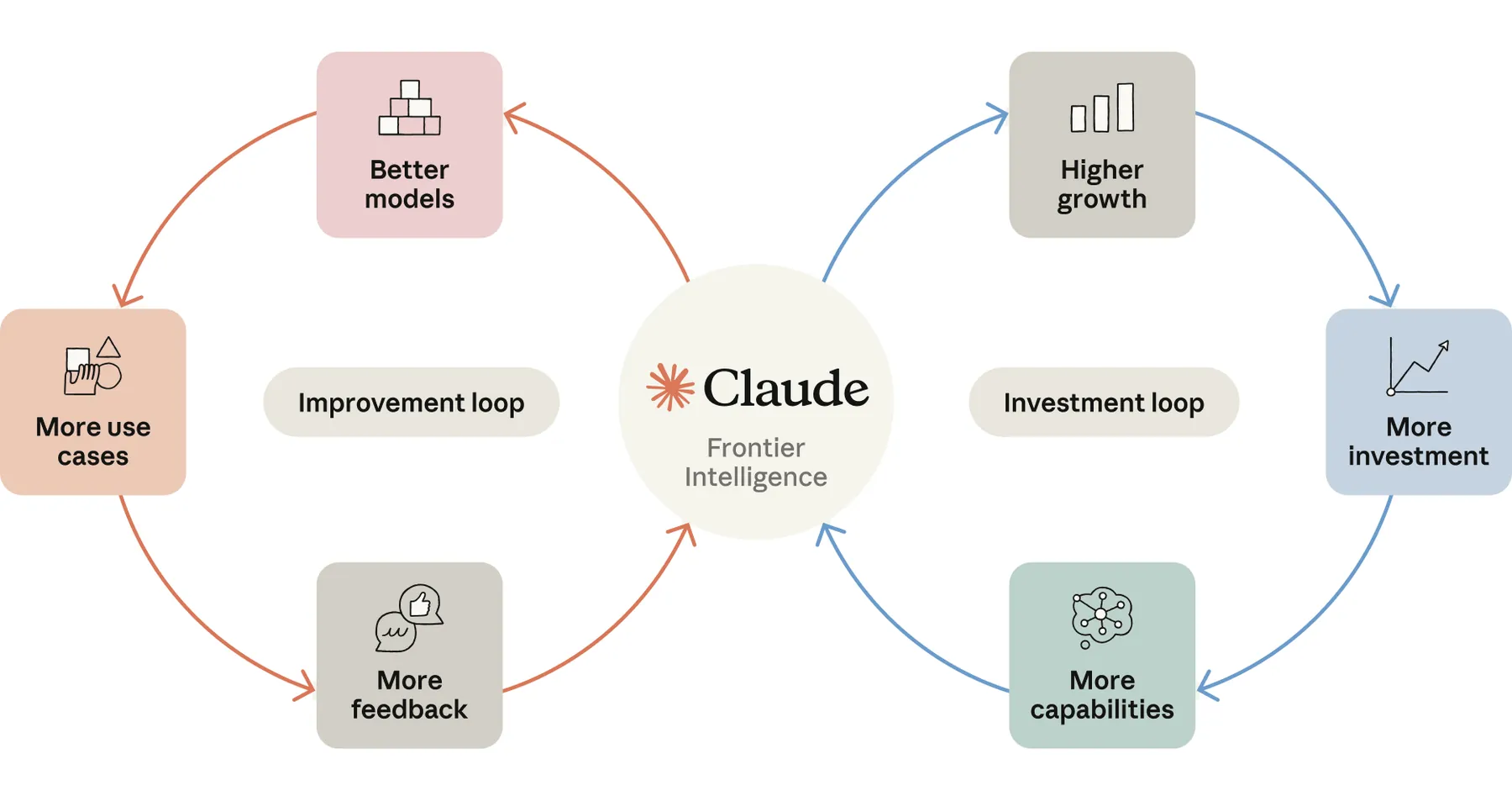
Anthropic 于 2021 年由一支研究团队创立,团队成员曾推动许多定义 AI 领域的重要突破。我们首先是一家研究实验室;我们的使命是负责任地开发和维护先进 AI,为人类带来长期利益。这一使命引导我们的工作重点,与人才和文化、前沿与安全研究、算力策略及企业战略一道,构成了使我们区别于其他公司的核心优势。这些优势让我们能够持续推进前沿人工智能,并塑造其安全、负责任发展的标准。我们通过模型、平台和应用程序向客户提供前沿人工智能 Claude。Claude 获得企业采用的速度超过历史上任何其他技术:收入从 2023 年第一季度商业发布时的 0 美元,增长至截至 2026 年 9 月 30 日止三个月的[金额留空]美元,体现了这一点。这种快速且不断扩大的采用形成了两个相互强化的循环:推动 Claude 进步的改进循环,以及为我们持续开展前沿人工智能研究提供资金的投资循环。
Our Core Advantages
我们的核心优势
Mission & Focus. All of our efforts are guided by a singular focus on our mission. This focus enables us to
concentrate talent, research, and compute investment on the highest-value work for humanity and to avoid
conflicting priorities. Achieving our mission means the world gains the enormous benefits of frontier AI while
mitigating the most significant risks, and we believe this requires safety and capability to advance together.
使命与专注。我们的一切努力都围绕唯一的使命展开。这种专注让我们能够将人才、研究和算力投资集中于对人类价值最高的工作,并避免相互冲突的优先事项。实现我们的使命,意味着世界能够获得前沿人工智能的巨大益处,同时减轻最重大的风险;我们认为,这需要安全性和能力同步提升。
Talent & Culture. Our mission and focus enable us to attract and retain world-class talent, including
researchers and engineers who want their work to shape a better future. We also have a culture that promotes a
low-ego, truth-seeking environment, where frontier AI capability and safety are mutually reinforcing. We
believe our culture has driven our talent density as we have scaled.
人才与文化。我们的使命与专注,使我们能够吸引并留住世界一流的人才,包括希望用自己的工作塑造更美好未来的研究人员和工程师。我们也倡导淡化自我、追求真相的文化,让前沿人工智能能力与安全性相互促进。我们认为,在公司扩大规模的过程中,这种文化帮助我们保持了高水平的人才密度。
Frontier & Safety Research. We believe that sustained, focused research at the frontier of intelligence is
required to build the most capable and safest AI systems. Our frontier capabilities and safety research are
deeply integrated and directly shape model design, training, and deployment, helping us produce systems that
are more reliable, steerable, and well-suited for real-world deployment, particularly in demanding enterprise
environments. We translate our research leadership into innovation velocity, and have consistently released
better models, platform capabilities, and applications. Each version of a Claude model assists in building the
next, helping to compress development timelines and produce compounding improvements in the speed at
which we innovate. We refer to this recursive dynamic as “closing the loop,” and we believe it is one of the most
significant structural advantages in frontier AI.
前沿与安全研究。我们认为,要构建能力最强且最安全的 AI 系统,就必须在智能前沿持续、专注地开展研究。我们的前沿能力研究与安全研究深度融合,直接影响模型设计、训练及部署,帮助我们构建更可靠、更可控、也更适合实际部署的系统,尤其适用于要求严格的企业环境。我们将研究优势转化为创新速度,并持续推出更好的模型、平台能力和应用程序。Claude 模型的每一代版本都协助开发下一代,帮助缩短开发周期,让创新速度的提升不断累积、相互放大。我们将这种递归推进的动态称为“形成迭代循环”(closing the loop),并认为它是前沿人工智能领域最重要的结构性优势之一。
5
原文件第 17 页 · 目录
Our Approach to Compute. We manage compute as a single, fungible pool from multiple strategic partners, and
we dynamically direct available compute between workloads based on where the marginal unit is expected to be
most productive at any given time. We believe that this approach to compute enables us to deliver superior
models, serve more customers, and achieve greater productivity from our compute investment. This compute
efficiency creates the foundation for us to advance the frontier of AI capabilities through research and model
development, meet growing demand from customers, and provide for internal usage of Claude. We have
achieved this through our research breakthroughs and our multi-chip compute architecture across AWS
Trainium, Google TPUs, NVIDIA GPUs, and AMD GPUs, enabling us to orchestrate workloads to optimize for
price and performance. To support our research, model development, customer demand, and internal usage of
Claude, we continue to invest at scale. As of and subsequent to September 30, 2026, we have entered into
purchase commitments and lease agreements, including short-term commitments, as well as leases not yet
commenced, with an aggregate committed spend of more than $          , substantially all of which is related to
compute and infrastructure. These commitments include approximately $           expected to be incurred before
December 31, 2030, and substantially all of the remainder is expected to be incurred between 2031 and 2045.
Approximately $           of these commitments are due in the next 12 months. See the section titled
“Management’s Discussion and Analysis of Financial Condition and Results of Operations—Liquidity and
Capital Resources—Contractual Obligations” for more information.
我们的算力策略。我们将多个战略合作伙伴提供的算力作为一个统一、可灵活调配的资源池来管理,并根据任一时点新增一单位算力预计在哪类工作中最能发挥效益,在不同工作负载之间动态分配可用算力。我们认为,这种算力策略使我们能够提供更出色的模型、服务更多客户,并提高算力投资的生产效率。这种算力效率,为我们通过研究和模型开发推进 AI 能力前沿、满足不断增长的客户需求,以及支持内部使用 Claude 奠定了基础。我们凭借研究突破,以及横跨 AWS Trainium、Google TPU、NVIDIA GPU 和 AMD GPU 的多芯片算力架构实现了这一点;这种架构让我们能够调度工作负载,优化价格与性能。为支持研究、模型开发、客户需求和内部 Claude 使用,我们继续开展大规模投资。截至 2026 年 9 月 30 日及其后,我们已签订采购承诺和租赁协议,包括短期承诺及尚未开始的租赁,承诺支出合计超过[金额留空]美元,其中几乎全部与算力和基础设施有关。这些承诺中,约[金额留空]美元预计于 2030 年 12 月 31 日前发生,其余部分几乎全部预计于 2031 年至 2045 年间发生。其中约[金额留空]美元将在未来 12 个月到期。更多信息请参阅“管理层对财务状况与经营业绩的讨论和分析—流动性与资本资源—合同义务”。
Enterprise Strategy. Our enterprise strategy is built on the belief that frontier AI is most valuable in real-world
settings, as deployment across enterprises is where economic impact is greatest and where the improvement
loops from customer feedback are richest. Accordingly, we have organized our research priorities, our product
roadmap, and our go-to-market and Applied AI teams around enterprise use cases, which range from routine
knowledge work to the most complex problems. The customer feedback we gather directs our research focus
and makes Claude more capable over time. This broadens where Claude can be deployed and further expands
enterprise adoption, which helps ensure that the benefits of our AI reach people and organizations at scale.
企业战略。我们的企业战略基于这样的信念:前沿人工智能在实际应用场景中的价值最高,因为在企业中部署能够产生最大的经济影响,也能从客户反馈中形成最丰富的改进循环。因此,我们围绕企业使用场景安排研究重点、产品路线图、市场推广团队及应用 AI 团队;这些场景涵盖日常知识工作到最复杂的问题。我们收集的客户反馈引导研究重点,让 Claude 的能力不断提升。这扩大了 Claude 可部署的范围,也进一步推动企业采用,从而帮助确保我们的 AI 能大规模惠及个人和组织。
AI is Transforming Intelligence
AI 正在改变智能
We believe that Powerful AI, a highly capable and impactful form of frontier AI characterized by the following
key attributes, will become widely available within a few years:
我们认为,具备强大能力和影响力、并具有以下关键特征的前沿人工智能——强大 AI(Powerful AI)——将在未来几年内广泛普及:
•cognitive capabilities matching or exceeding those of top human experts across most professional and
scientific disciplines;
• 在大多数专业和科学领域,认知能力达到或超过顶尖人类专家;
•the ability to navigate all interfaces available to a human working virtually, including text, audio, video,
and direct computer control;
• 能够使用人类在线工作时可使用的所有界面,包括文本、音频、视频和直接控制计算机;
•the ability to reason through complex tasks autonomously over extended periods—lasting hours, days,
or weeks—and seek clarification and feedback when needed;
• 能够持续数小时、数天乃至数周,自主推理并完成复杂任务,同时在需要时寻求澄清与反馈;
•the ability to coordinate across multiple instances and collaborate with both humans and other AI
systems; and
• 能够协调多个自身实例,并与人类及其他 AI 系统协作;以及
•the ability to interface with the physical world by digitally controlling laboratory equipment, robotic
systems, and other machines through digital connections.
• 能够通过数字连接,以数字方式控制实验室设备、机器人系统及其他机器,从而与物理世界交互。
If Powerful AI is directed at solving humanity’s hardest problems and the risks are managed responsibly, the
potential is extraordinary. The possibilities include compressing decades of scientific progress into years;
accelerating drug discovery, disease detection, and the delivery of personalized therapy; providing individually
tailored education and expert financial and legal advice; advancing power grids and battery design for greater
efficiency and reliability; and extending to the developing world capabilities that took wealthy nations
generations to build.
如果强大 AI 用于解决人类最棘手的问题,同时风险得到负责任的管理,其潜力将极为巨大。可能实现的成果包括:将数十年的科学进步压缩到数年内;加快药物发现、疾病检测及个性化治疗的提供;提供因人而异的教育,以及专业财务和法律建议;改进电网与电池设计,提高效率和可靠性;并向发展中世界提供富裕国家历经数代才建立起来的能力。
A Near-Term Opportunity to Transform Cognitive Work
近期改变认知工作的机会
Frontier AI is transforming cognitive work—the application of knowledge, reasoning, and judgment to produce
economic value. We believe it will make humans far more capable and expand the world’s overall capacity for
that work, including accelerating scientific discovery and helping businesses grow. Knowledge workers are the
leading edge of this opportunity. As frontier AI advances, more capable models can unlock entirely new use
前沿人工智能正在改变认知工作,即运用知识、推理和判断创造经济价值的工作。我们认为,它会大幅增强人类能力,扩大世界整体完成此类工作的能力,包括加速科学发现、帮助企业发展。知识工作者处于这一机会的最前沿。随着前沿人工智能进步,能力更强的模型能够开辟全新的使用
6
原文件第 18 页 · 目录
cases while also efficiently serving a wide range of cognitive work at scale across the capability-cost-speed
curve. We believe the work that knowledge workers perform represented more than $40 trillion in economic
value globally in 2025,1 and with frontier AI’s potential to make them meaningfully more productive, our near-
term opportunity is to expand this value and accelerate economic growth. While it is still early to forecast
frontier AI’s full impact across the economy, International Data Corporation (“IDC”) estimates that investment
in AI solutions and services will yield a cumulative global economic impact of $22.5 trillion by 2031.2 We
believe the impact could be even greater.
场景,同时以不同的能力、成本和速度组合,大规模、高效率地服务于广泛的认知工作。我们认为,知识工作者在 2025 年完成的工作在全球创造了超过 40 万亿美元的经济价值¹;前沿人工智能有望显著提高他们的生产效率,因此我们的近期机会是扩大这一价值并加快经济增长。现在预测前沿人工智能对整个经济的全部影响尚早,但国际数据公司(International Data Corporation,简称“IDC”)估计,到 2031 年,AI 解决方案和服务投资将产生累计 22.5 万亿美元的全球经济影响²。我们认为,实际影响可能更大。
Frontier AI May Reshape Entire Sectors and Accelerate Novel Discoveries
前沿人工智能可能重塑整个行业并加快新发现
We believe frontier AI represents a larger opportunity than any prior technology cycle, and Claude is already
demonstrating this potential. Claude can now execute complex projects autonomously and turn open-ended
tasks into finished, high-quality deliverables. These capabilities enable it to transform the largest sectors of the
economy, driving meaningful gains in productivity and output. Frontier AI’s capabilities may extend beyond
current markets to open entirely new ones, reaching domains such as robotics, advanced manufacturing, and
logistics, and accelerating progress in scientific research, including drug discovery and materials science. For
example, in the life sciences sector, where annual global pharmaceutical spend is expected to exceed $2 trillion
in 2026,3 Claude is used in drug discovery and development by our customers, our biotechnology partners, and
our own researchers. We are also extending Claude into robotics, where our Model Hardware Standard enables
AI agents to operate lab and manufacturing equipment such as microscopes, liquid handlers, and off-the-shelf
robotic arms. Ultimately, we believe frontier AI will help drive global economic growth. As frontier AI makes
workers and organizations more productive, becomes embedded in the products and services they deliver, and
unlocks new business models, it creates economic output that did not previously exist. We believe our
opportunity is to capture a share not only of today’s economic activity but also of that newly created output as
the global economy expands.
我们认为,前沿人工智能带来的机会大于此前任何一轮技术周期,而 Claude 已经展现出这种潜力。Claude 如今能够自主执行复杂项目,将开放式任务转化为高质量的完整成果。这些能力使它能够改变经济中规模最大的行业,显著提高生产效率和产出。前沿人工智能的能力可能超越现有市场,开辟全新市场,延伸至机器人、先进制造和物流等领域,并加快药物发现、材料科学等科学研究的进展。例如,在生命科学领域,预计 2026 年全球年度药品支出将超过 2 万亿美元³;我们的客户、生物技术合作伙伴及自身研究人员,已将 Claude 用于药物发现和开发。我们也在将 Claude 扩展至机器人领域:我们的模型硬件标准(Model Hardware Standard)让 AI 智能体能够操作显微镜、液体处理设备及现成机械臂等实验室与制造设备。归根结底,我们认为前沿人工智能将有助于推动全球经济增长。当前沿人工智能提高工作者和组织的生产效率,融入他们提供的产品与服务,并促成新的商业模式时,它会创造此前并不存在的经济产出。我们认为,随着全球经济扩张,我们的机会不仅在于分享今天的经济活动,也在于分享这些新创造的产出。
The Importance of Safety and Ethical Behavior
安全性与合乎伦理的行为的重要性
While the potential benefits of AI are extraordinary, its rapid advancement will impact the economy and society
in ways that could create significant disruption, particularly if the technology is not developed and deployed
responsibly. For example, bad actors have already conducted high-profile cyberattacks using AI’s capabilities to
discover vulnerabilities, generate malware, and evade detection tools; other risks associated with misuse,
including in the domain of biology, could result in even greater harm. AI deployed at scale also has the potential
to concentrate power and wealth both within and between countries in ways that could erode trust, harm
society, and destabilize the geopolitical order. Misaligned AI systems could corrupt institutional decision-
making or cause large-scale harm through autonomous actions that are not visible or understandable to their
users and operators. We believe that frontier AI companies must invest in safety and alignment to help ensure
the responsible diffusion of this technology. We also believe that safety, alignment, and ethical behavior
resonate particularly strongly with enterprises, where rigorous safeguards, predictable model behavior, and
demonstrable accountability have become decisive criteria in selecting an AI partner for mission-critical
workloads.
尽管 AI 的潜在益处极为巨大,其快速进步对经济与社会的影响也可能造成重大冲击,尤其是在技术未得到负责任开发和部署的情况下。例如,不法行为者已经利用 AI 发现漏洞、生成恶意软件和规避检测工具的能力,实施了广受关注的网络攻击;其他滥用风险,包括生物领域的风险,可能造成更严重的伤害。大规模部署的 AI 还可能使权力和财富在国家内部及国家之间集中,从而侵蚀信任、损害社会并破坏地缘政治秩序的稳定。未能与人类意图和价值观对齐的 AI 系统,可能扭曲机构决策,或通过用户和操作者无法察觉或理解的自主行动造成大规模伤害。我们认为,前沿人工智能公司必须投资安全和对齐工作,帮助确保这项技术负责任地普及。我们也认为,安全、对齐及合乎伦理的行为,对企业尤为重要;在企业为关键业务工作负载选择 AI 合作伙伴时,严格的保障措施、可预测的模型行为,以及可证明的责任落实,已经成为决定性标准。
Claude as a Virtual Collaborator
作为虚拟协作者的 Claude
We believe we have reached an inflection point where AI systems can function as genuine collaborators in
professional work. They quickly complete substantive tasks that might otherwise occupy a skilled professional
for several hours, a full day, or longer. AI systems are also becoming increasingly capable of performing tasks
that were previously too difficult or costly to complete or surfacing original insights and analyses. We refer to
these AI systems that work alongside humans to perform complex, multi-step work at professional levels as
Virtual Collaborators. Virtual Collaborators carry the access rights, system connections, and context that their
organizations grant them, which allows them to function more accurately and reliably. They can navigate and
use internal tools and execute workflows that span multiple steps that require sustained reasoning. Virtual
我们认为,AI 系统已到达一个转折点,能够在专业工作中担任真正的协作者。它们可以迅速完成实质性任务,而这些任务原本可能需要熟练专业人士花费数小时、一整天甚至更久。AI 系统也越来越能够完成此前难度过高或成本过高的任务,或提出原创见解和分析。我们将这些与人类并肩工作、以专业水平完成复杂多步骤工作的 AI 系统称为虚拟协作者(Virtual Collaborators)。虚拟协作者拥有其所属组织授予的访问权限、系统连接及上下文,因此能够更准确、更可靠地工作。它们能够使用内部工具,执行跨越多个步骤、需要持续推理的工作流程。虚拟
1 See the section titled “Industry, Market, and Other Data” for a description of how we calculate annual economic value attributable
to knowledge workers globally.
2 IDC, The Economic Impact of AI: 2026 Edition, doc # US54452226, April 2026. Reflects the annual value created across AI
solutions and services, investments in the AI infrastructure supply chain, and enhancements in enterprise productivity and
efficiency unlocked by AI.
3 IQVIA Institute for Human Data Science, Global Medicine Use Trends 2026, February 2026.
1 关于我们如何计算全球知识工作者每年创造的经济价值,参见“行业、市场及其他数据”一节。 2 IDC,《人工智能的经济影响:2026 年版》,文件编号 US54452226,2026 年 4 月。该数据反映人工智能解决方案和服务、人工智能基础设施供应链投资,以及人工智能带来的企业生产率和效率提升每年创造的价值。 3 IQVIA 人类数据科学研究所,《2026 年全球药物使用趋势》,2026 年 2 月。
7
原文件第 19 页 · 目录
Collaborators are AI designed to be embedded where work gets done, and our aim is to continue extending
them to knowledge workers globally, a population that is estimated to exceed one billion in 2028.4
协作者是为融入实际工作场所而设计的 AI。我们的目标是继续将其推广给全球知识工作者;预计到 2028 年,这一群体将超过 10 亿人⁴。
Claude Code. The clearest manifestation of Virtual Collaborators today is Claude Code, our coding agent and
the product we believe has most concretely defined what autonomous AI work looks like. Claude Code shifted
the market’s understanding of what an AI system could do in collaboration with software developers: the model
suggests the next line of code and goes further by planning, writing, testing, and debugging—a process that
results in production-grade code. Within months of its release, autonomous coding became the reference point
for measuring the progress of frontier AI. For enterprise AI use cases, we believe the launch of Claude Code was
comparable in its impact to the introduction of the first widely adopted conversational AI assistants. What
makes Claude Code a Virtual Collaborator is its sustained reasoning, a harness that translates intent into
actions, an execution environment that maintains a persistent state whether on a developer’s machine or in a
sandboxed cloud environment, integration with existing tools and systems, and a user-friendly interface. Its
uses are highly varied and often surprising: for example, NASA engineers used Claude Code to plan and write
navigation commands for the Mars Perseverance rover, resulting in the first AI-planned drive on Mars.
Claude Code。当今虚拟协作者最清晰的体现是 Claude Code,即我们的编程智能体。我们认为,这款产品最具体地展示了自主 AI 工作的形态。Claude Code 改变了市场对 AI 系统能够如何与软件开发者协作的认识:模型不仅建议下一行代码,还会进一步规划、编写、测试和调试,最终产出达到生产环境要求的代码。发布仅数月,自主编程便成为衡量前沿人工智能进步的参照点。对于企业 AI 应用场景,我们认为 Claude Code 的推出,其影响堪比第一批获得广泛采用的对话式 AI 助手问世。Claude Code 之所以成为虚拟协作者,在于它具备持续推理能力、将意图转化为行动的执行框架、无论在开发者机器上还是云端沙箱中都能保持持久状态的执行环境、与现有工具和系统的集成,以及便于使用的界面。其用途十分多样,往往出人意料:例如,美国国家航空航天局(NASA)的工程师使用 Claude Code,为火星“毅力号”探测车规划并编写导航指令,实现了首次由 AI 规划的火星行驶。
Software developers are powerful advocates for Claude—they understand how systems work, have credibility
evaluating technical tools, and often serve as internal champions for adopting new technologies. Winning their
trust creates a foundation for broader diffusion of Virtual Collaborators across enterprise workforces. We are
already seeing this pattern play out with non-technical teams increasingly adopting Claude Code and Claude
Cowork to manage their own workflows.
软件开发者是 Claude 的有力支持者:他们理解系统如何运作,在评估技术工具时具有公信力,也经常成为组织内部推动采用新技术的人。赢得他们的信任,为虚拟协作者在企业员工中更广泛普及奠定了基础。我们已看到这一模式开始发生:越来越多的非技术团队采用 Claude Code 和 Claude Cowork 管理自身工作流程。
Claude Cowork. All digital work is ultimately an expression of code, and Claude’s mastery of it powers Virtual
Collaborators capable of handling complex work far beyond software development. Claude Cowork extends the
same agentic architecture of Claude Code to knowledge workers broadly by translating a user’s intent into
completed work, autonomously reading files, navigating applications, and executing multi-step workflows on a
user’s desktop while the underlying code is abstracted away. By extending beyond Claude Code with
applications purpose-built for specific professions and industry verticals, we accelerate Claude’s diffusion into
new categories of knowledge work and deepen our presence across the enterprise. As of September 30, 2026,
adoption of Claude Cowork, which we made available as a research preview in January 2026, outpaced the
adoption Claude Code achieved at the equivalent point following its research preview release in February 2025.
In September 2026, we began merging Claude Cowork and Claude.ai, bringing agentic and conversational work
into a unified application. Users can now move from a simple question to complex, multi-step tasks in the same
conversation.
Claude Cowork。所有数字工作最终都是代码的表现形式,Claude 对代码的掌握使虚拟协作者能够处理远超软件开发范围的复杂工作。Claude Cowork 将 Claude Code 相同的智能体架构推广给更广泛的知识工作者:它把用户意图转化为已完成的工作,在用户桌面上自主读取文件、操作应用程序并执行多步骤工作流程,同时让用户无需接触底层代码。我们在 Claude Code 之外推出专为特定职业及垂直行业设计的应用程序,加快 Claude 向新知识工作类别扩展,并加深其在企业内部的应用。截至 2026 年 9 月 30 日,Claude Cowork 的采用速度已超过 Claude Code 在研究预览发布后相同时间点的采用速度;前者于 2026 年 1 月推出研究预览,后者于 2025 年 2 月推出。2026 年 9 月,我们开始合并 Claude Cowork 与 Claude.ai,将智能体工作和对话式工作整合到同一个应用程序中。用户如今可以在同一段对话中,从简单提问转向复杂的多步骤任务。
Extending Virtual Collaborators. We believe the trajectory for Virtual Collaborators is clear and accelerating.
Each generation of Claude models has expanded along multiple dimensions: the depth and rigor of their
reasoning, the duration and autonomy of the work they can sustain, the complexity of tasks they can complete,
and the volume of useful output they can produce. Capability evaluations and benchmarking have shown
substantial improvements across Claude model versions in the duration and complexity of tasks that can be
completed reliably, with more recent model versions demonstrating particularly significant advances.
扩展虚拟协作者。我们认为,虚拟协作者的发展方向清晰,而且正在加速。每一代 Claude 模型都在多个维度提升:推理的深度和严谨性、能够持续工作的时长与自主程度、可完成任务的复杂性,以及可产出的有用成果数量。能力评估与基准测试表明,不同版本的 Claude 模型,在能够可靠完成任务的持续时间及复杂程度方面均有大幅改善,较新的模型版本尤其展现出显著进步。
We are building towards a world where Claude can be given open-ended tasks lasting hours, days, or weeks,
and then execute them autonomously with the judgment and initiative of a brilliant colleague. Ultimately,
millions of Virtual Collaborators can run in parallel, each working independently on unrelated problems or
collaborating seamlessly to achieve a shared objective. The result is something without historical precedent:
what we refer to as a country of geniuses in a data center, available to every organization and sector of the
economy.
我们正在构建这样的未来:人们可以给 Claude 布置持续数小时、数天乃至数周的开放式任务,由它像一位出色同事那样,凭借判断力和主动性自主执行。最终,数百万名虚拟协作者可以并行运行,各自独立解决互不相关的问题,或顺畅协作以实现共同目标。其结果将前所未有:我们将其称为“数据中心里的天才之国”,供每个组织和经济领域使用。
Enterprise Adoption of Claude
企业对 Claude 的采用
The speed and depth of our enterprise customer adoption are powerful evidence of Claude’s position at the
frontier of AI. Our customer base as of September 30, 2026 includes:
企业客户采用 Claude 的速度与深度,有力地证明了 Claude 位于 AI 前沿。截至 2026 年 9 月 30 日,我们的客户群包括:
•More than 11,900 customers with $100,000 or more of revenue on a TTM basis;
• 超过 11,900 家过去十二个月收入达到或超过 100,000 美元的客户;
•More than 1,900 customers with $1 million or more of revenue on a TTM basis; and
• 超过 1,900 家过去十二个月收入达到或超过 100 万美元的客户;以及
4 IDC, Worldwide Developer Population Growth Forecast, 2025–2029, doc # US53789825, September 2025.
4 IDC,《2025—2029 年全球开发者人数增长预测》,文件编号 US53789825,2025 年 9 月。
8
原文件第 20 页 · 目录
•Approximately 250 customers with $10 million or more of revenue on a TTM basis.
• 约 250 家过去十二个月收入达到或超过 1,000 万美元的客户。
We believe customers choose Claude for a wide variety of use cases, from routine knowledge work to their most
important problems. They come to us for access to frontier AI across our platform and applications that deliver
real-world outcomes. We see this conviction in customer behavior: enterprises consistently utilize our latest
and most capable models as soon as they are released, gravitating to the most advanced option for their highest-
value work. Our customers see us as a long-term partner for the frontier capabilities we offer today, for the
innovation they expect from us in the future, and for our ability to meet their needs across the capability-cost-
speed curve.
我们认为,客户选择 Claude 用于各种场景,从日常知识工作到他们最重要的问题。他们来到我们这里,是为了通过我们的平台和应用程序使用前沿人工智能,取得实际成果。客户行为体现了这种信心:我们的最新、最强模型一经发布,企业便持续采用,倾向于把最先进的选项用于价值最高的工作。客户将我们视为长期合作伙伴,看重的不仅是我们今天提供的前沿能力,也包括他们期待我们未来带来的创新,以及我们能够以不同能力、成本和速度的组合满足其需求。
Beyond our models, the Claude Platform provides primitives that enable customers to accelerate time-to-value
and leverage Claude’s intelligence in a variety of use cases. These primitives are the same ones we use to build
our own applications. Our applications, such as Claude Code and Claude Cowork, multiply the impact of
employees. Over time, our applications have become more capable and are now frequently being used to
conduct long-running autonomous work alongside employees. Improvements to our models, platform, and
applications accrue to the benefit of our customers and drive continued adoption.
在模型之外,Claude Platform 提供基础组件,让客户更快获得实际价值,并在多种场景中使用 Claude 的智能。这些组件与我们构建自身应用程序时使用的组件相同。Claude Code 和 Claude Cowork 等应用程序能够放大员工的工作成效。随着时间推移,我们的应用程序能力不断增强,如今经常与员工并肩承担长时间的自主工作。模型、平台和应用程序的改进不断让客户受益,并推动持续采用。
Our commitment to our mission instills confidence in our customers to choose Claude as a trusted partner. Our
investments in research on AI alignment, interpretability, cybersecurity, and enterprise-grade controls aim to
deliver the predictability and dependability that organizations need in customer-facing and regulated contexts.
This trust means that enterprises can expand the scope of the work that they delegate to Claude, as well as the
systems into which Claude is integrated. Enterprises are aligning their strategies around Claude with the
confidence that we are building frontier AI that serves their needs in the long term.
我们对使命的坚持,让客户有信心选择 Claude 作为可信赖的合作伙伴。我们在 AI 对齐、可解释性、网络安全及企业级控制措施方面的研究投入,旨在提供组织在面向客户及受监管场景中所需的可预测性与可靠性。这种信任意味着企业可以扩大委派给 Claude 的工作范围,也可以让 Claude 接入更多系统。企业围绕 Claude 制定战略,因为他们相信我们正在构建能长期满足其需求的前沿人工智能。
Today, enterprises rely on Claude to reason, plan, and execute across complex workflows with a level of
trustworthiness and judgment that we believe was not previously available from earlier generations of AI.
Customers realize value from Claude in three primary ways: more productive employees, faster processes, and
embedded intelligence in their products. As Claude’s capabilities grow, our customers benefit and often
broaden their adoption of Claude in new workflows. This expanding role reflects a broader shift in how Claude
is used inside the enterprise, from a tool that responds to discrete prompts to a Virtual Collaborator.
如今,企业依赖 Claude 在复杂工作流程中推理、规划和执行;我们认为,它所具备的可信赖程度和判断力,是以往 AI 世代所没有的。客户主要从三个方面获得 Claude 的价值:提高员工生产效率、加快流程,以及在自身产品中嵌入智能。随着 Claude 能力提升,客户从中受益,并经常扩大采用范围,将 Claude 用于新的工作流程。这种不断扩展的角色,反映了 Claude 在企业内部的用途正在发生更广泛的转变:从回应单次提示的工具,转为虚拟协作者。
We drive the diffusion of Claude primarily by making it accessible across multiple product surfaces. For
example:
我们主要通过多个产品入口提供 Claude,推动其普及。例如:
•Claude Platform, our comprehensive agentic development environment, provides customers with
direct access to the primitives to build, deploy, and scale their own applications that leverage Claude’s
capabilities within their own products and workflows.
• Claude Platform 是我们的综合智能体开发环境,客户可直接使用其中的基础组件,构建、部署和扩展自身应用程序,在自己的产品与工作流程中使用 Claude 的能力。
•Claude Code, our coding agent, works alongside human software developers on end-to-end software
development: writing, planning, editing, testing, debugging, and committing code across production-
scale codebases.
• Claude Code 是我们的编程智能体,与人类软件开发者并肩完成端到端软件开发:在生产规模的代码库中编写、规划、编辑、测试、调试和提交代码。
•Claude Cowork, our knowledge work agent, has computer use capability that enables it to work with
professionals on end-to-end business tasks: autonomously researching, drafting, analyzing,
synthesizing, and executing other knowledge work.
• Claude Cowork 是我们的知识工作智能体,具备计算机操作能力,能够与专业人士协作完成端到端业务任务:自主开展研究、起草文稿、分析、综合信息,并执行其他知识工作。
Much of the diffusion of Claude has been organic. We amplify this with our go-to-market and Applied AI teams,
which extend our reach by meeting customers where they are through distribution partnerships that place
Claude inside customers’ existing technology stacks. For example, Claude is accessible on all three major cloud
platforms—Amazon Web Services (“AWS”), Google Cloud Platform (“GCP”), and Microsoft Azure (“Azure”). We
have a joint go-to-market approach with these CSPs through which we establish direct contractual relationships
with our customers while paying a fee to each CSP. This structure allows us to foster stronger commercial
alignment with these CSPs, avoid channel conflict, set pricing, and realize the financial benefits of ongoing
compute efficiency improvements. Ecosystem partnerships also expand our reach, allowing customers to adopt
Claude through SIs, such as Accenture, Deloitte, KPMG, and PwC, consultants, and data platforms, such as
Salesforce and Snowflake. We recently launched an AI services company, Ode with Anthropic, in partnership
with leading private equity firms to bring Claude’s capabilities to mid-sized companies across sectors, building
solutions on the Claude Platform and supporting customers over the long term.
Claude 的普及在很大程度上来自自然增长。我们的市场推广团队和应用 AI 团队进一步放大这种增长,通过分销合作,将 Claude 带入客户现有的技术系统,在客户当前使用的环境中满足他们的需求,扩大我们的覆盖范围。例如,Claude 可在三大云平台使用:Amazon Web Services(“AWS”)、Google Cloud Platform(“GCP”)及 Microsoft Azure(“Azure”)。我们与这些 CSP 采用联合市场推广模式,由我们与客户建立直接合同关系,同时向相应 CSP 支付费用。这种安排让我们与 CSP 建立更一致的商业利益关系,避免渠道冲突、自主定价,并获得持续提高算力效率带来的财务收益。生态合作伙伴也扩大了我们的覆盖范围,使客户能够通过 Accenture、Deloitte、KPMG 和 PwC 等系统集成商、咨询顾问,以及 Salesforce 和 Snowflake 等数据平台采用 Claude。我们最近与领先的私募股权公司合作,成立了 AI 服务公司 Ode with Anthropic,将 Claude 的能力带给各行业的中型企业,在 Claude Platform 上构建解决方案,并长期支持客户。
9
原文件第 21 页 · 目录
Strengths of Our Financial Model
我们财务模式的优势
Building and scaling frontier AI is one of the most important and capital-intensive endeavors in history. Our
financial model provides us with the following strengths that allow us to build and scale efficiently:
构建并扩大前沿人工智能,是历史上最重要、资本密集度最高的事业之一。我们的财务模式提供了以下优势,使我们能够高效开发并扩大规模:
•Rapid Revenue Growth. Our enterprise strategy is designed to drive durable customer adoption by
embedding Claude directly into business-critical workflows and enabling the development of products
built on Claude. We believe that enterprise customers achieve a compelling return on investment from
Claude, as agentic workflows can drive both top-line growth and efficiency. This enables us to expand
quickly with customers, as demonstrated by our Net Revenue Retention of approximately 900% as of
September 30, 2026. Diffusion also accelerates as our models become more capable and efficient,
allowing us to lower the cost per task for customers. For example, Claude Opus 5.5 reduced customer
costs per task by approximately 40% compared to Claude Opus 5. Lower costs per task drive greater
usage, which in turn drives broader diffusion of Claude. Our compute efficiency allows us to deliver
these reductions while preserving our margins.
• 收入快速增长。我们的企业战略旨在将 Claude 直接嵌入关键业务工作流程,并支持基于 Claude 的产品开发,推动客户长期采用。我们认为,企业客户使用 Claude 可获得可观的投资回报,因为智能体工作流程既能推动收入增长,也能提高效率。这让我们能够迅速扩大与客户的业务规模;截至 2026 年 9 月 30 日,我们约 900% 的净收入留存率体现了这一点。随着模型能力和效率提高,我们能够降低客户每项任务的成本,采用速度也随之加快。例如,相较 Claude Opus 5,Claude Opus 5.5 将客户每项任务的成本降低了约 40%。每项任务成本下降会带动使用量增加,进而推动 Claude 更广泛普及。我们的算力效率让我们能够在降低这些成本的同时保持利润率。
•Compute Efficiency. Our compute efficiency drives more intelligence from research and model
development, and we believe this approach can support more customer and internal usage of Claude
for the same amount of compute compared to other approaches. Our compute efficiency is
demonstrated by revenue that grew 1,368% year over year for the three months ended June 30, 2026
compared to compute and infrastructure expenses that grew 300% during the same period.
• 算力效率。我们的算力效率让研究与模型开发产出更多智能;我们认为,相较其他做法,这种策略能用同样的算力支持更多客户使用及内部使用 Claude。算力效率的体现是:截至 2026 年 6 月 30 日止三个月,我们收入同比增长 1,368%,而同期算力和基础设施支出增长 300%。
•Operating Efficiency. Our operating efficiency, derived from our high talent density, our efficient go-
to-market, and how extensively our teams leverage Claude in their work, enables us to scale with a
smaller team relative to other large enterprise technology companies. Our operating efficiency is
demonstrated by TTM revenue per employee of over $6.6 million as of September 30, 2026, compared
to $1.4 million as of September 30, 2025.
• 运营效率。我们的运营效率来自高人才密度、高效的市场推广方式,以及团队在工作中广泛使用 Claude。这使我们能够相较其他大型企业科技公司,以更小的团队扩大业务规模。这种效率体现在:截至 2026 年 9 月 30 日,我们过去十二个月的人均员工收入超过 660 万美元,而截至 2025 年 9 月 30 日为 140 万美元。
The demonstrated growth, scale, and efficiency of our financial model help us to continue making significant
long-term investments to build frontier AI responsibly. Our business trajectory and financial profile have
enabled us to access capital and secure compute from investors and partners. As of June 30, 2026, we had
raised an aggregate of $141.1 billion of capital and had cash and cash equivalents of $112.4 billion and short-
term investments of $19.3 billion.
我们的财务模式已经展现出的增长、规模和效率,帮助我们继续开展重大长期投资,负责任地构建前沿人工智能。我们的业务发展轨迹和财务状况,使我们能够获得资本,并从投资者和合作伙伴处取得算力。截至 2026 年 6 月 30 日,我们累计筹集了 1,411 亿美元资本,持有现金及现金等价物 1,124 亿美元、短期投资 193 亿美元。
Our Self-Reinforcing Loops
我们相互强化的循环
Our scale and growth create self-reinforcing loops that make Claude better over time and that we believe create
durable competitive advantages.
我们的规模与增长形成了相互强化的循环,使 Claude 随时间不断进步;我们认为,这些循环创造了持久的竞争优势。
•Improvement Loop. Enterprise deployments of Claude deepen our understanding of the hard
problems, edge cases, and domain-specific challenges that matter most to our customers. We improve
our models, platform, and applications based on feedback from customers using our offerings in
production across their businesses. These improvements result in wider deployments and adoption
that fuel the next cycle of improvement.
• 改进循环。Claude 在企业中的部署,加深了我们对客户最在意的棘手问题、边缘情况及特定领域挑战的理解。我们依据客户在其业务实际运行中使用我们产品的反馈,改进模型、平台和应用程序。这些改进带来更广泛的部署与采用,又为下一轮改进提供动力。
•Investment Loop. Revenue from expanding enterprise adoption helps us to fund the compute,
research, and talent needed to improve Claude. Claude’s advancing capabilities expand the range of
• 投资循环。企业采用不断扩大所带来的收入,帮助我们为改进 Claude 所需的算力、研究和人才提供资金。Claude 能力的持续提升,扩大了
10
原文件第 22 页 · 目录
tasks and workflows customers use Claude for, broadening our addressable market and driving deeper
deployment, additional revenue, and continued reinvestment in Claude.
客户使用 Claude 的任务与工作流程范围,扩大了我们的可服务市场,推动更深入的部署,带来额外收入,并支持持续再投资于 Claude。
business2a.jpg
图片文字对照 · 原图保留在上方

More use cases

更多应用场景

Better models

更好的模型

Improvement loop

改进循环

More feedback

更多反馈

Claude — Frontier Intelligence

Claude——前沿智能

Higher growth

更高增长

Investment loop

投资循环

More capabilities

更多能力

More investment

更多投资
Claude is Accelerating Our Ability to Close the Loop
Claude 正在加快我们形成迭代循环的能力
Claude itself has become one of the most powerful drivers of our progress—each new version of a Claude model
directly accelerates development of the next. Many aspects of the research, training, and testing of subsequent
model generations now involve Claude, including running experiments, generating and processing training
data, automating evaluations and safety audits, and writing and reviewing code. We refer to this recursive
dynamic as “closing the loop.” A direct expression of this dynamic is our accelerating pace of producing
compute multipliers. More capable models help our researchers discover these improvements faster; in turn,
more powerful compute multipliers enable us to train even more capable models and deploy them more
efficiently.
Claude 本身已成为推动我们进步的最强动力之一:Claude 模型每个新版本都直接加快下一版本的开发。目前,后续模型世代的研究、训练和测试中,许多环节都已有 Claude 参与,包括运行实验、生成和处理训练数据、自动执行评估及安全审查,以及编写和审查代码。我们将这种递归推进的动态称为“形成迭代循环”(closing the loop)。这种动态的直接体现,是我们产生算力倍增因素的速度不断加快。能力更强的模型帮助研究人员更快发现这些改进;反过来,更强大的算力倍增因素让我们能够训练能力更强的模型,并更高效地部署它们。
Our Growth Strategy
我们的增长战略
We believe the diffusion of AI through the global economy represents one of the largest opportunities in history
to improve how humans live and work, and it is just beginning. In our view, the world has only begun to use the
capabilities of today’s frontier models, and the gap between what Claude can do and how broadly it is used
represents one of our largest growth opportunities, alongside continued advances at the frontier. Claude’s
capabilities have evolved significantly in recent years, and we expect they will continue advancing rapidly. This
will lead not only to an expanding addressable market, but also to an expanding scope of impact on the world.
We aim to ensure that impact is as positive as possible. Our core advantages, the speed and scale of enterprise
adoption of Claude, and our unprecedented financial model enable us to continue investing aggressively to
build an AI-enabled future that benefits humanity broadly. Elements of our growth strategy include:
我们认为,AI 在全球经济中的普及,是历史上改善人类生活和工作方式的最大机会之一,而这一进程才刚刚开始。在我们看来,世界才刚开始运用当今前沿模型的能力;除了持续推进能力前沿外,Claude 能做到什么与实际使用范围之间的差距,构成了我们最大的增长机会之一。近年来,Claude 的能力显著演进,我们预计它将继续快速提升。这不仅会扩大可服务市场,也会扩大其对世界的影响范围。我们致力于让这种影响尽可能积极。我们的核心优势、企业采用 Claude 的速度与规模,以及前所未有的财务模式,让我们能够继续积极投资,构建由 AI 支持、广泛惠及人类的未来。我们的增长战略包括以下方面:
•Talent and Culture. To recruit world-class researchers and engineers and retain exceptional people, we
intend to continue investing in our low-ego, high-impact, and mission-aligned culture that has driven
our talent density as we have scaled.
• 人才与文化。为了招募世界一流的研究人员和工程师,并留住卓越人才,我们计划继续投入建设淡化自我、重视实际影响、认同使命的文化;在我们扩大规模的过程中,这种文化推动了高人才密度的形成。
•Compute. We intend to secure further compute beyond our existing commitments, expand our own
data center footprint to secure additional long-term compute, improve compute efficiency across our
multi-chip compute architecture, and produce further algorithmic advances in model efficiency.
• 算力。我们计划在现有承诺之外取得更多算力,扩大自有数据中心布局以保障额外的长期算力,提高多芯片算力架构的效率,并在模型效率方面取得更多算法进展。
11
原文件第 23 页 · 目录
•Claude’s Intelligence, Capability, and Safety. We plan to continue advancing Claude’s core intelligence
and safety in tandem, expand the frontier of what AI systems can reliably do, and pioneer new ways AI
can be applied across professional domains.
• Claude 的智能、能力与安全性。我们计划继续同步推进 Claude 的核心智能和安全性,扩大 AI 系统能够可靠完成工作的范围,并开创 AI 在各专业领域的新应用方式。
•Claude’s Accessibility. We plan to continue making Claude’s intelligence accessible across every surface
where work happens, including through our own platform and applications, through AWS, GCP, and
Azure, and through embedding in enterprise applications.
• Claude 的可获取性。我们计划继续让 Claude 的智能覆盖所有实际开展工作的界面,包括我们的平台与应用程序、AWS、GCP 和 Azure,以及嵌入企业应用程序的场景。
•Claude’s Adoption. We intend to grow our direct go-to-market and Applied AI teams, deepen cloud
distribution partnerships, invest in brand and marketing, and expand our international presence to
drive adoption of Claude as the trusted AI partner for organizations worldwide.
• Claude 的采用。我们计划扩大直接市场推广团队和应用 AI 团队,深化云端分销合作,投资品牌及营销,并扩大国际布局,推动全球组织采用 Claude 作为可信赖的 AI 合作伙伴。
•Enter New Markets. We intend to extend frontier AI to accelerate novel discoveries, reaching domains
from healthcare and life sciences to robotics and physical work, where we believe compounding model
capabilities can unlock transformative opportunities.
• 进入新市场。我们计划将前沿人工智能推广至更多领域以加快新发现,涵盖医疗保健、生命科学、机器人及实体工作。我们认为,在这些领域不断累积增强的模型能力可以带来变革性机会。
•Strategic Transactions and Partnerships. We intend to selectively pursue acquisitions, investments,
and strategic partnerships, including ecosystem partnerships with SIs, consultants, and data platforms,
that accelerate our mission, expand our reach, and strengthen our competitive position.
• 战略交易与合作。我们计划有选择地开展收购、投资和战略合作,包括与系统集成商、咨询顾问及数据平台建立生态合作,以加快实现使命、扩大覆盖范围并增强竞争地位。
Our Commitment to Public Benefit
我们对公共利益的承诺
We founded Anthropic on the belief that the most transformative technology in human history demands an
extraordinary level of responsibility, and that responsibility extends far beyond building safe systems. We
intend to direct a meaningful portion of our resources toward ensuring that frontier AI is safe and its benefits
are broadly distributed, which we refer to as our public benefit initiatives.
我们创立 Anthropic,是基于这样的信念:人类历史上最具变革性的技术,需要非同寻常的责任担当,而这种责任远不止于构建安全系统。我们计划将相当一部分资源用于确保前沿人工智能安全,并让其益处得到广泛分享;我们将这些工作称为公共利益举措。
As part of these initiatives, we contributed 846,840,960 shares of our Class N common stock, representing 5%
of our fully diluted shares as of June 30, 2026 (assuming full conversion of the Amazon Notes, as defined
below), to Anthropic Public Benefit Fund, LLC (the “Anthropic Public Benefit Fund”), our wholly owned
subsidiary dedicated to the Company Purpose (as defined below) (such issuance, the “Initial Public Benefit
Issuance”). Our board of directors has also approved a framework under which it may, in its discretion, issue
shares of our Class N common stock to the Anthropic Public Benefit Fund (or other designee) representing up
to an additional 2% of our then-outstanding shares (plus any shares subject to options, restricted stock units,
and other convertible securities and any shares held by the Anthropic Public Benefit Fund) each time our share
price appreciates 50% above the prior share price milestone, beginning with our initial public offering price (the
“Public Benefit Issuances”). In addition, our co-founders have each pledged to dedicate 80% of their personal
equity in Anthropic to philanthropic causes. For additional information regarding these pledges, including
related risks, see the section titled “Risk Factors—Risks Related to Ownership of our Class A Common Stock.”
Separate from the co-founders’ pledges, we also maintain a donation matching program through which
employees can pledge a meaningful portion of their equity awards toward charitable giving, which we match
with shares of our Class N common stock.
作为这些举措的一部分,我们向 Anthropic Public Benefit Fund, LLC(“Anthropic 公共利益基金”)投入了 846,840,960 股 N 类普通股,相当于截至 2026 年 6 月 30 日我们完全摊薄股份的 5%(假设下文定义的亚马逊票据全部转换);该基金是我们的全资子公司,致力于实现下文定义的公司宗旨(该次发行称为“首次公益发行”)。董事会还批准了一套框架:以首次公开发行价格为起点,每当股价较前一股价里程碑上涨 50%,董事会可酌情向 Anthropic 公共利益基金(或其他指定对象)发行 N 类普通股,额外发行数量最高相当于届时已发行股份数量,加上期权、受限制股份单位及其他可转换证券所对应股份,以及 Anthropic 公共利益基金持有股份后,总数的 2%(“公益发行”)。此外,我们的每位联合创始人均已承诺,将其个人持有的 Anthropic 股权的 80% 用于慈善事业。关于这些承诺及相关风险的更多信息,请参阅“风险因素—与持有我们的 A 类普通股有关的风险”。除联合创始人的承诺外,我们还设有配捐计划,员工可承诺将其股权奖励中的相当一部分用于慈善捐赠,我们以 N 类普通股配捐。
Our Governance Structure and Its Goals
我们的治理结构及其目标
Our novel capital and corporate governance structure has been carefully designed and differs significantly from
that of other public companies. We strive to help bring humanity safely into an era where transformative AI
exerts tremendous and potentially decisive influence over a broad range of human undertakings. Operating as a
public benefit corporation (“PBC”) gives our board of directors the necessary latitude to balance the pecuniary
interests of our stockholders, the best interests of those materially affected by our conduct, and the specific
public benefit purpose that we promote. Our specific public benefit purpose is the responsible development and
maintenance of advanced AI for the long-term benefit of humanity (the “Company Purpose”). In addition, a
financially disinterested trust, which we refer to as the Long-Term Benefit Trust (the “LTBT”) and which
generally has the power to elect and remove a majority of the authorized members of our board of directors, is
designed to supply both the incentives and insights for striking this balance appropriately. We also believe that
our seven co-founders are distinctly equipped to be stewards of our mission.
我们的新型资本与公司治理结构经过精心设计,与其他上市公司的结构显著不同。我们努力帮助人类安全地进入这样一个时代:具有变革性的 AI 将对人类广泛活动产生巨大、甚至可能具有决定性的影响。采用公益公司(“PBC”)形式经营,赋予董事会必要的裁量空间,权衡股东的金钱利益、受到我们行为重大影响的人士的最佳利益,以及我们所推动的特定公共利益宗旨。我们的特定公共利益宗旨,是负责任地开发和维护先进 AI,为人类带来长期利益(“公司宗旨”)。此外,一个没有财务利益关系的信托——我们称之为长期利益信托(“LTBT”)——通常有权选举和罢免董事会法定席位中的多数董事;其设计旨在提供恰当实现上述平衡所需的动机与见解。我们也认为,七位联合创始人在守护我们的使命方面具备独特条件。
12
原文件第 24 页 · 目录
Public Benefit Corporation Status
公益公司身份
Consistent with our long-term commitment to AI safety and responsibility, we are incorporated as a PBC under
Delaware law. PBCs are a class of corporations that are intended to produce a public benefit and operate in a
responsible and sustainable manner. Under Delaware law, a PBC is required to identify in its certificate of
incorporation the public benefit or benefits it will promote, and its directors have a duty to manage the affairs of
the corporation in a manner that balances the pecuniary interests of the corporation’s stockholders, the best
interests of those materially affected by the corporation’s conduct, and the specific public benefit purpose
identified in the corporation’s certificate of incorporation. As provided in our amended and restated certificate
of incorporation, the public benefit that we promote, which we must always consider in the management of our
company, is the Company Purpose.
为践行我们对 AI 安全与责任的长期承诺,我们依据特拉华州法律注册为公益公司。公益公司是一类旨在创造公共利益,并以负责任、可持续方式经营的公司。依据特拉华州法律,公益公司必须在公司注册证书中指明其将推动的公共利益;董事有义务以兼顾股东金钱利益、受到公司行为重大影响的人士的最佳利益,以及注册证书所载特定公共利益宗旨的方式管理公司事务。根据我们经修订及重述的公司注册证书,我们所推动、并在管理公司时必须始终考虑的公共利益,就是公司宗旨。
Long-Term Benefit Trust
长期利益信托
In 2023, we implemented an innovative governance structure featuring the LTBT, which is designed to ensure
that we are managed in a manner that responsibly balances our tripartite goals as a PBC: the pecuniary
interests of our stockholders, the best interests of those materially affected by our conduct, and the Company
Purpose. The LTBT is intended to operate as an independent body of five financially disinterested voting
trustees (“Trustees”) with expertise in AI safety, national security, public policy, and social enterprise. Through
a special class of common stock, Class T common stock, the LTBT generally has the authority to elect and
remove the Class T directors, who together will constitute a majority of the authorized members of our board of
directors. Our Class T common stock does not otherwise have voting rights on matters submitted to
stockholders generally.
2023 年,我们建立了以 LTBT 为核心的创新治理结构,旨在确保公司管理能负责任地平衡公益公司的三方面目标:股东的金钱利益、受到我们行为重大影响的人士的最佳利益,以及公司宗旨。LTBT 旨在作为一个独立机构运作,由五名没有财务利益关系的有表决权受托人(“受托人”)组成,他们在 AI 安全、国家安全、公共政策及社会企业方面具备专业知识。通过 T 类普通股这一特殊类别的普通股,LTBT 通常有权选举和罢免 T 类董事;T 类董事合计将占董事会法定席位的多数。除此以外,我们的 T 类普通股对于通常提交股东表决的事项不享有表决权。
Founder Voting Structure
创始人表决权结构
We believe that our seven co-founders, Dario Amodei, Daniela Amodei, Tom Brown, Jack Clark, Jared Kaplan,
Sam McCandlish, and Christopher Olah, as a group, are distinctly equipped to be stewards of our mission.
Immediately prior to the completion of this offering, we will issue a single share of Class F common stock, a
special class of our common stock, to a limited liability company of which our seven co-founders will initially be
the sole members (the “Founder LLC”).
我们认为,七位联合创始人 Dario Amodei、Daniela Amodei、Tom Brown、Jack Clark、Jared Kaplan、Sam McCandlish 和 Christopher Olah,作为一个整体,在守护我们的使命方面具备独特条件。在本次发行完成前,我们将向一家有限责任公司发行一股特殊类别普通股——F 类普通股;该有限责任公司的初始成员仅为这七位联合创始人(“创始人有限责任公司”)。
Our Class F common stock will be entitled to an aggregate number of votes that equals 50.1% of the total voting
power of our outstanding shares of capital stock with respect to matters submitted to stockholders generally,
including the election of our directors other than the Class T directors.
对于通常提交股东表决的事项,包括选举 T 类董事以外的董事,我们的 F 类普通股将享有相当于全部已发行股本总表决权 50.1% 的票数。
Board Governance
董事会治理
Decisions regarding our business and affairs are made by our board of directors. Immediately prior to the
completion of this offering, we will enter into a stockholders’ agreement (the “Stockholders’ Agreement”) with
the LTBT and the Founder LLC, under which they will agree to vote their shares and take other actions to give
effect to the board composition, director nomination, and director removal provisions described in our
governing documents. Collectively, the LTBT and the Founder LLC will have the ability to elect all members of
our board of directors. Regardless of the class or classes of stock by which a director is elected, there is no limit
to the number of terms a director may serve.
有关公司业务和事务的决策由董事会作出。在本次发行完成前,我们将与 LTBT 及创始人有限责任公司签订股东协议(“股东协议”);根据该协议,两者将同意行使其股份表决权并采取其他行动,使治理文件中关于董事会组成、董事提名及董事罢免的条款得以落实。LTBT 与创始人有限责任公司合计有能力选举全部董事会成员。无论董事由哪一类或哪几类股份选举产生,其可连任的届数均不受限制。
While the LTBT has significant influence over our board of directors through its ability to generally elect and
remove a majority of the authorized members of our board of directors, neither the LTBT nor the Trustees have
decision-making authority in the day-to-day management or strategy setting of the company. The LTBT’s role is
to select directors who are well-equipped to make decisions in furtherance of the responsible balancing of the
pecuniary interests of our stockholders, the best interests of those materially affected by our conduct, and the
Company Purpose, and to support our management’s decision-making through advice and guidance.
虽然 LTBT 通常能够选举和罢免董事会法定席位中的多数董事,因此对董事会具有重大影响力,但 LTBT 及受托人均无权决定公司的日常管理或战略制定。LTBT 的职责,是选择具备充分能力的董事,使他们在决策时负责任地权衡股东的金钱利益、受到我们行为重大影响的人士的最佳利益及公司宗旨,并以建议和指导支持管理层决策。
The Founder LLC will also have significant influence over our business and affairs through its ability to vote our
Class F common stock, which is entitled to an aggregate number of votes that equals 50.1% of the total voting
power of our outstanding shares of capital stock with respect to matters submitted to stockholders generally,
including the election of our directors other than the Class T directors.
创始人有限责任公司也将因能够行使 F 类普通股的表决权,而对我们的业务和事务产生重大影响。对于通常提交股东表决的事项,包括选举 T 类董事以外的董事,F 类普通股享有相当于全部已发行股本总表决权 50.1% 的票数。
13
原文件第 25 页 · 目录
See the sections titled “Risk Factors—Risks Related to our Governance Structure,” “Our Governance Structure
and Its Goals,” “Management,” “Certain Relationships and Related Person Transactions,” and “Description of
Capital Stock” for more information.
更多信息请参阅“风险因素—与我们的治理结构有关的风险”“我们的治理结构及其目标”“管理层”“特定关系及关联人士交易”及“股本说明”等章节。
Controlled Company Status
受控公司身份
We are considered a “controlled company” within the meaning of the Nasdaq Global Select Market corporate
governance requirements because the LTBT, as the sole holder of our Class T common stock, generally has the
power to elect a majority of the authorized members of our board of directors. As such, we are permitted to opt
out of compliance with certain Nasdaq Global Select Market corporate governance requirements. Accordingly, if
we elect not to comply with certain requirements, you will not have the same protections afforded to
stockholders of companies that are subject to all of the Nasdaq Global Select Market corporate governance
requirements. Although we qualify as a “controlled company,” we do not expect to rely on this exemption except
with respect to our nominating and corporate governance committee (“NGC”), which will not consist entirely of
independent directors. Our board of directors currently consists of a majority of independent directors and our
audit and compensation committees currently consist entirely of independent directors. See the sections titled
“Risk Factors—Risks Related to our Governance Structure—We are considered a “controlled company” within
the meaning of the Nasdaq Global Select Market corporate governance requirements, and, as a result, we
qualify for, and currently rely on, exemptions from certain corporate governance requirements,” “Our
Governance Structure and Its Goals,” “Management,” and “Description of Capital Stock” for additional
information.
根据纳斯达克全球精选市场的公司治理要求,我们属于“受控公司”,因为 LTBT 作为 T 类普通股的唯一持有人,通常有权选举董事会法定席位中的多数董事。因此,我们可以选择不遵守纳斯达克全球精选市场的某些公司治理要求。如果我们选择不遵守某些要求,您将无法获得那些须遵守纳斯达克全球精选市场全部公司治理要求的公司股东所享有的同等保护。虽然我们符合“受控公司”资格,但除提名与公司治理委员会(“NGC”)外,我们预计不会依赖这项豁免;该委员会将不会全部由独立董事组成。目前,我们董事会的多数成员为独立董事,审计委员会和薪酬委员会则全部由独立董事组成。更多信息请参阅“风险因素—与我们的治理结构有关的风险—根据纳斯达克全球精选市场公司治理要求,我们属于‘受控公司’,因此有资格享有且目前依赖某些公司治理要求的豁免”“我们的治理结构及其目标”“管理层”及“股本说明”等章节。
14
原文件第 26 页 · 目录
Our Capital Structure
我们的资本结构
The following table summarizes certain key terms of each class or series of our common stock that will be
authorized following the completion of this offering:
下表概述本次发行完成后将获授权的各类或各系列普通股的部分关键条款:
Category of
Rights
Class A Common
Stock
Class N
Common Stock
Class T Common
Stock
Class F Common
Stock
Class E Common
Stock
Votes per share
1
0
1
50.1% of
outstanding voting
power on record
date
1
Matters on which
entitled to vote
All matters
submitted to
stockholders
generally; election
of non-Class T
directors; certain
amendments to the
terms of the LTBT
or the rights of our
Class T common
stock; redemption
of our Class T
common stock
Not entitled to vote
except as required
by law, in which
case our Class N
common stock will
have one vote per
share
Election of Class T
directors, which
constitute a
majority of our
board of directors;
redemption of our
Class E common
stock; certain
amendments to the
rights of our Class
F common stock 
All matters
submitted to
stockholders
generally; election
of non-Class T
directors; certain
amendments to the
terms of the LTBT
or the rights of our
Class T common
stock; redemption
of our Class T
common stock;
redemption of our
Class E common
stock
Nomination,
change in
designation, or
removal of the
Specified Class T
Director (as
defined below)
(only if our NGC
does not concur in
the LTBT’s
nomination,
change in
designation, or
removal); certain
amendments to the
terms of the LTBT
or the rights of our
Class T common
stock; redemption
of our Class T
common stock
Conversion
rights
None
Converts into Class
A common stock
upon a sale or
transfer to an
unaffiliated third
party
None
None
None
Transferability
Generally
transferable
Generally
transferable;
converts to Class A
common stock
upon transfer as
described above
Transferable only
upon approval of
persons comprising
the Trust
Amendment
Threshold (as
defined below)
Not transferable
except in the case
of a reorganization
or redomiciliation
of the Founder LLC
that is approved by
our board of
directors and does
not result in a
change to the
members of the
Founder LLC
Not transferable
Dividend rights
Entitled to
participate pro rata
in dividends and
distributions
Entitled to
participate pro rata
in dividends and
distributions
None
None
None
Right to receive
liquidation
distributions
Entitled to
participate pro rata
in liquidation
distributions
Entitled to
participate pro rata
in liquidation
distributions
Entitled to par
value per share
Entitled to par
value per share
Entitled to par
value per share
Redeemable by
company
No
No
Redeemable by us
for no
consideration upon
occurrence of
certain events
Redeemable by us
for no
consideration upon
occurrence of
certain events
Redeemable by us
for no
consideration upon
occurrence of
certain events
权利类别A 类普通股N 类普通股T 类普通股F 类普通股E 类普通股
每股表决票数101股权登记日已发行股份表决权的 50.1%1
有权表决的事项通常提交股东表决的所有事项;选举非 T 类董事;对 LTBT 条款或 T 类普通股权利的某些修订;赎回 T 类普通股除法律要求外,不享有表决权;如法律要求,N 类普通股每股享有一票选举占董事会多数的 T 类董事;赎回 E 类普通股;对 F 类普通股权利的某些修订通常提交股东表决的所有事项;选举非 T 类董事;对 LTBT 条款或 T 类普通股权利的某些修订;赎回 T 类普通股;赎回 E 类普通股指定 T 类董事(定义见下文)的提名、指定变更或罢免(仅当提名与公司治理委员会不赞同 LTBT 的提名、指定变更或罢免时);对 LTBT 条款或 T 类普通股权利的某些修订;赎回 T 类普通股
转换权无出售或转让予非关联第三方时,转换为 A 类普通股无无无
可转让性通常可转让通常可转让;转让时按上述规定转换为 A 类普通股仅在达到信托修订批准门槛(定义见下文)所需人士批准后,方可转让不得转让,但创始人有限责任公司经董事会批准的重组或迁册除外,且该重组或迁册不得导致其成员发生变化不得转让
股息权有权按比例参与股息及分派有权按比例参与股息及分派无无无
收取清算分配的权利有权按比例参与清算分配有权按比例参与清算分配有权取得每股面值有权取得每股面值有权取得每股面值
公司能否赎回否否发生某些事件时,我们可无偿赎回发生某些事件时,我们可无偿赎回发生某些事件时,我们可无偿赎回
For more information about our capital structure, see the section titled “Description of Capital Stock.”
有关资本结构的更多信息,请参阅“股本说明”。
Risk Factors Summary
风险因素摘要
Our business is subject to numerous risks and uncertainties, including those highlighted in the section titled
“Risk Factors” immediately following this prospectus summary. These risks could adversely affect our business,
financial condition, and results of operations, which could cause the market price of our Class A common stock
我们的业务面临众多风险和不确定性,包括本招股说明书摘要之后“风险因素”章节重点列出的风险。这些风险可能不利于我们的业务、财务状况和经营业绩,导致我们的 A 类普通股市价
15
原文件第 27 页 · 目录
to decline and could result in a loss of all or part of your investment. Additional risks, beyond those summarized
below or discussed elsewhere in this prospectus, may apply to our business, activities, or operations as currently
conducted or as we may conduct them in the future and in the markets in which we operate or may in the future
operate. These risks include the following:
下跌,并可能导致您损失全部或部分投资。除下文概述或本招股说明书其他部分讨论的风险外,我们目前或未来开展的业务、活动或经营,以及目前或未来经营所在的市场,还可能面临其他风险。这些风险包括:
•Our success depends in large part on our ability to continue to develop the most advanced and capable
AI models, and any failure to do so could adversely affect our business.
• 我们的成功很大程度上取决于能否继续开发最先进、能力最强的 AI 模型;如果无法做到,可能不利于我们的业务。
•If we are unable to secure adequate compute or if we fail to direct our compute effectively across our
workloads, we may be unable to train models that remain competitive with those of our competitors or
adequately serve our customers.
• 如果无法取得充足算力,或未能在不同工作负载之间有效分配算力,我们可能无法训练出相较竞争对手仍具竞争力的模型,也可能无法充分服务客户。
•Constraints on the critical inputs supporting compute could limit our ability to secure adequate
compute.
• 支撑算力的关键投入要素受到限制,可能妨碍我们取得充足算力。
•We are highly dependent on the continued service of our co-founders, senior management team, and
key technical employees, and the loss of any of these individuals may adversely affect our business,
financial condition, and results of operations.
• 我们高度依赖联合创始人、高级管理团队及关键技术员工持续任职,失去其中任何人都可能不利于我们的业务、财务状况及经营业绩。
•Our company culture has contributed to our success and, if we cannot maintain this culture as we
grow, our business could be adversely affected.
• 公司文化对我们的成功有所贡献;如果在发展过程中无法保持这种文化,业务可能受到不利影响。
•We face intense competition, and if we are unable to compete effectively, our business, financial
condition, and results of operations could be adversely affected.
• 我们面临激烈竞争;如果无法有效竞争,业务、财务状况及经营业绩可能受到不利影响。
•If the market for our models, platform, and applications develops more slowly than we expect or
declines, our growth may slow or stall, and our business, financial condition, and results of operations
could be adversely affected.
• 如果我们的模型、平台及应用程序市场发展速度低于预期,或出现萎缩,我们的增长可能放缓或停滞,业务、财务状况及经营业绩可能受到不利影响。
•If the use of our AI models results in harm, whether through use by malicious actors or misuse by other
third parties, or if our model guardrails or safeguards fail to prevent such misuse, our reputation and
brand, business, financial condition, and results of operations could be adversely affected.
• 如果使用我们的 AI 模型造成伤害,无论源于恶意行为者的使用还是其他第三方的滥用,或模型防护机制及保障措施未能阻止此类滥用,我们的声誉、品牌、业务、财务状况及经营业绩都可能受到不利影响。
•Our AI models may behave in unintended, misaligned, or autonomous ways, including by taking
harmful actions that no user or third party directed, which could adversely affect our reputation and
brand, business, financial condition, and results of operations.
• 我们的 AI 模型可能以非预期、未对齐或自主的方式行动,包括采取并非任何用户或第三方指示的有害行动,从而可能不利于我们的声誉、品牌、业务、财务状况及经营业绩。
•We may be exposed to liability, litigation, and regulatory action arising from harms associated with our
AI models, and our contractual protections and insurance may be insufficient, any of which could
adversely affect our business, financial condition, and results of operations.
• 我们可能因与 AI 模型有关的伤害而承担责任、面临诉讼和监管行动,而合同保护及保险可能不足;上述任何情况都可能不利于我们的业务、财务状况及经营业绩。
•A substantial portion of our revenue and accounts receivable is driven by a limited number of
customers and distribution channels, and the loss of, or a significant reduction in, spend from one or
more of our top customers or disruption through those channels could adversely affect our prospects,
business, and financial condition.
• 我们相当一部分收入和应收账款来自少数客户与分销渠道;失去一家或多家主要客户、这些客户支出大幅减少,或相关渠道中断,都可能不利于我们的前景、业务和财务状况。
•We have a limited operating history in an evolving and nascent industry, which makes it difficult to
evaluate our future prospects and may increase the risk that we will not be successful.
• 我们身处尚在起步、不断演变的行业,经营历史有限,因此难以评估未来前景,也可能增加我们无法取得成功的风险。
•We are at an early stage of our revenue growth, we have experienced rapid growth in recent periods,
and our historical growth rates are not indicative of future performance or our ability to sustain or
forecast future revenue growth.
• 我们的收入增长仍处于早期阶段,近期经历了快速增长;历史增长率不能代表未来表现,也不能说明我们能够维持或预测未来收入增长。
•Our business is subject to an evolving and uncertain regulatory and political environment, which could
increase our costs, restrict our operations, or adversely affect demand for our models, platform, and
applications.
• 我们的业务所处的监管和政治环境不断变化且存在不确定性,可能增加成本、限制经营,或不利于模型、平台和应用程序的需求。
•Our reliance on a limited number of CSPs and suppliers, some of which have strategic and investment
relationships with us and are our customers, creates complex dynamics that could give rise to conflicts
of interest and adversely affect our access to compute.
• 我们依赖少数 CSP 和供应商,其中一些既与我们存在战略和投资关系,也是我们的客户。这种复杂关系可能产生利益冲突,并不利于我们获取算力。
16
原文件第 28 页 · 目录
•Our capital stock structure features certain provisions that are novel or otherwise not common among
other corporations with multiple-class structures, and may effectively eliminate the ability of holders of
our Class A common stock to influence important decisions, including a change in control.
• 我们的股本结构包含某些创新条款,或其他采用多类别股份结构的公司并不常见的条款;这些条款可能实际上使 A 类普通股持有人无法影响包括控制权变更在内的重要决策。
•Our capital structure will concentrate voting power with the LTBT and the Founder LLC for the
foreseeable future and will result in the LTBT and the Founder LLC having voting power that is not
derived from or proportionate to economic interests in our company.
• 在可预见的未来,我们的资本结构将使表决权集中于 LTBT 和创始人有限责任公司,且其表决权并非源自其在本公司的经济权益,也不与该经济权益成比例。
•Our focus on the long-term best interests of our company as a PBC, and the duty of our directors to
balance the pecuniary interests of our stockholders, the best interests of those stakeholders materially
affected by our conduct, and our Company Purpose, may conflict with short-, medium-, or long-term
financial interests and business performance, which may negatively impact the value of our Class A
common stock.
• 我们重视公司作为公益公司的长期最佳利益,且董事有义务权衡股东的金钱利益、受到我们行为重大影响的利益相关方的最佳利益,以及公司宗旨。这可能与短期、中期或长期财务利益和业务表现冲突,从而不利于 A 类普通股的价值。
Channels for Disclosure of Information
信息披露渠道
Investors, the media, and others should note that, following the completion of this offering, we intend to
announce material information to the public through filings with the Securities and Exchange Commission
(“SEC”), the investor relations page on our website (www.anthropic.com), blog posts on our website, press
releases, public conference calls, public webcasts, our X accounts (@AnthropicAI and @ClaudeAI), our
Instagram page (@claudeai), our Threads account (@claudeai), and our LinkedIn page (https://
www.linkedin.com/company/anthropicresearch/).
投资者、媒体及其他人士应注意,本次发行完成后,我们计划通过以下渠道向公众公布重大信息:向美国证券交易委员会(“SEC”)提交的文件、公司网站(www.anthropic.com)的投资者关系页面、公司网站博客、新闻稿、公开电话会议、公开网络直播、X 账户(@AnthropicAI 和 @ClaudeAI)、Instagram 页面(@claudeai)、Threads 账户(@claudeai),以及 LinkedIn 页面(https://www.linkedin.com/company/anthropicresearch/)。
The information disclosed by the foregoing channels could be deemed to be material information. As such,
following the completion of this offering, we encourage investors, the media, and others to follow the channels
listed above and to review the information disclosed through such channels. We are not incorporating any of
the information in such channels into this prospectus.
通过上述渠道披露的信息可能视为重大信息。因此,本次发行完成后,我们鼓励投资者、媒体及其他人士关注上述渠道,并查阅其中披露的信息。我们未将这些渠道中的任何信息纳入本招股说明书。
Any updates to the list of disclosure channels through which we will announce information will be posted on the
investor relations page on our website.
我们用于公布信息的披露渠道名单如有更新,将在公司网站的投资者关系页面发布。
Corporate Information
公司信息
We were incorporated as a Delaware PBC in January 2021. Our principal executive offices are located at 548
Market Street, PMB 90375, San Francisco, California 94104, and our telephone number is (415) 326-6303. Our
website address is www.anthropic.com. Information contained on, or that can be accessed through, our website
does not constitute part of this prospectus and references to our website address in this prospectus are inactive
textual references only. You should not consider information contained on our website to be part of this
prospectus or in deciding whether to purchase shares of our Class A common stock.
我们于 2021 年 1 月依据特拉华州法律注册为公益公司。主要行政办公地点为 548 Market Street, PMB 90375, San Francisco, California 94104,电话号码为 (415) 326-6303。网站地址为 www.anthropic.com。我们网站所载或可通过网站访问的信息,不构成本招股说明书的一部分;本招股说明书对网站地址的引用仅为不具活动链接的文字引用。您不应将网站所载信息视为本招股说明书的一部分,也不应在决定是否购买我们的 A 类普通股时将其纳入考虑。
“Anthropic,” our logo, and our other registered or common law trademarks, service marks, or trade names
appearing in this prospectus are the property of Anthropic, PBC. Other trademarks and trade names referred to
in this prospectus are the property of their respective owners. Solely for convenience, trademarks and trade
names referred to in this prospectus may appear without the ® or ™ symbols, but such references are not
intended to indicate, in any way, that we will not assert, to the fullest extent under applicable law, our rights, or
the rights of any applicable licensor, to these trademarks and trade names. 
本招股说明书中的“Anthropic”、公司标志,以及其他已注册或依据普通法受保护的商标、服务标志或商号,均属于 Anthropic, PBC。本招股说明书提及的其他商标和商号属于各自所有人。仅为行文方便,本招股说明书提及商标和商号时,可能省略 ® 或 ™ 符号;此类引用绝不意味着我们不会在适用法律允许的最大范围内,主张我们或相关许可方对这些商标和商号享有的权利。
17
原文件第 29 页 · 目录
The Offering
本次发行
Class A common stock offered by us
           shares
Class A common stock offered by the selling
stockholders
           shares
Underwriters’ option to purchase additional
shares of Class A common stock from us
           shares
Class A common stock to be outstanding after
this offering
           shares (or            shares if the underwriters exercise
their option to purchase additional shares of our Class A
common stock in full)
Class N common stock to be outstanding after
this offering
           shares
Class T common stock to be outstanding after
this offering
1 share
Class E common stock to be outstanding after
this offering
0 shares
Class F common stock to be outstanding after
this offering
1 share
Class A, Class N, Class T, Class E, and Class F
common stock to be outstanding after this
offering
           shares (or            shares if the underwriters exercise
their option to purchase additional shares of our Class A
common stock in full)
Use of proceeds
We estimate that the net proceeds from the sale of shares of
our Class A common stock by us in this offering will be
approximately $           (or approximately $           if the
underwriters’ option to purchase additional shares of our
Class A common stock is exercised in full), based upon the
assumed initial public offering price of $           per share,
which is the midpoint of the estimated offering price range
set forth on the cover page of this prospectus, and after
deducting estimated underwriting discounts and
commissions and estimated offering expenses payable by
us. We will not receive any proceeds from the sale of shares
of Class A common stock by the selling stockholders.
The principal purposes of this offering are to increase our
capitalization and financial flexibility, create a public
market for our Class A common stock, facilitate an orderly
distribution of shares for the selling stockholders, and
enable access to the public equity markets for us and our
stockholders. We intend to use the net proceeds from this
offering for general corporate purposes, including working
capital, operating expenses, and capital expenditures,
including investments in compute and infrastructure, as
well as hiring and retention of highly skilled personnel.
Additionally, we may use a portion of the net proceeds to
acquire or invest in businesses, products, services, or
technologies. However, we do not have agreements or
commitments for any material acquisitions or investments
at this time. We also intend to use a portion of the net
proceeds to satisfy our anticipated tax withholding and
remittance obligations related to the settlement of certain
of our outstanding restricted stock units (“RSUs”). See the
section titled “Use of Proceeds” for more information.
我们发售的 A 类普通股[数量留空]股
售股股东发售的 A 类普通股[数量留空]股
承销商向我们购买额外 A 类普通股的选择权[数量留空]股
本次发行后已发行的 A 类普通股[数量留空]股(若承销商全额行使购买额外 A 类普通股的选择权,则为[数量留空]股)
本次发行后已发行的 N 类普通股[数量留空]股
本次发行后已发行的 T 类普通股1 股
本次发行后已发行的 E 类普通股0 股
本次发行后已发行的 F 类普通股1 股
本次发行后已发行的 A 类、N 类、T 类、E 类及 F 类普通股[数量留空]股(若承销商全额行使购买额外 A 类普通股的选择权,则为[数量留空]股)
募集资金用途以假设首次公开发行价格每股[金额留空]美元(即本招股说明书封面所列预计发行价格区间的中点)计算,并扣除预计承销折扣、佣金及我们承担的预计发行费用后,我们估计本次发行出售 A 类普通股所得净额约为[金额留空]美元(若承销商全额行使购买额外 A 类普通股的选择权,则约为[金额留空]美元)。我们不会从售股股东出售 A 类普通股中获得任何款项。本次发行的主要目的,是增强资本实力和财务灵活性,为 A 类普通股建立公开交易市场,便利售股股东有序出售股份,并使我们及股东能够进入公开股权市场。我们计划将募集资金净额用于一般公司用途,包括营运资金、经营开支和资本支出,其中包括算力与基础设施投资,以及招聘和留住高技能人才。此外,我们可能将部分净额用于收购或投资业务、产品、服务或技术。不过,目前我们尚未就任何重大收购或投资达成协议或作出承诺。我们还计划将部分净额用于履行结算某些已授出受限制股份单位(“RSU”)所预计产生的代扣代缴税款义务。更多信息请参阅“募集资金用途”。
18
原文件第 30 页 · 目录
Voting rights
Shares of our Class A common stock are entitled to one vote
per share. Shares of our Class N common stock have no
voting rights, except as otherwise required by law. The
share of our Class T common stock has no voting rights
with respect to matters submitted to stockholders
generally, except as set forth within our amended and
restated certificate of incorporation, including with respect
to the election of a majority of our board of directors or as
required by law. The share of our Class F common stock
will be entitled to an aggregate number of votes that
represents 50.1% of the total voting power of our
outstanding shares as of the applicable record date on all
matters submitted to a vote of stockholders generally,
including the election of the directors other than the Class T
directors. Shares of our Class E common stock will be
entitled to one vote per share with respect to certain limited
matters.
Controlled company
We are considered a “controlled company” within the
meaning of the Nasdaq Global Select Market corporate
governance requirements. See the sections titled “Our
Governance Structure and Its Goals,” “Management,” and
“Description of Capital Stock” for additional information.
Risk Factors
See the section titled “Risk Factors” and other information
included in this prospectus for a discussion of some of the
factors you should consider before deciding to invest in our
Class A common stock.
Proposed trading symbol
“ANT”
表决权A 类普通股每股享有一票表决权。除法律另有要求外,N 类普通股不享有表决权。T 类普通股对于通常提交股东表决的事项不享有表决权,但经修订及重述的公司注册证书所规定的事项(包括选举董事会多数成员)或法律要求的事项除外。对于通常提交股东表决的所有事项,包括选举 T 类董事以外的董事,F 类普通股将享有相当于有关股权登记日全部已发行股份总表决权 50.1% 的票数。E 类普通股就某些有限事项每股享有一票表决权。
受控公司根据纳斯达克全球精选市场公司治理要求,我们属于“受控公司”。更多信息请参阅“我们的治理结构及其目标”“管理层”及“股本说明”。
风险因素关于您决定投资我们的 A 类普通股之前应考虑的部分因素,请参阅“风险因素”章节及本招股说明书所载其他信息。
拟采用的交易代码“ANT”
The number of shares of our Class A common stock, Class N common stock, Class T common stock, and Class F
common stock that will be outstanding after this offering is based on            shares of our Class A common stock,
           shares of our Class N common stock, one share of our Class T common stock, and one share of our Class F
common stock outstanding as of September 30, 2026, which reflects:
本次发行后将已发行的 A 类、N 类、T 类及 F 类普通股数量,以截至 2026 年 9 月 30 日已发行的[数量留空]股 A 类普通股、[数量留空]股 N 类普通股、一股 T 类普通股及一股 F 类普通股为基础,并反映以下事项:
•the automatic conversion of (i) all            outstanding shares of our Series A, C-1, D-1, D-2, E-1, F-1, G-1,
and H-1 redeemable convertible preferred stock into            shares of Class A common stock and (ii) all
           outstanding shares of our Series B, C-2, D-3, E-2, E-3, E-4, E-5, F-2, G-2, G-3, G-4, H-2, H-3,
and H-4 redeemable convertible preferred stock into            shares of Class N common stock,
immediately prior to the completion of this offering pursuant to the terms of our amended and restated
certificate of incorporation (collectively, the “Preferred Stock Conversion”);
• 在本次发行完成前,依据经修订及重述的公司注册证书,(i)全部已发行 A、C-1、D-1、D-2、E-1、F-1、G-1 及 H-1 系列可赎回可转换优先股自动转换为[数量留空]股 A 类普通股;(ii)全部已发行 B、C-2、D-3、E-2、E-3、E-4、E-5、F-2、G-2、G-3、G-4、H-2、H-3 及 H-4 系列可赎回可转换优先股自动转换为[数量留空]股 N 类普通股(合称“优先股转换”);
•one share of our Class F common stock that will be issued immediately prior to the completion of this
offering to the Founder LLC (the “Class F Stock Issuance”);
• 在本次发行完成前,向创始人有限责任公司发行一股 F 类普通股(“F 类股份发行”);
•the conversion of $           in aggregate principal amount of our
outstanding convertible promissory notes into            shares of Class N common stock immediately
prior to the completion of this offering, representing shares issuable to Amazon Web Services, Inc.
upon the completion of this offering without causing it to exceed the applicable ownership cap (the
“Convertible Notes Conversion”);
• 在本次发行完成前,将本金总额为[金额留空]美元的未偿还可转换本票,转换为[数量留空]股 N 类普通股;该数量为在不导致 Amazon Web Services, Inc. 超过适用持股上限的情况下,可于本次发行完成时向其发行的股份数量(“可转换票据转换”);
•the Initial Public Benefit Issuance, the shares of which (i) are considered legally outstanding, (ii) are
not considered outstanding for accounting purposes while held by our wholly owned subsidiary, and
(iii) accordingly will not be reflected as outstanding in our consolidated financial statements; and
• 首次公益发行:其股份(i)在法律上视为已发行;(ii)由我们的全资子公司持有期间,在会计上不视为已发行;因此(iii)不会在合并财务报表中体现为已发行股份;以及
•the net issuance of            shares of Class A common stock subject to RSUs for which the service-based
vesting condition was satisfied as of the date of this prospectus and the performance-based vesting
condition will be satisfied upon the effectiveness of the registration statement of which this prospectus
forms a part, after giving effect to the withholding of            shares of Class A common stock subject to
such RSUs to satisfy the associated estimated tax withholding and remittance obligations (based upon
the assumed initial public offering price of $           per share, which is the midpoint of the estimated
• 就截至本招股说明书日期已满足服务归属条件、且将在本招股说明书所属注册声明生效时满足业绩归属条件的 RSU,净发行[数量留空]股 A 类普通股;该净额已扣除为履行相关预计代扣代缴税款义务而扣留的[数量留空]股 RSU 对应 A 类普通股(按假设首次公开发行价格每股[金额留空]美元,即本招股说明书封面所列预计
19
原文件第 31 页 · 目录
offering price range set forth on the cover page of this prospectus, and an assumed           % tax
withholding rate) (the “RSU Settlement”).
发行价格区间的中点,以及假设税款扣缴率[比例留空]% 计算)(“RSU 结算”)。
The shares of our Class A common stock, Class N common stock, Class T common stock, and Class F common
stock outstanding as of September 30, 2026 exclude the following:
截至 2026 年 9 月 30 日已发行的 A 类、N 类、T 类及 F 类普通股,不包括以下股份:
•           shares of our Class A common stock issuable upon the exercise of options to purchase shares of
our Class A common stock outstanding as of September 30, 2026, with a weighted-average exercise
price of $           per share;
• 截至 2026 年 9 月 30 日尚未行使的 A 类普通股购买期权行使后可发行的[数量留空]股 A 类普通股,其加权平均行使价为每股[金额留空]美元;
•           shares of our Class A common stock issuable upon the vesting and settlement of RSUs
outstanding as of the date of this prospectus, but for which (i) the service-based vesting condition was
not satisfied as of such date and (ii) the performance-based vesting condition, if applicable, will be
satisfied upon the effectiveness of the registration statement of which this prospectus forms a part;
• 截至本招股说明书日期尚未结算的 RSU 归属及结算后可发行的[数量留空]股 A 类普通股,但这些 RSU 的(i)服务归属条件截至该日尚未满足;(ii)业绩归属条件(如适用)将在本招股说明书所属注册声明生效时满足;
•           shares of our Class A common stock issued after September 30, 2026 in connection with our
acquisitions of privately-held companies; and
• 2026 年 9 月 30 日之后,因收购非上市公司而发行的[数量留空]股 A 类普通股;以及
•           shares of our Class A common stock reserved for future issuance under our equity compensation
plans, consisting of:
• 根据股权薪酬计划为未来发行预留的[数量留空]股 A 类普通股,其中包括:
◦           shares of our Class A common stock reserved for future issuance upon conversion of Class N
common stock issuable under our Donation Matching Plan (as amended and restated, the
“Donation Matching Plan”);
◦ 为未来将配捐计划(经修订及重述后称为“配捐计划”)下可发行的 N 类普通股转换时发行,而预留的[数量留空]股 A 类普通股;
◦           shares of our Class A common stock to be reserved for future issuance under our 2026
Equity Incentive Plan (our “2026 Plan”), which will become effective prior to the completion of
this offering;
◦ 根据将在本次发行完成前生效的《2026 年股权激励计划》(“2026 年计划”),拟为未来发行预留的[数量留空]股 A 类普通股;
◦           shares of our Class A common stock reserved for future issuance under our Amended and
Restated 2021 Stock Plan (our “2021 Plan”) as of September 30, 2026, which number of shares will
be added to the shares of our Class A common stock to be reserved for future issuance under our
2026 Plan upon its effectiveness, at which time we will cease granting awards under our 2021 Plan;
and
◦ 截至 2026 年 9 月 30 日,根据《经修订及重述的 2021 年股票计划》(“2021 年计划”)为未来发行预留的[数量留空]股 A 类普通股;在 2026 年计划生效时,这些股份数量将并入该计划为未来发行预留的 A 类普通股数量,届时我们将停止根据 2021 年计划授予奖励;以及
◦           shares of our Class A common stock to be reserved for future issuance under our 2026
Employee Stock Purchase Plan (our “ESPP”), which will become effective prior to the completion
of this offering.
◦ 根据将在本次发行完成前生效的《2026 年员工购股计划》(“ESPP”),拟为未来发行预留的[数量留空]股 A 类普通股。
Our 2026 Plan and ESPP each provide for an annual automatic increase in the number of shares of our Class A
common stock reserved thereunder, and our 2026 Plan provides for increases to the number of shares that may
be granted thereunder based on awards under our 2021 Plan that expire or are cancelled or forfeited, and
shares under our 2021 Plan that are tendered to or withheld by us for payment of an exercise price or for
satisfying tax withholding obligations or are forfeited or otherwise repurchased by us, as more fully described in
the section titled “Executive Compensation—Equity Plans.”
2026 年计划及 ESPP 均规定,其项下预留的 A 类普通股数量每年自动增加。2026 年计划还规定,如 2021 年计划下的奖励到期、取消或被没收,或 2021 年计划下的股份交回给我们或由我们扣留,用于支付行使价或履行代扣税款义务,或有关股份被没收或以其他方式由我们购回,则可增加 2026 年计划下可授予的股份数量;详见“高管薪酬—股权计划”。
20
原文件第 32 页 · 目录
Except as otherwise indicated, all information in this prospectus assumes:
除非另有说明,本招股说明书的所有信息均基于以下假设:
•the Preferred Stock Conversion will occur immediately prior to the completion of this offering;
• 优先股转换将在本次发行完成前立即发生;
•the Convertible Notes Conversion will occur immediately prior to the completion of this offering;
• 可转换票据转换将在本次发行完成前立即发生;
•the filing and effectiveness of our amended and restated certificate of incorporation in Delaware and
the effectiveness of our amended and restated bylaws will each occur immediately prior to the
completion of this offering;
• 经修订及重述的公司注册证书将在本次发行完成前立即于特拉华州提交并生效,经修订及重述的公司细则也将在该时点生效;
•the Class F Stock Issuance will occur immediately prior to the completion of this offering;
• F 类股份发行将在本次发行完成前立即发生;
•no issuance of shares of Class E common stock prior to the completion of this offering;
• 本次发行完成前不发行 E 类普通股;
•a 10-for-one forward split of our Class A common stock and Class N common stock effected on
September 17, 2026, including a proportional increase in the authorized shares of our capital stock,
with all share, option, RSU, and per share information for all periods presented in this prospectus
adjusted to reflect such forward split on a retroactive basis;
• A 类普通股及 N 类普通股于 2026 年 9 月 17 日实施一股拆为十股的股份拆细,包括按比例增加获授权股本数量;本招股说明书所列所有期间的股份、期权、RSU 及每股信息,均已追溯调整以反映该次拆股;
•a one-for-1,000 reverse split of our Class T common stock effected on September 17, 2026;
• T 类普通股于 2026 年 9 月 17 日实施每 1,000 股合并为一股的股份合并;
•no exercise of outstanding stock options or settlement of outstanding RSUs subsequent to September
30, 2026, other than the RSU Settlement; and
• 除 RSU 结算外,2026 年 9 月 30 日之后没有行使尚未行使的股票期权,也没有结算尚未结算的 RSU;以及
•no exercise by the underwriters of their option to purchase up to an additional            shares of our
Class A common stock from us in this offering.
• 承销商不行使其在本次发行中向我们额外购买最多[数量留空]股 A 类普通股的选择权。
21
原文件第 33 页 · 目录
Summary Consolidated Financial and Other Data
合并财务及其他数据摘要
The following tables summarize our consolidated financial and other data. We have derived the summary
consolidated statements of operations data for the years ended December 31, 2023, 2024, and 2025 from our
audited consolidated financial statements included elsewhere in this prospectus. We have derived the summary
consolidated statements of operations data for the six months ended June 30, 2025 and 2026, and the
summary consolidated balance sheet data as of June 30, 2026, from our unaudited interim consolidated
financial statements included elsewhere in this prospectus. The summary consolidated financial data in this
section are not intended to replace our consolidated financial statements and related notes and are qualified in
their entirety by our consolidated financial statements and related notes included elsewhere in this prospectus.
Our historical results are not necessarily indicative of the results that may be expected in the future and our
results for the six months ended June 30, 2026 are not necessarily indicative of the results that may be
expected for the full year ending December 31, 2026 or any other period. The following summary consolidated
financial and other data should be read in conjunction with the section titled “Management’s Discussion and
Analysis of Financial Condition and Results of Operations” and our consolidated financial statements and
related notes thereto included elsewhere in this prospectus.
下表汇总我们的合并财务及其他数据。截至 2023 年、2024 年及 2025 年 12 月 31 日止年度的合并经营报表摘要数据,取自本招股说明书其他部分所载经审计合并财务报表。截至 2025 年及 2026 年 6 月 30 日止六个月的合并经营报表摘要数据,以及截至 2026 年 6 月 30 日的合并资产负债表摘要数据,取自本招股说明书其他部分所载未经审计中期合并财务报表。本节合并财务摘要数据不拟替代合并财务报表及相关附注,并应全部以本招股说明书其他部分所载合并财务报表及相关附注为准。历史业绩不一定代表未来可预期业绩;截至 2026 年 6 月 30 日止六个月的业绩,也不一定代表截至 2026 年 12 月 31 日止全年或其他任何期间可预期的业绩。阅读以下合并财务及其他数据摘要时,应一并参阅“管理层对财务状况与经营业绩的讨论和分析”,以及本招股说明书其他部分所载合并财务报表和相关附注。
Consolidated Statements of Operations Data
合并经营报表数据
Year Ended December 31,
Six Months Ended June 30,
(in millions, except share and per share
amounts)
2023
2024
2025
2025
2026
Revenue
$41
$386
$4,585
$1,163
$16,286
Operating expenses:
Compute and infrastructure
433
2,522
7,326
2,334
8,945
Personnel(1)
95
454
1,839
538
3,152
Bartz settlement
—
—
1,500
—
—
Sales, marketing, and partnerships
2
43
568
120
3,168
Other operating and administrative
62
347
1,412
306
1,714
Total operating expenses
592
3,366
12,645
3,298
16,979
Operating loss
(551)
(2,980)
(8,060)
(2,135)
(693)
Interest income
69
106
431
115
1,111
Change in fair value of convertible
notes, derivative liabilities, and SAFEs
(1,045)
(5,434)
(34,308)
(10,942)
(72,388)
Other income (expense), net
(2)
—
(8)
—
(8,757)
Total other income (expense), net
(978)
(5,328)
(33,885)
(10,827)
(80,034)
Loss before provision for income taxes
(1,529)
(8,308)
(41,945)
(12,962)
(80,727)
Provision for income taxes
2
1
20
7
21
Net loss(2)
$(1,531)
$(8,309)
$(41,965)
$(12,969)
$(80,748)
Net loss per share attributable to common
stockholders, basic and diluted
$(1.42)
$(5.43)
$(23.04)
$(7.25)
$(39.88)
Weighted-average number of shares
outstanding, basic and diluted
1,076,880,510
1,528,994,540
1,821,084,860
1,788,730,900
2,024,972,990
截至 12 月 31 日止年度截至 6 月 30 日止六个月
(单位:百万,股份及每股金额除外)20232024202520252026
收入$41$386$4,585$1,163$16,286
经营费用:
算力和基础设施4332,5227,3262,3348,945
人员费用(1)954541,8395383,152
Bartz 案和解费用——1,500——
销售、营销及合作伙伴关系2435681203,168
其他经营及行政费用623471,4123061,714
经营费用总额5923,36612,6453,29816,979
经营亏损(551)(2,980)(8,060)(2,135)(693)
利息收入691064311151,111
可转换票据、衍生负债及 SAFE 的公允价值变动(1,045)(5,434)(34,308)(10,942)(72,388)
其他收入(费用)净额(2)—(8)—(8,757)
其他收入(费用)净额合计(978)(5,328)(33,885)(10,827)(80,034)
所得税计提前亏损(1,529)(8,308)(41,945)(12,962)(80,727)
所得税费用2120721
净亏损(2)$(1,531)$(8,309)$(41,965)$(12,969)$(80,748)
归属于普通股股东的每股净亏损,基本及摊薄$(1.42)$(5.43)$(23.04)$(7.25)$(39.88)
已发行股份加权平均数,基本及摊薄1,076,880,5101,528,994,5401,821,084,8601,788,730,9002,024,972,990
(1)Includes stock-based compensation expense of $29 million, $192 million, and $1.2 billion for the years ended December 31,
2023, 2024, and 2025, respectively, and $286 million and $2.2 billion for the six months ended June 30, 2025 and 2026,
respectively.
(2)Includes change in fair value of convertible notes, derivative liabilities, and simple agreements for future equity (“SAFEs”),
which were $1.0 billion, $5.4 billion, and $34.3 billion for the years ended December 31, 2023, 2024, and 2025, respectively,
and $10.9 billion and $72.4 billion for the six months ended June 30, 2025 and 2026, respectively. These changes were
primarily driven by an increase in the fair value of our outstanding convertible promissory notes resulting from an increase in
our enterprise valuation during each of the respective periods.
(1)包含股份支付费用:截至 2023 年、2024 年及 2025 年 12 月 31 日止年度分别为 2,900 万美元、1.92 亿美元及 12 亿美元;截至 2025 年及 2026 年 6 月 30 日止六个月分别为 2.86 亿美元及 22 亿美元。(2)包含可转换票据、衍生负债及未来股权简单协议(“SAFE”)的公允价值变动:截至 2023 年、2024 年及 2025 年 12 月 31 日止年度分别为 10 亿美元、54 亿美元及 343 亿美元;截至 2025 年及 2026 年 6 月 30 日止六个月分别为 109 亿美元及 724 亿美元。这些变动主要源于各相应期间企业估值上升,导致未偿还可转换本票的公允价值增加。
22
原文件第 34 页 · 目录
The following table sets forth the computation of unaudited pro forma net loss per share, basic and diluted, of
common stock attributable to common stockholders for the periods presented:
下表列示所示期间归属于普通股股东的未经审计备考每股净亏损(基本及摊薄)的计算:
(in millions, except share and per share amounts)
Year Ended
December 31,
2025
Six Months
Ended June
30, 2026
Numerator:
Net loss
$(41,965)
$(80,748)
Pro forma adjustment to record stock-based compensation expense related to
RSUs for which the performance-based vesting condition will be satisfied upon
the effectiveness of the registration statement of which this prospectus forms a
part
Pro forma adjustment to eliminate the change in fair value recognized related to
the Convertible Notes Conversion
Pro forma net loss
Denominator:
Weighted-average number of shares outstanding, basic and diluted
1,821,084,860
2,024,972,990
Pro forma adjustment to reflect the Preferred Stock Conversion
Pro forma adjustment to reflect the RSU Settlement
Pro forma adjustment to reflect the Convertible Notes Conversion
Weighted-average number of shares outstanding used to compute pro forma net
loss per share, basic and diluted(1)(2)
Pro forma net loss per share, basic and diluted(1)(2)
(单位:百万,股份及每股金额除外)截至 2025 年 12 月 31 日止年度截至 2026 年 6 月 30 日止六个月
分子:
净亏损$(41,965)$(80,748)
备考调整:记录将在本招股说明书所属注册声明生效时满足业绩归属条件的 RSU 相关股份支付费用
备考调整:剔除与可转换票据转换有关的已确认公允价值变动
备考净亏损
分母:
已发行股份加权平均数,基本及摊薄1,821,084,8602,024,972,990
反映优先股转换的备考调整
反映 RSU 结算的备考调整
反映可转换票据转换的备考调整
用于计算备考每股净亏损的已发行股份加权平均数,基本及摊薄(1)(2)
备考每股净亏损,基本及摊薄(1)(2)
______________
(1)The unaudited pro forma net loss per share and pro forma weighted-average number of shares used in computing pro forma net
loss per share give effect to (i) the Preferred Stock Conversion, as if such conversion had occurred on January 1, 2025, (ii) the
Convertible Notes Conversion, as if such conversion had occurred on January 1, 2025, (iii) stock-based compensation expense
related to RSUs for which the service-based vesting condition was satisfied or partially satisfied, and as if the performance
condition had been satisfied on January 1, 2025, of $           and $           for the year ended December 31, 2025 and the six
months ended June 30, 2026, respectively, (iv) the net issuance of            and            shares of our Class A common stock upon
the vesting and settlement of RSUs, for which the service-based vesting condition was satisfied, and as if the performance
condition had been satisfied on January 1, 2025, for the year ended December 31, 2025 and the six months ended June 30,
2026, respectively, and (v) the filing and effectiveness of our amended and restated certificate of incorporation in Delaware that
will become effective immediately prior to the completion of this offering. The pro forma weighted-average number of shares
does not give effect to the Initial Public Benefit Issuance, as shares of our Class N common stock held by our wholly owned
subsidiary are not considered outstanding for accounting purposes.
(2)As of           , 2026, unrecognized stock-based compensation expense not reflected in pro forma net loss per share was
$          related to RSUs for which the service-based vesting condition was not satisfied, and which is expected to be recognized
over a weighted-average period of approximately            years, and $           related to our other outstanding equity awards, which
is expected to be recognized over a weighted-average period of approximately            years.
______________(1)未经审计备考每股净亏损,以及计算该指标所使用的备考股份加权平均数,反映以下事项:(i)优先股转换,假设转换于 2025 年 1 月 1 日发生;(ii)可转换票据转换,假设转换于 2025 年 1 月 1 日发生;(iii)已全部或部分满足服务归属条件的 RSU 相关股份支付费用,并假设业绩条件于 2025 年 1 月 1 日满足,截至 2025 年 12 月 31 日止年度及截至 2026 年 6 月 30 日止六个月分别为[金额留空]美元及[金额留空]美元;(iv)已满足服务归属条件的 RSU 归属及结算后净发行的 A 类普通股,并假设业绩条件于 2025 年 1 月 1 日满足,截至 2025 年 12 月 31 日止年度及截至 2026 年 6 月 30 日止六个月分别为[数量留空]股及[数量留空]股;以及(v)经修订及重述的公司注册证书在特拉华州提交并生效,该证书将在本次发行完成前立即生效。备考股份加权平均数不反映首次公益发行,因为全资子公司持有的 N 类普通股,在会计上不视为已发行股份。(2)截至 2026 年[日期留空],未计入备考每股净亏损的未确认股份支付费用,包括与尚未满足服务归属条件的 RSU 有关的[金额留空]美元,预计将在约[年数留空]年的加权平均期间内确认;以及与其他尚未结清的股权奖励有关的[金额留空]美元,预计将在约[年数留空]年的加权平均期间内确认。
23
原文件第 35 页 · 目录
Consolidated Balance Sheet Data
合并资产负债表数据
As of June 30, 2026
(in millions)
Actual
Pro Forma(1)
Pro Forma As
Adjusted(2)(3)
Cash, cash equivalents, and short-term investments
$131,651
$                     
$                     
Working capital(4)
$130,760
$                     
$                     
Total assets
$147,358
$                     
$                     
Total liabilities
$117,467
$                     
$                     
Redeemable convertible preferred stock
$157,510
$                     
$                     
Additional paid-in capital
$5,336
$                     
$                     
Accumulated deficit
$(132,902)
$                     
$                     
Total stockholders’ deficit
$(127,619)
$                     
$                     
截至 2026 年 6 月 30 日
(单位:百万)实际数备考数(1)经调整备考数(2)(3)
现金、现金等价物及短期投资$131,651$$
营运资金(4)$130,760$$
资产总额$147,358$$
负债总额$117,467$$
可赎回可转换优先股$157,510$$
额外实缴资本$5,336$$
累计亏损$(132,902)$$
股东权益亏绌总额$(127,619)$$
______________
(1)The pro forma column in the consolidated balance sheet gives effect to (i) the Preferred Stock Conversion, as if such conversion
had occurred on June 30, 2026, (ii) the Convertible Notes Conversion, as if such conversion had occurred on June 30, 2026,
(iii) the Class F Stock Issuance, as if it had occurred on June 30, 2026, (iv) an increase to additional paid-in capital and
accumulated deficit related to stock-based compensation of $           related to RSUs subject to the RSU Settlement, and (v) the
filing and effectiveness of our amended and restated certificate of incorporation in Delaware that will become effective
immediately prior to the completion of this offering.
(2)The pro forma as adjusted column gives effect to (i) the pro forma adjustments set forth above, (ii) the sale and issuance by us
of             shares of our Class A common stock in this offering, based upon the assumed initial public offering price of $           per
share, which is the midpoint of the estimated price range set forth on the cover page of this prospectus, and after deducting
estimated underwriting discounts and commissions and estimated offering expenses payable by us, and (iii) the use of net
proceeds from this offering, together with existing cash and cash equivalents, if necessary, to satisfy the estimated tax
withholding and remittance obligations related to the RSU Settlement. We will not receive any proceeds from the sale of shares
of our Class A common stock by any of the selling stockholders.
(3)Each $1.00 increase (decrease) in the assumed initial public offering price would increase (decrease) each of cash, cash
equivalents, and short-term investments; working capital; total assets; additional paid-in capital; and total stockholders’ deficit
by $          , assuming the number of shares offered by us as stated on the cover page of this prospectus remains unchanged and
after deducting the estimated underwriting discounts and commissions and estimated offering expenses payable by us.
Similarly, an increase (decrease) of 1.0 million shares in the number of shares offered by us, as set forth on the cover page of
this prospectus, would increase (decrease) each of cash, cash equivalents, and short-term investments; working capital; total
assets; additional paid-in capital; and total stockholders’ deficit by $          , assuming the assumed initial public offering price of
$           per share (the midpoint of the price range set forth on the cover page of this prospectus) remains the same, and after
deducting the estimated underwriting discounts and commissions and estimated offering expenses payable by us. We will not
receive any proceeds from the sale of shares of our Class A common stock by any of the selling stockholders.
(4)Working capital is defined as current assets less current liabilities.
______________(1)合并资产负债表中的备考栏反映:(i)优先股转换,假设于 2026 年 6 月 30 日发生;(ii)可转换票据转换,假设于 2026 年 6 月 30 日发生;(iii)F 类股份发行,假设于 2026 年 6 月 30 日发生;(iv)因 RSU 结算涉及的 RSU 相关股份支付费用[金额留空]美元,而增加额外实缴资本及累计亏损;以及(v)经修订及重述的公司注册证书在特拉华州提交并生效,该证书将在本次发行完成前立即生效。(2)经调整备考栏反映:(i)上述备考调整;(ii)我们在本次发行中出售及发行[数量留空]股 A 类普通股,按假设首次公开发行价格每股[金额留空]美元(即本招股说明书封面所列预计价格区间的中点)计算,并扣除预计承销折扣、佣金及我们承担的预计发行费用;以及(iii)使用本次发行所得净额,并在必要时结合现有现金及现金等价物,履行 RSU 结算相关的预计代扣代缴税款义务。我们不会从任何售股股东出售 A 类普通股中获得款项。(3)假设我们发售的股份数量保持本招股说明书封面所列数量不变,在扣除预计承销折扣、佣金及我们承担的预计发行费用后,假设首次公开发行价格每增加(减少)1.00 美元,现金、现金等价物及短期投资、营运资金、资产总额、额外实缴资本以及股东权益亏绌总额各项均将增加(减少)[金额留空]美元。同样,假设首次公开发行价格维持每股[金额留空]美元(即封面所列价格区间的中点)不变,在扣除上述预计费用后,我们发售的股份数量较本招股说明书封面所列数量每增加(减少)100 万股,上述各项均将增加(减少)[金额留空]美元。我们不会从任何售股股东出售 A 类普通股中获得款项。(4)营运资金定义为流动资产减去流动负债。
Non-GAAP Financial Measures
非 GAAP 财务指标
In addition to the measures presented in our consolidated financial statements that were prepared in
accordance with accounting principles generally accepted in the United States (“GAAP”), we use Adjusted
Operating Income (Loss), Adjusted Operating Margin, and Adjusted Net Income (Loss) as non-GAAP financial
measures to evaluate our business, measure our performance, identify trends affecting our business, formulate
business plans, and make strategic decisions.
除依据美国公认会计原则(“GAAP”)编制的合并财务报表所列指标外,我们还使用调整后经营利润(亏损)、调整后经营利润率,以及调整后净利润(亏损)作为非 GAAP 财务指标,评估业务、衡量业绩、识别影响业务的趋势、制定业务计划,并作出战略决策。
Year Ended December 31,
Six Months Ended June 30,
(in millions, except for percentages)
2023
2024
2025
2025
2026
Adjusted Operating Income (Loss)
$(522)
$(2,788)
$(4,854)
$(1,849)
$1,618
Operating margin
(1,344)%
(772)%
(176)%
(184)%
(4)%
Adjusted Operating Margin
(1,273)%
(722)%
(106)%
(159)%
10%
Adjusted Net Income (Loss)
$(457)
$(2,683)
$(4,448)
$(1,741)
$2,671
截至 12 月 31 日止年度截至 6 月 30 日止六个月
(单位:百万,百分比除外)20232024202520252026
调整后经营利润(亏损)$(522)$(2,788)$(4,854)$(1,849)$1,618
经营利润率(1,344)%(772)%(176)%(184)%(4)%
调整后经营利润率(1,273)%(722)%(106)%(159)%10%
调整后净利润(亏损)$(457)$(2,683)$(4,448)$(1,741)$2,671
See the section titled “Management’s Discussion and Analysis of Financial Condition and Results of Operations
—Non-GAAP Financial Measures” for a definition of each non-GAAP financial measure, a discussion of the
请参阅“管理层对财务状况与经营业绩的讨论和分析—非 GAAP 财务指标”,以了解各项非 GAAP 财务指标的定义、有关
24
原文件第 36 页 · 目录
limitations of each non-GAAP financial measure, and a reconciliation of each non-GAAP financial measure to
its most comparable GAAP financial measure for the periods presented and additional information. 
各项非 GAAP 财务指标局限性的讨论、所列期间各项非 GAAP 财务指标与最可比 GAAP 财务指标的调节,以及更多信息。
25
原文件第 37 页 · 目录
a2026-10x24riska.jpg
图片文字对照 · 原图保留在上方

Risk Factors

风险因素
原文件第 38 页 · 目录
Risk Factors
风险因素
Investing in our Class A common stock involves a high degree of risk. You should carefully consider the risks
and uncertainties described below, together with all of the other information in this prospectus, including the
section titled “Management’s Discussion and Analysis of Financial Condition and Results of Operations” and
our consolidated financial statements and related notes, before making a decision to invest in our Class A
common stock. The disclosures in this section reflect our beliefs and opinions as to matters that could
materially and adversely affect us in the future, and are not representations as to whether such matters have
or have not occurred previously, except as otherwise disclosed. References to past events are provided by way
of example only and are not intended to be a complete listing or a representation as to their likelihood of
occurring in the future. Our business, financial condition, results of operations, or prospects could also be
adversely affected by risks and uncertainties not currently known to us or that we currently do not believe
are material. If any of the risks actually occur, our business, financial condition, results of operations, and
prospects could be adversely affected. In that event, the market price of our Class A common stock could
decline, and you could lose part or all of your investment.
投资我们的 A 类普通股涉及高度风险。在决定投资之前,您应仔细考虑以下风险和不确定性,以及本招股说明书中的全部其他信息,包括“管理层对财务状况与经营业绩的讨论和分析”、合并财务报表及相关附注。本节披露反映了我们对于未来可能对公司产生重大不利影响之事项的看法和意见;除另有披露外,这些内容并非就相关事项此前是否发生过作出陈述。提及过去事件仅为举例,并非意在完整列举,也不表示这些事件未来发生的可能性。我们目前尚未知悉、或目前认为不重大的风险和不确定性,也可能不利于业务、财务状况、经营业绩或前景。如果任何风险实际发生,我们的业务、财务状况、经营业绩及前景均可能受到不利影响。届时,A 类普通股市价可能下跌,您可能损失部分或全部投资。
Risks Related to our Business and Industry
与我们的业务和行业有关的风险
Our success depends in large part on our ability to continue to develop the most advanced and
capable AI models, and any failure to do so could adversely affect our business.
我们的成功很大程度上取决于能否继续开发最先进、能力最强的 AI 模型;如果无法做到,可能不利于我们的业务。
Our success depends in large part on our ability to continuously develop, improve, and deploy the most
advanced, capable, and useful AI models. Achieving and maintaining this position depends on our ability to:
我们的成功很大程度上取决于能否持续开发、改进并部署最先进、能力最强且最实用的 AI 模型。取得并保持这一地位,取决于我们能否:
•advance the frontier of AI capabilities through breakthrough research, innovative architectures, and
efficient training methodologies;
• 通过突破性研究、创新架构和高效训练方法,推进 AI 能力前沿;
•ensure our models are safe, reliable, and trustworthy while maintaining competitive performance;
• 在保持有竞争力表现的同时,确保模型安全、可靠且值得信赖;
•secure the compute and infrastructure necessary to power and support our increasing needs;
• 取得必要的算力和基础设施,为日益增长的需求提供动力与支持;
•advance compute efficiency through algorithmic and architectural innovations, including compute
multiplier advancements;
• 通过算法与架构创新,包括算力倍增因素方面的进展,提高算力效率;
•retain the continued service of our co-founders, senior management team, and key technical
employees, and attract, retain, and motivate leading researchers, engineers, and technical talent in an
intensely competitive and evolving market;
• 留住联合创始人、高级管理团队及关键技术员工,并在竞争激烈、不断变化的市场中吸引、留住和激励领先的研究人员、工程师及技术人才;
•continue revenue growth and maintain access to sufficient capital, including through potential equity
and debt financing, to make the investments we believe are necessary to support our growth trajectory;
• 继续增长收入,并保持获得充足资本的渠道,包括可能开展股权和债务融资,以完成我们认为支持增长轨迹所必需的投资;
•secure and maintain relationships with data providers, licensors, and partners to obtain the diverse,
high-quality datasets necessary for world-class model performance;
• 与数据提供方、许可方及合作伙伴建立并维持关系,取得实现世界一流模型表现所需的多样化、高质量数据集;
•secure and maintain relationships with cloud, ecosystem, and other partners to facilitate the diffusion
of Claude;
• 与云服务、生态系统及其他合作伙伴建立并维持关系,推动 Claude 普及;
•build, operate, and maintain the infrastructure required to deploy frontier models cost-effectively and
at scale;
• 建设、运营和维护所需基础设施,以符合成本效益的方式大规模部署前沿模型;
•translate model capabilities into products that meet evolving customer needs and achieve meaningful
adoption;
• 将模型能力转化为符合不断变化的客户需求、并获得实质性采用的产品;
•allocate substantial financial resources efficiently across research, infrastructure, and operations; and
• 在研究、基础设施和运营之间高效分配大量财务资源;以及
•navigate an evolving, uncertain, and at times divergent global regulatory landscape and engage with
legislators, regulators, and other stakeholders to promote the development of regulatory frameworks
that we believe are good for society, our customers, and the long-term health of the global economy.
• 应对不断变化、充满不确定性且有时存在分歧的全球监管环境,并与立法者、监管机构及其他利益相关方沟通,推动形成我们认为有利于社会、客户和全球经济长期健康发展的监管框架。
27
原文件第 39 页 · 目录
Our failure to achieve any of the foregoing could prevent us from maintaining our competitive position, cause
us to fall behind competitors, reduce customer adoption of, or demand for, our models, platform, and
applications, and impair our revenue growth. Limitations to our revenue growth could, in turn, constrain our
ability to fund the substantial and increasing expenditures required for frontier AI development, including
investments in compute, model training, data acquisition, and safety and security systems, as well as our ability
to attract, retain, and appropriately compensate highly skilled technical and operational personnel in a highly
competitive market. Any such constraints could slow our rate of development and innovation, degrade model
performance or reliability relative to competitors, limit our participation in industry standards-setting and
regulatory processes, and reduce our attractiveness to enterprises and prosumers. These effects could create a
self-reinforcing or compounding cycle in which diminished growth limits our capacity to invest in the resources
necessary to remain competitive, which in turn could further weaken our ability to sustain or increase our
revenue growth, making it increasingly difficult and costly to regain technological leadership and operate at the
frontier of AI. Any of the foregoing could adversely affect our business, financial condition, and results of
operations.
若无法做到上述任何一项,我们可能无法保持竞争地位、落后于竞争对手,使客户对模型、平台和应用程序的采用或需求减少,并损害收入增长。收入增长受限,继而可能限制我们承担前沿人工智能开发所需的大额且不断增长的支出的能力,包括算力、模型训练、数据获取以及安全与信息安全系统方面的投资;也可能限制我们在高度竞争的市场中吸引、留住高技能技术和运营人才,并向他们支付适当报酬的能力。这些限制可能拖慢开发和创新速度,使模型相较竞争对手的性能或可靠性下降,限制我们参与行业标准制定和监管程序,并降低我们对企业及专业个人用户的吸引力。这些影响可能形成自我强化或不断叠加的循环:增长减弱限制了我们投资于保持竞争力所需资源的能力,反过来进一步削弱维持或提高收入增速的能力,使我们重新取得技术领先地位、保持在 AI 前沿的难度和成本不断上升。上述任何情况都可能不利于我们的业务、财务状况及经营业绩。
Our ability to maintain our position at the frontier of AI depends in part on our use of AI systems to accelerate
our research processes, a recursive dynamic we refer to as “closing the loop,” in which successive versions of our
models assist in building the next, with the goal of compounding capability gains over time. Our models have
been and are increasingly becoming critical tools in designing, training, testing, and optimizing next-generation
AI systems. If we fail to direct sufficient compute and research efforts to AI-assisted development, or if our
competitors more effectively leverage AI to enhance their own innovation cycles, we risk falling progressively
further behind as competitors continuously use AI to further enhance their own development capabilities,
enabling the creation of increasingly advanced systems at an accelerating pace. As our reliance on our own AI
systems to write production code, conduct research, and build subsequent model versions deepens, any
systemic flaw, bias, or error in our current models could propagate into the next versions of models and
products built using those systems, compounding across successive versions of Claude models in ways that may
be difficult to detect or remediate. If we are unable to manage the foregoing risks, our ability to deploy the most
advanced, capable, and useful AI models could be adversely affected.
我们保持在 AI 前沿的能力,部分取决于使用 AI 系统加快研究过程。这是一种我们称为“形成迭代循环”的递归动态:模型每一代版本协助构建下一代,目标是让能力提升随时间不断累积、相互放大。我们的模型已成为且越来越成为设计、训练、测试和优化下一代 AI 系统的关键工具。如果我们未能为 AI 辅助开发投入足够算力和研究力量,或竞争对手更有效地用 AI 加强自身创新循环,那么随着竞争对手持续使用 AI 增强自身开发能力、以越来越快的速度创造更先进系统,我们就可能越落后越远。随着我们越来越依赖自身 AI 系统编写生产代码、开展研究和构建后续模型版本,当前模型中的任何系统性缺陷、偏差或错误,都可能传入使用这些系统构建的下一代模型和产品,并在 Claude 的连续版本中不断叠加,且可能难以察觉或修复。如果无法管理上述风险,我们部署最先进、能力最强且最实用的 AI 模型的能力可能受到不利影响。
In addition, our increasing use of AI systems to accelerate our own research and development may cause the
capabilities of our models to advance more rapidly than our ability to develop, validate, and implement
corresponding safety, alignment, and security measures. Much of our evidence regarding the pace of such AI-
driven acceleration is derived from lagging indicators, and our ability to forecast or measure the rate at which
our capabilities are advancing, including any acceleration attributable to our most recent or unreleased models,
is limited. As a result, we may not identify a significant acceleration in our rate of development until after it has
occurred. If our capabilities were to outpace our safety, alignment, and security measures, or if we were unable
to anticipate the pace of such advancement, we may be unable to adequately assess or mitigate the resulting
risks, which could increase the likelihood of safety incidents, regulatory intervention, or reputational harm, and
could adversely affect our business, financial condition, and results of operations. In light of these uncertainties,
including limits on our ability to observe the pace at which our capabilities are advancing, we have adopted, and
may continue to adopt, precautionary safety, alignment, and security measures to allow our safety efforts to
advance together with model capabilities. In the past these measures have included delaying the release of
models and limiting their initial availability, such as with Mythos through Project Glasswing, and in the future,
as we learn more about model capabilities and behavior, they could include additional measures that affect
whether, how, and when we develop or deploy new models or capabilities. We cannot predict with precision
when we will determine that such measures are necessary, what measures will be required, or how long they
will remain in place, and as the capabilities of our models advance, such measures may become more frequent
and more costly. These measures could slow our capability gains relative to competitors that do not adopt
similar constraints, and could adversely affect our competitive position, revenue growth, and results of
operations.
此外,我们越来越多地使用 AI 系统加快自身研发,可能使模型能力提升速度超过我们开发、验证及实施相应安全、对齐和信息安全措施的能力。有关这种 AI 驱动加速的大量证据来自滞后指标,我们预测或衡量能力提升速度的能力有限,包括衡量最新或尚未发布模型带来的加速。因此,我们可能直到开发速度已显著加快之后,才识别出这种变化。如果能力提升快于安全、对齐及信息安全措施的发展,或我们无法预见提升速度,便可能无法充分评估或减轻由此产生的风险,从而增加安全事件、监管干预或声誉损害的可能性,并不利于业务、财务状况和经营业绩。考虑到这些不确定性,包括我们观察能力提升速度的局限,我们已采取并可能继续采取预防性的安全、对齐和信息安全措施,让安全工作与模型能力同步推进。过去,这些措施包括延迟模型发布、限制初期供应,例如通过 Project Glasswing 提供 Mythos;未来,随着我们进一步了解模型能力和行为,还可能采取影响是否、如何以及何时开发或部署新模型或能力的额外措施。我们无法准确预测何时会认定有必要采取这些措施、需要哪些措施,或措施会持续多久;随着模型能力提高,这些措施可能更频繁、成本更高。相较没有采取类似约束的竞争对手,这些措施可能减慢我们的能力提升,并不利于竞争地位、收入增长和经营业绩。
The development of frontier AI models requires substantial investments of compute resources, capital, and
human capital to conduct large-scale training runs that may span weeks or months and cost many millions of
dollars. There is no guarantee that any given training run will succeed—a run may fail for a number of reasons,
such as failing to achieve the targeted capability or safety thresholds, producing unexpected or undesirable
behaviors that cannot be adequately remediated, or yielding a model that is ultimately not competitive with
alternatives available in the market. We would also face the additional cost and delay of initiating a new training
开发前沿人工智能模型需要大量算力、资本和人力投入,以开展可能持续数周或数月、耗资数百万美元甚至更多的大规模训练。任何一次训练都无法保证成功;训练可能因多种原因失败,例如未达到目标能力或安全门槛、产生无法充分修复的意外或不良行为,或最终形成的模型无法与市场上的替代方案竞争。为尝试实现预期的模型改进,我们还会面临启动新一轮训练
28
原文件第 40 页 · 目录
run to attempt to achieve the intended model improvements. We have in the past experienced, and may in the
future experience, such failed or underperforming training runs, resulting in a loss of invested resources with
limited or no corresponding benefit to our business. Given the scale of compute and other resources required
for frontier model training and the extended timelines involved, a failed or underperforming training run could
also delay our product roadmap, affect our competitive position, and adversely affect our business, financial
condition, and results of operations.
所产生的额外成本和延迟。我们过去经历过、未来也可能经历这种失败或表现不佳的训练,导致投入资源损失,却只能为业务带来有限益处,甚至毫无益处。鉴于前沿模型训练需要大规模算力及其他资源,并涉及较长周期,失败或表现不佳的训练还可能延误产品路线图、影响竞争地位,并不利于业务、财务状况及经营业绩。
In addition, new models, features, or capabilities may not be introduced on schedule, may not perform as
intended, may require significant iteration after release, may fail to gain meaningful adoption, or may take
longer than expected to gain meaningful adoption, any of which could reduce customer demand or place us at a
competitive disadvantage. In addition, considerations relating to model safety, interpretability, alignment, and
welfare may lead us to limit or delay the deprecation of older models or to continue supporting legacy versions
alongside newer releases, creating trade-offs in product development and compute distribution that could
adversely affect innovation velocity, infrastructure utilization, and revenue. In addition, customers who have
integrated older models into their workflows may resist migration to newer versions, and any accelerated or
forced deprecation could result in customer attrition, contractual disputes, or reputational harm. We have also
changed, and may in the future change, usage limits, rate limits, or model and product capabilities, which could
adversely affect our reputation and the perceived value of our offerings. Some of these changes have resulted,
and could in the future result, in claims that our disclosures regarding model access or capabilities were
inadequate or misleading.
此外,新模型、功能或能力可能无法按时推出,无法达到预期表现,发布后需要大量迭代,未能获得实质性采用,或获得实质性采用所需时间超过预期;上述任何情况都可能降低客户需求,或使我们处于竞争劣势。与模型安全、可解释性、对齐及福利有关的考虑,还可能使我们限制或延缓淘汰旧模型,或在推出新版本的同时继续支持旧版本。这会在产品开发和算力分配上产生取舍,可能不利于创新速度、基础设施利用率及收入。此外,已将旧模型接入工作流程的客户可能不愿迁移至新版本,任何加速或强制淘汰都可能导致客户流失、合同争议或声誉损害。我们也曾经、未来可能再次改变使用量限制、调用频率限制或模型及产品能力,这可能不利于我们的声誉和产品服务的感知价值。其中一些变更已经导致、未来也可能导致有关模型访问或能力披露不足或具有误导性的指控。
Further, the industry benchmarks commonly used to test AI models may not accurately reflect real-world
performance or utility, and even models that perform well on such benchmarks may not meet customer
expectations when deployed in production environments, which could lead to customer dissatisfaction, reduced
usage, or reputational harm. If we are unable to effectively innovate and improve our models, platform, and
applications while addressing these challenges, or if competitors are able to deliver AI solutions that are
perceived as more capable, safer, or more reliable, or that offer adequate performance at a lower cost, our
business, financial condition, and results of operations could be adversely affected.
此外,行业通常用于测试 AI 模型的基准,可能无法准确反映实际表现或实用性;即使模型在这些基准上表现良好,在生产环境中部署后也可能达不到客户预期,从而造成客户不满、使用量下降或声誉损害。如果我们无法一边应对这些挑战,一边有效创新并改进模型、平台和应用程序,或竞争对手能提供被认为能力更强、更安全、更可靠,或以更低成本提供足够性能的 AI 解决方案,我们的业务、财务状况及经营业绩可能受到不利影响。
In addition, innovation in AI involves addressing complex and evolving challenges related to data quality, data
integrity, training methodologies, bias, safety, accuracy, and the behavior of model outputs. AI algorithms may
be flawed, and AI systems may contain bugs, errors, or defects or fail to follow instructions or produce
inaccurate, misleading, offensive, inappropriate, or otherwise harmful outputs; reflect or amplify unwanted or
unknown biases present in training data; or raise concerns relating to intellectual property, privacy, or other
legal and ethical considerations. We must continually invest resources to identify, mitigate, remediate, and
reduce the occurrence of such issues, including through managing and improving datasets, training techniques,
evaluation methods, safeguards, and human oversight. However, we may not be able to obtain the datasets that
we need, including through licenses or strategic data partnerships. In addition, we or our data providers may
use synthetic or AI-generated data in the training process, which could introduce quality issues, amplify biases
or errors, contribute to model degradation, or raise novel legal questions regarding ownership, licensing, or
intellectual property rights that may not be timely or clearly resolved by courts or regulators. Such unintended
consequences, failures, or misuse of our models could impair customer trust, slow adoption, expose us to legal
or regulatory scrutiny, or adversely affect our brand and reputation.
此外,AI 创新需要应对与数据质量、数据完整性、训练方法、偏差、安全、准确性及模型输出行为有关的复杂且不断变化的挑战。AI 算法可能存在缺陷,AI 系统可能包含程序错误、失误或缺陷,无法遵循指令,或产生不准确、误导性、冒犯性、不适当或其他有害输出;可能反映或放大训练数据中不希望存在或尚未知晓的偏差;也可能引发知识产权、隐私及其他法律与伦理方面的担忧。我们必须持续投入资源,识别、缓解、修复并减少此类问题,包括管理和改进数据集、训练技术、评估方法、防护措施及人工监督。不过,我们可能无法取得所需数据集,包括无法通过许可或战略数据合作取得。此外,我们或数据提供方可能在训练过程中使用合成数据或 AI 生成的数据,这可能引入质量问题、放大偏差或错误、导致模型退化,或引发关于所有权、许可或知识产权的新法律问题,而法院或监管机构可能无法及时或明确解决这些问题。模型出现此类非预期后果、失效或滥用,可能损害客户信任、减缓采用,使我们面临法律或监管审查,或不利于品牌和声誉。
If we are unable to secure adequate compute or if we fail to direct our compute effectively
across our workloads, we may be unable to train models that remain competitive with those
of our competitors or adequately serve our customers.
如果无法取得充足算力,或未能在不同工作负载之间有效分配算力,我们可能无法训练出相较竞争对手仍具竞争力的模型,也可能无法充分服务客户。
Our ability to develop, train, improve, and deploy frontier models depends on our access to enormous and
increasing quantities of specialized compute. The training of Claude models has required, and we expect will
continue to require, substantial compute. Industry participants, academic researchers, and our own experience
suggest that, in certain contexts, applying greater amounts of compute during model training has been
associated with improvements in model capabilities. These observations are consistent with aspects of broader
empirical relationships among model performance, model size, training data, and compute scale that are
commonly referred to as “Scaling Laws,” although the extent, efficiency, and durability of such improvements
are uncertain, and these relationships may plateau, diminish, or fail to materialize at larger scales or under
different conditions. Accordingly, our ability to remain at the frontier of AI capabilities is substantially
dependent on our ability to secure compute at the scale required to sustain all our workloads, including to train
我们开发、训练、改进和部署前沿模型的能力,取决于取得数量庞大且不断增加的专用算力。Claude 模型训练一直需要大量算力,我们预计今后仍将如此。行业参与者、学术研究者及我们的自身经验表明,在某些情况下,训练时投入更多算力与模型能力改善有关。这些观察结果符合模型表现、模型规模、训练数据和算力规模之间更广泛的经验关系的部分特征;这些关系通常称为“规模定律”(Scaling Laws)。但这种改善的幅度、效率和持续性存在不确定性,在更大规模或不同条件下,关系可能趋于平缓、减弱,甚至无法体现。因此,我们能否保持在 AI 能力前沿,高度依赖能否以所需规模取得算力,支持全部工作负载,包括训练
29
原文件第 41 页 · 目录
next-generation models, and we cannot provide assurance that increased investment in compute will result in
commensurate improvements in model performance.
下一代模型;我们无法保证增加算力投资会带来相应的模型表现改善。
The market for compute is intensely competitive. We compete for access to compute with some of the world’s
largest and most well-capitalized technology companies, many of which develop their own competitive AI
models and have significantly greater financial resources than us. Many own and operate cloud computing data
center infrastructure, maintain captive chip manufacturing or design capabilities, have long-standing strategic
relationships with key hardware suppliers, or have significant equity investments from, or other financial
arrangements with, such suppliers. These competitors can outbid us for scarce compute, secure priority
allocations from chip manufacturers and CSPs, and make long-term capital commitments that we cannot
match. We expect demand for advanced compute to continue to grow, and the cost of compute could rise
significantly, particularly if AI-driven demand accelerates or if the ability to build highly capable models
becomes more broadly available and shifts competition toward access to advanced compute. Additionally,
numerous well-funded AI companies are pursuing large-scale AI model development, further increasing
demand for limited compute. Certain CSPs from which we obtain substantial compute also develop and offer
their own AI models and related services. As a result, our commercial relationships with these providers may
not always be fully aligned with our long-term interests, and if the compute we have access to from third parties
is curtailed, repriced, or terminated, whether for competitive reasons or otherwise, our business, financial
condition, and results of operations could be adversely affected.
算力市场竞争极为激烈。我们与全球部分规模最大、资金最充裕的科技公司争夺算力,其中许多公司自行开发与我们竞争的 AI 模型,财务资源也远超我们。许多竞争对手拥有并运营云计算数据中心基础设施,具备内部芯片制造或设计能力,与关键硬件供应商保持长期战略关系,或获得这些供应商的大额股权投资、与其存在其他财务安排。这些竞争对手能够出更高价格争取稀缺算力,获得芯片制造商及 CSP 的优先供应,并作出我们无法匹敌的长期资本承诺。我们预计,先进算力的需求将持续增长,算力成本可能显著上升,尤其是在 AI 驱动的需求加速增长,或构建高能力模型的技术变得更普及、使竞争转向先进算力获取的情况下。此外,众多资金充裕的 AI 公司正推进大规模模型开发,进一步增加了对有限算力的需求。向我们提供大量算力的某些 CSP,也开发和提供自身 AI 模型及相关服务。因此,我们与这些供应商的商业关系未必始终完全符合长期利益;若第三方提供给我们的算力因竞争或其他原因受到削减、重新定价或终止,业务、财务状况及经营业绩可能受到不利影响。
In addition to competition from third parties, our ability to secure compute is subject to allocation decisions by
our CSPs. Although our CSPs are generally subject to contractual commitments with us regarding the provision
of compute, our ability to obtain such capacity remains dependent on those providers’ operational execution,
adherence to the terms of such contractual provisions, and broader business considerations, such as capacity
constraints, internal demand for compute to support their own AI and computing operations, relationships with
or contractual obligations to third parties (which may include other AI companies), and risk management
considerations. As a result, we may not receive the full amount of compute we seek, or such compute may not
be delivered on the timelines we require, even where contractual arrangements are in place. Additionally, we
have in the past sought quantities of compute from CSPs in excess of what those partners were willing to
provide. If our CSPs reduce, limit, or fail to increase our allocations to keep pace with our growing requirements
for any reason, we may need to seek alternative compute sources on less favorable terms or timelines, and we
may be unable to secure adequate alternative compute, or any at all. Any such shortfall could constrain our
ability to train models, serve customers, or maintain our competitive position.
除来自第三方的竞争外,我们取得算力的能力还受 CSP 分配决策影响。虽然 CSP 通常对我们承担提供算力的合同承诺,但实际取得算力仍依赖其运营执行、遵守合同条款,以及更广泛的商业考量,例如容量限制、支持其自身 AI 和计算业务的内部算力需求、与第三方的关系或合同义务(第三方可能包括其他 AI 公司),以及风险管理考量。因此,即便已有合同安排,我们也可能无法获得所需的全部算力,或无法按要求的时间取得算力。此外,我们过去曾向 CSP 寻求超过其愿意提供数量的算力。若 CSP 因任何原因减少、限制或未能增加对我们的分配,以满足不断增长的需求,我们可能需要以更不利的条款或时间安排寻找替代来源,也可能无法取得充足替代算力,甚至完全无法取得。任何此类缺口都可能限制模型训练、客户服务或维持竞争地位的能力。
Even if we are able to secure compute, we must still direct it efficiently across the full range of workloads that
are a part of our business, including research, model development, serving customers, and internal usage of
Claude. While we manage our compute as a single, fungible pool and direct available compute between
workloads based on where the marginal unit is expected to be most productive at any given time, there can be
no assurance that this approach to compute will be the most efficient or that it will support the needs of each of
our workloads. Because demand for compute has historically exceeded available capacity, any constraint on our
ability to procure, maintain, or expand that capacity could adversely affect multiple aspects of our business
simultaneously, including our ability to serve customers at the quality and scale they expect, to train and
improve our models, and to develop new products and capabilities. While we actively manage and balance such
compute capacity across these workloads via our capacity management system, if this system fails to perform as
intended, or if our ability to dynamically rebalance capacity across workloads is disrupted, customer-facing
service quality or model and product development timelines could be adversely affected. There can be no
assurance that we will make optimal resourcing decisions, and any significant inefficiencies, including those
related to deployment and rebalancing, could adversely affect both our near-term results of operations and our
long-term strategic position. These compute resourcing challenges are heightened by the growth of our agentic
offerings, which involve multi-step reasoning chains, iterative tool invocations, extended context windows, and
sustained inference sessions that consume significantly more compute per user interaction than single-turn API
calls or chat-based interactions. As agentic workloads grow as a proportion of our total compute demand, the
aggregate compute required to serve our customers could increase disproportionately relative to the associated
revenue, placing additional strain on our compute workload management decisions.
即使取得了算力,我们仍必须在业务的全部工作负载之间高效分配,包括研究、模型开发、客户服务及内部使用 Claude。虽然我们把算力作为统一、可灵活调配的资源池管理,并根据任一时点新增一单位算力预计在哪类工作中最能发挥效益来分配,但无法保证这种策略效率最高,或能够满足各类工作负载需求。由于历史上算力需求一直超过可用容量,采购、维持或扩大容量的任何限制,都可能同时不利于业务多个方面,包括按客户预期的质量和规模提供服务、训练和改进模型,以及开发新产品和能力。虽然我们通过容量管理系统主动管理和平衡这些工作负载的算力,但如果系统未按预期运作,或跨工作负载动态调配容量的能力受干扰,面向客户的服务质量或模型及产品开发进度可能受到不利影响。我们无法保证资源分配决策最优;任何重大低效,包括部署和重新调配方面的低效,都可能不利于近期经营业绩及长期战略地位。智能体产品的发展加剧了这些算力分配挑战:其涉及多步骤推理、反复调用工具、更长的上下文窗口及持续推理会话,每次用户交互所需算力远超单轮 API 调用或聊天式交互。随着智能体工作负载占总算力需求的比例提高,服务客户所需总算力可能相较相关收入以不成比例的速度增长,进一步增加算力工作负载管理决策的压力。
The majority of our compute is procured under multi-year commitments that are typically entered into well in
advance of the periods in which that compute is deployed. Because different AI accelerators have varying
我们的多数算力通过多年期承诺采购,通常在实际部署之前很久就已签订。由于不同 AI 加速器在不同类型工作负载下具有不同的
30
原文件第 42 页 · 目录
performance characteristics across workload types, the composition of our committed compute portfolio,
including the mix of accelerator architectures procured from our partners, reflects our demand forecasts and
development roadmap assumptions at the time those commitments are made. If the magnitude or mix of
workloads we need to support differs materially from those forecasts, whether due to changes in model
architecture, customer demand, internal operations, or research priorities, the composition of our available
compute may not optimally match our needs in a given period. This could affect our ability to serve customers,
develop models, and support internal operations.
性能特征,我们已承诺采购的算力组合,包括从合作伙伴采购的加速器架构构成,反映的是作出承诺时的需求预测和开发路线图假设。如果因模型架构、客户需求、内部运营或研究重点变化,实际需支持的工作负载规模或构成与预测显著不同,某一期间可用算力的构成就可能无法最佳匹配需求。这可能影响客户服务、模型开发及内部运营支持能力。
If we fail to secure sufficient compute, or if we fail to effectively direct the limited compute we have across our
workloads to develop and deploy models with capabilities at least comparable to those of our competitors, we
risk falling behind the technological frontier. The pace of AI development is extremely rapid, with successive
versions of models emerging in compressed timeframes, often measured in months rather than years. As a
result, even a brief period without access to sufficient compute could cause us to fall behind quickly. With AI
development, the gap between frontier models and those one or two versions behind can be significant in terms
of capability, performance, and commercial applicability. Customers, partners, and software developers may
shift to competitors whose models offer superior capabilities, and we may be unable to attract or retain the
technical talent necessary for frontier research if our researchers lack access to adequate compute or if we are
not perceived as operating at the forefront of model development. Any inability to maintain our position at the
frontier could result in loss of customers and revenue, diminished brand and reputation, and a decline in our
competitive position, each of which may be difficult to regain. If we are unable to manage the foregoing risks,
our business, financial condition, and results of operations could be adversely affected.
如果未能取得充足算力,或未能在各项工作负载之间有效分配有限算力,以开发和部署能力至少可与竞争对手相比的模型,我们就可能落后于技术前沿。AI 开发速度极快,新一代模型接连出现的时间间隔不断缩短,往往以月而非年计。因此,即使短时间无法取得充足算力,也可能使我们迅速落后。在 AI 开发领域,前沿模型与落后一两个版本的模型,在能力、表现和商业适用性方面可能存在显著差距。客户、合作伙伴和软件开发者可能转向能力更强的竞争对手模型;如果研究人员没有充足算力,或市场不再认为我们处于模型开发最前沿,我们可能无法吸引或留住前沿研究所需的技术人才。无法保持前沿地位,可能导致客户和收入流失、品牌及声誉受损,以及竞争地位下降,而这些一旦失去,都可能难以挽回。如果无法管理上述风险,业务、财务状况及经营业绩可能受到不利影响。
If our actual compute requirements differ materially from our projections, we may fail to
secure sufficient compute to meet our needs or we may be committed to excess compute that
remains underutilized.
如果实际算力需求与预测显著不同,我们可能无法取得满足需求的充足算力,也可能已经承诺采购过剩且利用不足的算力。
The competitive and structural dynamics of the compute market require us to make binding financial
commitments for compute months or years in advance of our day-to-day delivery and use. Chip manufacturers,
CSPs, and data center developers require advance commitments in order to allocate production capacity, plan
infrastructure investments, and manage their own supply chains. As a result, we must forecast our compute
requirements well in advance of their deployment and commit capital accordingly, often with limited ability to
adjust commitments if our needs change.
算力市场的竞争与结构特点,要求我们在日常交付及使用之前数月或数年,就作出具有约束力的财务承诺。芯片制造商、CSP 及数据中心开发商需要提前承诺,以分配产能、规划基础设施投资并管理自身供应链。因此,我们必须在部署之前很久预测算力需求,并据此承诺资本投入,而在需求变化时调整承诺的能力往往有限。
These forecasts for future compute usage are inherently uncertain. Our actual compute requirements depend on
numerous factors that are difficult to predict, including the pace of our research progress, the compute intensity
of training techniques we develop or adopt, changes in the competitive landscape that may require us to
accelerate or modify our development plans, customer demand for inference compute, and the evolution of
hardware or other technological efficiencies and changes. If we underestimate our compute requirements, we
may be unable to secure sufficient compute to support our forecasted customer demand and model
development roadmap. In the past, we have significantly underestimated our compute requirements, which left
us capacity constrained and impacted both product development and deployment. Further, the timing of
compute coming online may not align with the timing of demand growth, which could result in periods of
excess or underutilized compute and committed cash outflows that do not produce immediate revenue.
未来算力使用预测本身存在不确定性。实际算力需求取决于许多难以预测的因素,包括研究进展速度、我们开发或采用的训练技术所需算力强度、可能要求我们加快或修改开发计划的竞争环境变化、客户对推理算力的需求,以及硬件或其他技术效率的演进和变化。如果低估算力需求,我们可能无法取得足够算力,支持预计客户需求及模型开发路线图。过去,我们曾大幅低估算力需求,导致容量受限,并影响产品开发和部署。此外,算力上线时间未必与需求增长时间一致,可能出现算力过剩或利用不足,以及承诺的现金流出无法立即产生收入的时期。
Our ability to forecast and secure the compute we need is further challenged by our ongoing transition from a
cloud-only, fixed-time arrangement compute model to a hybrid model that includes directly leased chips that
are hosted in dedicated data center facilities leased and operated on our behalf, to our specification. This
transition introduces additional variables into our procurement planning, including the timing of facility
completion, the pace at which newly commissioned facilities achieve full operational capacity, our ability to
operate, maintain, and integrate on-premise capacity with cloud-based infrastructure, the operational
execution of our suppliers, and the performance of hardware in new facility environments. Delays in securing
energy, water, and other critical services for these facilities could further slow the pace at which newly
commissioned compute becomes available for use. Errors in forecasting any of these transition-related
variables could compound our risks related to securing sufficient compute and result in either capacity
shortfalls or underutilized capacity during the transition period.
我们正从完全依赖云端、按固定期限安排的算力模式,转向混合模式;新模式包括直接租赁芯片,并将其托管在按我们的规格、代表我们租赁和运营的专用数据中心设施中。这一转变进一步增加了预测并取得所需算力的难度,也为采购规划引入额外变量,包括设施完工时间、新投运设施达到满负荷运行的速度、我们运营和维护现场容量并将其与云端基础设施集成的能力、供应商的运营执行,以及硬件在新设施环境中的表现。取得能源、水及其他关键服务的延迟,可能进一步放慢新投运算力可供使用的速度。对上述任何转型变量预测失误,都可能加重取得充足算力方面的风险,并在转型期间造成容量短缺或利用不足。
We have entered into, and expect to continue to enter into, long-term agreements for compute and other
compute resources that involve minimum purchase commitments, take-or-pay provisions, and other terms that
我们已经并预计将继续签订算力及其他计算资源的长期协议,其中包括最低采购承诺、照付不议条款及其他要求我们
31
原文件第 43 页 · 目录
obligate us to pay for resources regardless of actual utilization. These commitments represent substantial fixed
obligations. As of and subsequent to September 30, 2026, we have entered into purchase commitments and
lease agreements, including short-term commitments, as well as leases not yet commenced, with an aggregate
committed spend of more than $          , substantially all of which is related to compute and infrastructure. These
commitments include approximately $           expected to be incurred before December 31, 2030, and
substantially all of the remainder is expected to be incurred between 2031 and 2045. Approximately $           of
these commitments are due in the next 12 months. See the section titled “Management’s Discussion and
Analysis of Financial Condition and Results of Operations—Liquidity and Capital Resources—Contractual
Obligations” for more information.
无论实际使用多少资源都必须付款的条款。这些承诺构成重大固定义务。截至 2026 年 9 月 30 日及其后,我们已签订采购承诺和租赁协议,包括短期承诺及尚未开始的租赁,承诺支出合计超过[金额留空]美元,其中几乎全部与算力和基础设施有关。这些承诺中,约[金额留空]美元预计于 2030 年 12 月 31 日前发生,其余部分几乎全部预计于 2031 年至 2045 年间发生。其中约[金额留空]美元将在未来 12 个月到期。更多信息请参阅“管理层对财务状况与经营业绩的讨论和分析—流动性与资本资源—合同义务”。
Our ability to meet the substantial and growing financial obligations of these requirements to secure compute
depends on our ability to generate significant revenue growth. We must grow our customer base and expand
revenue rapidly in order to generate the cash flows necessary to satisfy these commitments. However, our
revenue is primarily consumption-based, and much of it is not subject to long-term contractual commitments,
while our compute and infrastructure commitments generally extend over multiple years. As a result, we may
enter into these obligations based on revenue expectations that may not be realized. If our revenue growth does
not keep pace with our compute-related payment obligations, if we are unable to successfully convert our
compute investment into revenue-generating customer workloads, if we fail to raise additional capital on
acceptable terms, or if we experience other adverse developments affecting our liquidity, we may be unable to
satisfy these obligations. Any such failure could also result in defaults under our agreements, loss of access to
critical resources, and reputational harm. In particular, a default under certain commercial agreements could
trigger cross-default provisions under the A&R Credit Agreement (as defined below), and certain of our
outstanding convertible promissory notes, potentially resulting in the acceleration of substantially all of our
outstanding, and any future, indebtedness. Such cross-defaults could set off a cascading series of adverse
consequences, including the exercise of remedies by multiple creditors, the termination of key commercial
arrangements, enforcement actions against our assets, and severe liquidity constraints. An acceleration of our
indebtedness, combined with the loss of access to critical data center infrastructure, among other things, could
impair our ability to train and deploy models, serve customers, and fund ongoing operations, which could have
an adverse effect on our business, financial condition, and results of operations. For more information, see the
sections titled “—We have incurred significant indebtedness in order to operate and grow our business,
including to fund our substantial compute commitments, and our ability to service this indebtedness may be
constrained by our cash flows and liquidity” and “—We may not have the ability to raise the funds necessary to
repay the principal and accrued interest of our outstanding convertible promissory notes or the A&R Credit
Agreement in cash when required by the terms of the notes or the A&R Credit Agreement, as applicable, or at
their maturity.”
能否履行为获取算力而承担的大额且不断增长的财务义务,取决于我们能否实现显著收入增长。我们必须迅速扩大客户群和收入,产生足够现金流以履行这些承诺。但我们的收入主要按用量计费,其中很大部分没有长期合同承诺,而算力及基础设施承诺通常持续多年。因此,我们可能基于最终未能实现的收入预期承担这些义务。如果收入增长跟不上算力相关付款义务,无法成功将算力投资转化为创收的客户工作负载,无法以可接受条款筹得额外资本,或出现其他不利于流动性的情况,就可能无法履行义务。这还可能造成协议违约、失去关键资源及声誉损害。尤其是某些商业协议项下的违约,可能触发下文定义的经修订及重述信贷协议(A&R Credit Agreement)和某些未偿还可转换本票中的交叉违约条款,潜在导致几乎全部现有及未来债务提前到期。这类交叉违约可能引发一连串不利后果,包括多家债权人行使救济权、关键商业安排终止、对资产采取强制执行,以及严重流动性限制。债务提前到期,加上失去关键数据中心基础设施等因素,可能损害我们训练和部署模型、服务客户及为持续经营提供资金的能力,并不利于业务、财务状况及经营业绩。更多信息请参阅“—为运营和发展业务,包括为重大算力承诺提供资金,我们已承担大量债务,而现金流和流动性可能限制偿债能力”,以及“—我们可能无法筹得必要资金,在未偿还可转换本票或经修订及重述信贷协议的条款要求时,或到期时,以现金偿还相应本金和应计利息”。
Additionally, the rapid pace of technological change across AI infrastructure, hardware, software, system
architectures, and model development techniques means that compute secured today may become less efficient
or economically attractive relative to future alternatives. We may find ourselves committed to using older-
generation hardware and infrastructure while competitors gain access to more advanced systems, or we may be
paying premium prices for resources that have declined in market value. These dynamics could adversely affect
our cost structure and competitive position. Certain of our financing arrangements require us to enter into
exclusive or preferential supply commitments with particular chip suppliers with respect to the compute
financed pursuant to such arrangements. These commitments may limit our ability to shift procurement to
alternative suppliers or newer chip architectures if our needs or the technology landscape evolve, potentially
leaving us committed to platforms that are suboptimal for our actual workload requirements and reducing our
ability to adjust our compute portfolio in response to changed circumstances. If we are unable to manage the
foregoing risks, our business, financial condition, and results of operations could be adversely affected.
此外,AI 基础设施、硬件、软件、系统架构及模型开发技术快速变化,意味着今天取得的算力,相较未来替代方案可能变得效率更低或经济吸引力更弱。竞争对手获得更先进系统时,我们可能仍受承诺约束而使用旧一代硬件和基础设施,或仍为市场价值已下降的资源支付高价。这些动态可能不利于成本结构和竞争地位。某些融资安排要求我们,就该安排所融资的算力,与特定芯片供应商签订独家或优先供应承诺。如果需求或技术环境变化,这些承诺可能限制我们转向其他供应商或更新芯片架构的能力,使我们仍须使用并不最适合实际工作负载的平台,也降低我们根据情况变化调整算力组合的能力。如果无法管理上述风险,业务、财务状况及经营业绩可能受到不利影响。
Constraints on the critical inputs supporting compute could limit our ability to secure
adequate compute.
支撑算力的关键投入要素受到限制,可能妨碍我们取得充足算力。
The compute necessary for training and deploying frontier models depends on a supply chain with multiple
potential points of constraint or failure. The availability, pricing, and lead times for compute are affected by the
supply of advanced chips and other IT equipment, the availability of sufficient electrical power and the
infrastructure required to generate and deliver it, and the capacity of data center infrastructure. Each of these
inputs faces significant constraints that may limit our ability to secure the compute we need. In addition,
训练和部署前沿模型所需的算力,依赖一条存在多个潜在瓶颈或故障点的供应链。算力的可获得性、价格和交付周期,受先进芯片及其他 IT 设备供应、充足电力及其发电和输送基础设施的可获得性,以及数据中心基础设施容量影响。每项投入都面临重大约束,可能限制我们取得所需算力。此外,
32
原文件第 44 页 · 目录
increasing demand for compute has contributed to, and may continue to contribute to, increases in the cost of
such resources, which could limit our ability to invest in, develop, or deploy our models, platform, and
applications at the pace we anticipate.
不断增长的算力需求已经推动、并可能继续推动这些资源成本上升,从而限制我们按预期速度投资、开发或部署模型、平台及应用程序的能力。
Supply and Concentration of Chips, Memory, and Data Center Equipment
芯片、内存和数据中心设备的供应及集中度
The specialized chips required for AI workloads, particularly high-performance AI accelerators and memory,
are produced by a limited number of manufacturers. The production of advanced chips is extraordinarily
complex, requiring manufacturing processes at the leading edge of technological capability.
AI 工作负载所需的专用芯片,尤其是高性能 AI 加速器和内存,由少数制造商生产。先进芯片生产极为复杂,需要处于技术能力最前沿的制造工艺。
The majority of the world’s most advanced chip manufacturing capacity is concentrated in Taiwan, primarily at
Taiwan Semiconductor Manufacturing Company (“TSMC”). This geographic concentration creates significant
risks, including exposure to natural disasters such as earthquakes and typhoons, potential disruption from
geopolitical tensions between Taiwan and China, vulnerability to any interruption in Taiwan’s power grid, water
supply, or other critical infrastructure, and susceptibility to developing trade regulations and restrictions. Any
military conflict, tariffs and trade restrictions, economic coercion, blockade, natural disaster, or other incident
affecting Taiwan could severely disrupt the global supply of advanced chips, with effects that could persist for
years given the time required to construct and qualify alternative fabrication facilities. Efforts to establish
sufficient advanced chip manufacturing capacity outside of Taiwan, including in the United States, remain in
early stages and may not produce adequate compute to materially reduce these concentration risks within the
foreseeable future. In addition, due to the demand for advanced chip manufacturing, TSMC has, at times, been
unable to fully satisfy market demand for chip manufacturing capacity, and as a result, we have not always been
able to obtain sufficient quantities of chips on a timely basis. Accordingly, any restrictions or delays on the
supply of advanced chips out of Taiwan or TSMC would adversely affect our business, financial condition, and
results of operations.
全球最先进的芯片制造产能大部分集中在台湾,主要位于台湾积体电路制造股份有限公司(“台积电”或“TSMC”)。这种地域集中带来重大风险,包括地震、台风等自然灾害风险,台湾与中国之间地缘政治紧张可能造成的中断,台湾电网、供水或其他关键基础设施中断所带来的脆弱性,以及不断变化的贸易法规和限制的影响。任何影响台湾的军事冲突、关税和贸易限制、经济胁迫、封锁、自然灾害或其他事件,都可能严重扰乱全球先进芯片供应;考虑到建造替代晶圆制造设施并完成验证所需的时间,影响可能持续多年。在台湾以外地区(包括美国)建立足够先进芯片制造能力的努力仍处于早期阶段,在可预见未来可能无法提供足够算力,以实质降低这些集中风险。此外,由于先进芯片制造需求旺盛,台积电有时无法完全满足市场对制造产能的需求,导致我们并非总能及时取得足够数量的芯片。因此,台湾或台积电先进芯片供应受到任何限制或延误,都将不利于我们的业务、财务状况及经营业绩。
In addition, both high bandwidth memory, which is a key component in high performance AI accelerators, and
other high performance memory products used in compute infrastructure, are largely manufactured by SK
hynix Inc., Samsung Electronics Co., and Micron Technology, Inc. Each of these manufacturers is working to
expand its production capacity to meet demand. However, there is no guarantee that these efforts will result in
adequate supply fast enough to meet demand, particularly if large customers or competitors secure exclusive
supply commitments or otherwise reserve substantially all of a manufacturer’s available production capacity.
此外,高性能 AI 加速器的关键组件高带宽内存,以及算力基础设施使用的其他高性能内存产品,主要由 SK hynix Inc.、Samsung Electronics Co. 和 Micron Technology, Inc. 制造。各制造商都在扩大产能以满足需求,但无法保证这些努力能足够快地带来充足供应,尤其是在大型客户或竞争对手锁定独家供应承诺,或以其他方式预留某制造商几乎全部可用产能的情况下。
The concentration and constraints in manufacturing supply expose us to the risk that manufacturers may make
allocation decisions or strategic shifts that adversely affect our access to the advanced chips needed for our
business. We also face risks that specialized chips may contain defects, or that their production or delivery may
be delayed or disrupted, which, given long replacement lead times, could constrain available compute and
adversely affect our operations and ability to scale. A meaningful portion of the components we and our
partners rely on is sourced from or manufactured outside of the United States, and new or increased tariffs,
import restrictions, or trade disputes could delay deliveries, force supply-chain changes, or raise our costs,
some of which we bear directly under pass-through arrangements. For more information, see the section titled
“—Governmental trade controls, including export and import controls, sanctions, customs requirements, and
related regimes, could subject us to liability or loss of contracting privileges or limit our ability to compete in
certain markets.”
制造供应的集中和限制,使我们面临制造商的分配决策或战略调整不利于取得业务所需先进芯片的风险。我们还面临专用芯片可能存在缺陷,或生产、交付可能延迟或中断的风险;由于替换周期较长,这可能限制可用算力,并不利于运营及扩张能力。我们与合作伙伴依赖的相当一部分组件来自或制造于美国境外,新增或提高的关税、进口限制或贸易争端可能延误交付、迫使供应链调整,或提高成本;部分成本根据转嫁安排由我们直接承担。更多信息请参阅“—政府贸易管制,包括进出口管制、制裁、海关要求及相关制度,可能使我们承担责任、丧失缔约资格,或限制我们在某些市场竞争的能力”。
We also depend on third-party chip design and services companies for the design, manufacture, and support of
certain custom accelerator platforms, as well as for related infrastructure financing arrangements. Disruption to
these relationships, or any failure by these parties to deliver hardware or services on expected timelines and
specifications, could adversely affect the availability, performance, or cost of accelerator platforms on which we
rely.
我们还依赖第三方芯片设计和服务公司,设计、制造并支持某些定制加速器平台,以及安排相关基础设施融资。这些关系受到干扰,或相关方未能按预期时间及规格交付硬件或服务,都可能不利于我们所依赖加速器平台的可获得性、性能或成本。
Data centers also require electrical, generation, and transmission equipment, cooling systems, backup
generators, and networking hardware, some of which are made by only a few manufacturers, must be ordered
years in advance, and require substantial pre-delivery payments that we may not recover if our plans change. In
addition, certain equipment, such as high-voltage transformers, switchgear, turbines, generators, substations,
and transmission components, has been subject to extended delivery timelines, price increases, tariffs and
national security requirements, and allocation constraints as demand from data center operators and other
large electricity consumers has grown. If such equipment is delayed or unavailable, we may be able to replace it
数据中心还需要电气、发电和输电设备、冷却系统、备用发电机及网络硬件,其中部分仅由少数制造商生产,必须提前数年订购,并要求交付前支付大额款项;如果计划改变,我们可能无法收回这些款项。此外,随着数据中心运营商及其他大型用电方需求增长,高压变压器、开关设备、涡轮机、发电机、变电站和输电组件等设备,面临交付周期延长、涨价、关税、国家安全要求及供应分配限制。如果这些设备延迟或无法供应,我们可能只能
33
原文件第 45 页 · 目录
only at higher prices or under less favorable long-term commitments. In order to secure near-term access to
compute, we may also elect, or be required, to procure long-lead-time generation and electrical equipment at
prices above prevailing market rates on the expectation that it can be deployed on an accelerated timeline to
unlock capacity in the near term. Realizing the benefit of paying such prices depends on the timely and
successful engineering, procurement, and construction of the associated facilities, which requires specialized
expertise that is currently in short supply and involves significant execution risk. Delays, cost overruns, or
failure to secure energy on the anticipated schedule could mean that we do not obtain the energy and capacity
for which we paid such prices. In some cases, these arrangements also depend on a developer or other
counterparty agreeing to purchase the equipment at such prices, finance such purchase, and recover those costs
and associated financing costs from us over time, and we may bear these costs even if the underlying capacity is
delayed or never realized. Our equipment supply framework agreements and similar arrangements may expose
us to further risks, including minimum purchase or take-or-pay commitments, price escalation, and obligations
that we are unable to align with our actual deployment needs.
以更高价格或更不利的长期承诺获得替代品。为在近期取得算力,我们还可能选择或被要求以高于现行市场的价格,采购交付周期长的发电和电气设备,预期借助加快部署,在近期释放容量。支付这种价格能否带来益处,取决于相关设施的设计、采购和施工能否及时成功完成;这需要目前短缺的专业能力,并存在重大执行风险。延迟、成本超支或未能按预期时间取得能源,可能使我们无法获得为此支付高价的能源和容量。在某些情况下,这类安排还依赖开发商或其他交易对方同意按上述价格购置设备、为采购融资,并随后逐步向我们收回采购及融资成本;即使相关容量延迟或最终从未实现,我们也可能承担这些成本。设备供应框架协议及类似安排还可能带来额外风险,包括最低采购或照付不议承诺、价格上调,以及无法与实际部署需求匹配的义务。
Additionally, the U.S. government has imposed and may continue to impose export controls restricting the sale
of advanced chips and chip manufacturing equipment to certain countries, including China. These restrictions
have affected global chip and related equipment supply allocation, and future changes in export control policy
could affect the availability or pricing of the compute resources on which we rely. Future export controls could
be more restrictive, for example, by placing restrictions on the countries in which advanced chips may be
installed or in which model weights may be stored, which could limit where we or our partners are able to build
data centers, constrain our international expansion, or increase our costs.
此外,美国政府已经并可能继续实施出口管制,限制向包括中国在内的某些国家销售先进芯片及芯片制造设备。这些限制已影响全球芯片及相关设备的供应分配,未来出口管制政策变化可能影响我们依赖的算力资源的可获得性或价格。未来管制可能更加严格,例如限制先进芯片可安装的国家,或模型权重可存储的国家,从而限制我们或合作伙伴建设数据中心的地点、约束国际扩张,或增加成本。
Electrical Power and Fuel Constraints
电力和燃料限制
The operation of data centers at the scale required for frontier AI development and deployment consumes
substantial quantities of electrical power. The availability of sufficient electrical power has emerged as a
significant constraint on data center development and expansion in many geographies, including the United
States. Electrical grid infrastructure in the United States and other countries was not designed to accommodate
the rapid increase in demand associated with AI development, and the lead times required to build new
generation capacity, transmission infrastructure, and grid interconnections can extend for years. Demand on
electric grid infrastructure is also increasing as a result of the increased electrification of homes, vehicles, and
industry, and this growing demand is occurring at a time when power generation capacity additions,
transmission expansion, and grid modernization efforts have not kept pace and certain existing generation
resources are being retired, all of which has contributed to higher electricity prices and longer interconnection
timelines in certain regions. We have publicly committed to covering the cost of electricity price increases to
consumers caused by our data centers, including both the cost of electricity itself and the infrastructure
necessary to deliver it.
以前沿人工智能开发和部署所需规模运营数据中心,会消耗大量电力。在包括美国在内的许多地区,能否取得充足电力已成为数据中心开发和扩张的重大限制。美国及其他国家的电网基础设施,在设计时并未考虑 AI 开发带来的快速需求增长,而建设新发电能力、输电设施及电网接入可能需要数年。同时,住宅、车辆和工业电气化程度提高,也在增加电网需求;而发电容量新增、输电扩张及电网现代化建设未能同步跟上,某些现有发电资源又正在退役,这些因素使部分地区电价提高、电网接入周期延长。我们已公开承诺,承担因我们数据中心导致消费者电价上涨的成本,包括电力本身及输送所需基础设施的成本。
Our access to electrical power also depends on our ability, and the ability of the third parties on which we rely
for the construction, management, and operation of our data center facilities, to negotiate and maintain
contracts with utility providers and grid operators and to obtain approvals from public utility commissions and
other regulators. These parties may be unable or unwilling to approve, or may condition or delay, the
connections, capacity expansions, special or negotiated rate arrangements, and infrastructure investments
necessary to support data center growth, or may grant them only at costs that limit the economic efficiency and
viability of certain facilities, such as by requiring us to bear grid upgrade or interconnection costs beyond those
attributable to serving our facilities—representing a larger share of costs than is required under existing or prior
regulatory constructs. Interconnection queues for large new electricity loads have also lengthened substantially
in many regions, which could delay or limit our access to grid power. Utility providers and regulators may also
reallocate previously committed capacity that our data center facilities may require. In many jurisdictions, a
single utility provider has substantial control over the terms, timing, and cost of the service and infrastructure
necessary to power our data center facilities. The commercial and regulatory priorities of utility providers may
differ from ours, including with respect to which infrastructure investments are made, how their costs are
allocated, and whether alternative or self-supplied generation arrangements are permitted and on what
conditions. Utility providers and other stakeholders may also seek regulatory or legislative measures affecting
large electricity loads, self-supply, or alternative power generation arrangements. The outcomes of our
negotiations and regulatory proceedings involving utilities are uncertain, and unfavorable results could increase
our costs, delay our projects, or limit the alternatives available to us. More broadly, regulatory proceedings
我们取得电力还取决于自身,以及负责数据中心建设、管理和运营的第三方,能否与公用事业供应商及电网运营商协商并维持合同,以及取得公用事业委员会和其他监管机构的批准。这些主体可能无法或不愿批准,或对支持数据中心增长所需的接入、扩容、特殊或协商电价安排及基础设施投资附加条件或延迟,也可能只在付出限制某些设施经济效率和可行性的成本后才予批准,例如要求我们承担超出服务自身设施所应归属范围的电网升级或接入成本,使承担比例高于现有或先前监管制度要求。许多地区大型新增用电负荷的接入排队时间也显著延长,可能延迟或限制我们使用电网电力。公用事业供应商及监管机构还可能重新分配此前已承诺、而我们数据中心可能需要的容量。在许多司法管辖区,单一公用事业供应商对数据中心供电所需服务和基础设施的条款、时机及成本具有重大控制力。其商业和监管优先事项可能与我们不同,包括进行哪些基础设施投资、如何分摊成本,以及是否允许替代或自供发电安排及允许条件。公用事业供应商和其他利益相关方还可能推动影响大型用电负荷、自供电或替代发电安排的监管或立法措施。我们与公用事业机构的谈判及相关监管程序结果不确定;不利结果可能增加成本、延迟项目或限制可选方案。更广泛而言,有关
34
原文件第 46 页 · 目录
relating to cost allocation, rate design, and the treatment of large electricity loads are ongoing in numerous
jurisdictions, and adverse outcomes, changes in policy, or the imposition of new tariffs, surcharges, or
curtailment obligations applicable to data centers could increase our costs or limit our access to electrical
power.
成本分摊、电价设计及大型用电负荷待遇的监管程序,正在众多司法管辖区进行。不利结果、政策变化,或针对数据中心施加新的电价、附加费或限电义务,可能增加成本或限制我们取得电力。
In addition, the construction of the generation and transmission infrastructure on which we depend is itself
capital-intensive and exposed to labor shortages, supply chain disruptions, permitting delays, changes in
interest rates, tariffs, other cost overruns, and financing constraints. The significant and increasing capital
required to fund these generation, transmission, and related infrastructure investments, whether incurred by
us, our utility and energy supply providers, or our data center development partners, is sensitive to prevailing
interest rates and the availability of debt or equity financing on acceptable terms. Any inability of our partners
to access capital when needed, and the limitations, cost, and competition for such capital, could increase the
cost of the power on which we depend, delay or halt projects, or render certain facilities commercially unviable,
and under certain of our arrangements, we bear these financing and capital costs directly or on a pass-through
basis. Furthermore, newer sources of generation, such as solar, wind, battery storage, nuclear, and geothermal
power, may not be available in the quantities or on the timelines we require, or may be available only at higher
cost. Our facilities separately depend on access to reliable water for cooling, which in some regions is scarce,
subject to use restrictions, or increasingly costly. Any of the foregoing could adversely affect the availability of
the power or water we require, increase our costs, or limit our ability to develop, expand, or operate our data
center facilities, which could adversely affect our business, financial condition, and results of operations.
此外,我们依赖的发电和输电基础设施建设,本身资本密集,并面临劳动力短缺、供应链中断、审批延误、利率变化、关税、其他成本超支及融资限制。为这些发电、输电及相关基础设施投资提供资金所需的资本数额巨大且不断增加,无论由我们、公用事业和能源供应商,还是数据中心开发伙伴承担,都对现行利率及能否以可接受条款获得债务或股权融资敏感。伙伴无法在需要时获得资本,以及资本供应的限制、成本和竞争,可能提高我们依赖的电力成本、延迟或终止项目,或使某些设施在商业上不可行;根据某些安排,这些融资和资本成本由我们直接承担或转嫁给我们。此外,太阳能、风能、电池储能、核能及地热能等较新的发电来源,可能无法按所需数量或时限供应,或只能以更高成本供应。我们的设施还需要可靠的冷却用水,而某些地区水资源稀缺、受使用限制,或成本日益上升。上述任何情况都可能不利于所需电力或水的供应、增加成本,或限制数据中心开发、扩张或运营能力,从而不利于业务、财务状况及经营业绩。
Competition for access to electrical supply and data center locations with adequate power availability is intense,
and we compete for such access with well-capitalized CSPs, some of which produce and develop competing AI
models, cryptocurrency mining operations, and other large-scale electricity consumers. In addition to, or
sometimes in lieu of, grid-based electricity, an increasing share of data centers are being developed with
dedicated on-site power generation capacity that supplies electricity directly to the facility independent of any
utility-operated electric grid. The reliability of such off-grid power generation solutions varies by the underlying
technology, the equipment used, and the operator and will reflect site-by-site operational and environmental
profiles. Development of this new capacity in turn requires power generation and electrical infrastructure that
are themselves subject to supply challenges and operational complexity. For example, certain of our planned
data center facilities rely on dedicated on-site natural gas-fired generation, which exposes us to fuel price
volatility and supply disruptions that are outside of our control and for which we bear the cost on a pass-
through basis. These facilities are also subject to constraints on pipeline capacity and firm fuel transportation
necessary to deliver natural gas. As data center operators increasingly rely on natural gas-fired generation, and
because behind-the-meter and on-site arrangements are feasible only in some jurisdictions given the applicable
regulatory frameworks, we expect increased competition among users for the same natural gas supply and
pipeline capacity in those areas. This competition could drive up the price of natural gas in such areas and may
adversely affect our ability to contract for firm fuel supply and transportation and to secure the pipeline
connections and laterals our facilities require.
争取电力供应,以及电力充足的数据中心地点,竞争十分激烈;竞争者包括资金充裕的 CSP(其中一些也生产和开发竞争性 AI 模型)、加密货币挖矿业务及其他大型用电方。除电网供电之外,或有时完全替代电网供电,越来越多数据中心建设专用现场发电能力,独立于公用事业电网,直接向设施供电。这些离网发电方案的可靠性随底层技术、设备及运营商而异,也取决于各站点的运营和环境条件。开发这种新容量又需要本身存在供应挑战和运营复杂性的发电及电气基础设施。例如,我们某些规划中的数据中心依赖专用现场天然气发电,使我们面临无法控制的燃料价格波动和供应中断,相关成本以转嫁方式由我们承担。这些设施还受制于天然气输送所需的管道容量及有保障燃料运输服务。随着数据中心运营商越来越依赖天然气发电,加上适用监管框架使表后和现场发电安排仅在部分司法管辖区可行,我们预计这些地区的用户将更激烈地争夺相同的天然气供应和管道容量。这种竞争可能推高当地天然气价格,也可能不利于我们签订有保障燃料供应和运输合同,以及取得设施所需管道接入和支线的能力。
These dynamics present several related risks. We may be unable to secure firm gas supply and transportation
during the development of a facility, causing a planned site to be delayed or abandoned; we may face fuel supply
or delivery disruptions once a facility is operating; and because our arrangements generally provide for fuel and
related costs to be borne by us on a pass-through basis without cost caps, we remain exposed to increases in the
cost of natural gas and its transportation. More broadly, the cost of electricity is subject to significant variability
that is largely outside of our control, as wholesale electricity prices fluctuate with changing supply and demand,
weather, fuel prices, tariffs or surcharges, and grid stress, and can rise sharply during periods of peak demand
or constrained supply, and such increases in energy costs could adversely affect our results of operations.
这些动态带来若干相关风险。设施开发期间,我们可能无法取得有保障的天然气供应和运输,导致规划地点延迟或放弃;设施运营后,可能面临燃料供应或交付中断;而且由于安排通常约定燃料及相关成本无上限地转嫁给我们,我们仍面临天然气及运输成本上涨风险。更广泛而言,电力成本可能大幅波动,且主要不在我们控制之内;批发电价随供需、天气、燃料价格、关税或附加费及电网压力变化,在需求高峰或供应受限期间可能急升。能源成本上升可能不利于经营业绩。
In some regions, including certain regions where we have contracted compute commitments, data center
development has prompted public controversy and regulatory scrutiny regarding environmental impact, land
and water use, and the allocation of limited power resources. For example, if our efforts to secure electrical
power are perceived to affect other utility customers and the broader grid, regulators may impose conditions,
standby charges, or other requirements intended to address such impacts. More broadly, our access to electrical
power is subject to an evolving regulatory framework characterized by complexity, jurisdictional overlap, and
rules that were largely designed around service by incumbent utility providers and existing generation
arrangements and that may not readily accommodate new entrants or alternative approaches, which can result
在某些地区,包括我们已签订算力承诺的部分地区,数据中心开发引发了公众争议和监管审查,涉及环境影响、土地和用水,以及有限电力资源的分配。例如,若我们争取电力的行动被认为影响其他公用事业客户及更广泛电网,监管机构可能附加条件、备用供电收费或其他要求,以处理这些影响。更广泛而言,我们取得电力受不断演变的监管框架约束;该框架复杂、管辖范围重叠,规则大多围绕现有公用事业供应商服务及既有发电安排设计,未必容易容纳新进入者或替代做法,从而可能造成
35
原文件第 47 页 · 目录
in significant delay or prevent the development of the generation we require. Grid-tied electrical supply, for
instance, is subject to the jurisdiction of federal and state energy regulators, regional grid operators, and public
utility commissions, while behind-the-meter and on-site generation is subject to a distinct set of exclusive
service franchise protections, permitting, environmental, air quality, interconnection, and siting requirements.
In addition, environmental standards applicable to power generation continue to evolve, including as a result of
changing governmental priorities and shifting public and political views regarding climate change and the
appropriate treatment of various power generation sources. Any failure to secure access to adequate electrical
power, any legal, regulatory, or other administrative action or change limiting the availability of electricity, or
any significant increase in energy or compliance costs, could adversely affect our cost structure and limit our
ability to scale our compute infrastructure, develop and deploy our models, and service our customers. We have
also made, and may in the future make, voluntary commitments to offset the impact of our data center energy
consumption on local communities and electricity ratepayers, including commitments to cover grid
infrastructure upgrade costs, procure new power generation to match our energy needs, invest in curtailment
systems to reduce strain on the grid during peak demand periods, and address environmental impacts. These
commitments have increased, and we expect will continue to increase, our operating costs. Moreover, we
believe this is part of a broader emerging trend in the AI industry, and such commitments, or similar
obligations, may become increasingly standard or required, which could further increase our costs. In addition,
the physical effects of climate change may increase our operating costs over time, as higher average
temperatures can increase the power consumption and water usage required to cool equipment at the facilities
on which we depend.
重大延误,或阻止开发我们所需的发电能力。例如,并网供电受联邦和州能源监管机构、区域电网运营商及公用事业委员会管辖,而表后及现场发电则受另一套独家服务特许权保护、许可、环境、空气质量、电网接入和选址要求约束。此外,适用于发电的环境标准不断变化,包括政府重点调整,以及公众和政治层面对气候变化和不同发电来源应如何对待的看法转变。无法取得充足电力,任何限制电力供应的法律、监管或其他行政行动与变化,或能源、合规成本显著增加,都可能不利于成本结构,并限制扩大算力基础设施、开发和部署模型以及服务客户的能力。我们也已作出、未来可能继续作出自愿承诺,以抵消数据中心能源使用对当地社区和电费缴纳者的影响,包括承担电网基础设施升级成本、采购与能源需求相匹配的新增发电量、投资在用电高峰期间降低电网压力的限电系统,以及处理环境影响。这些承诺已增加运营成本,我们预计今后仍将如此。我们认为,这也是 AI 行业更广泛新趋势的一部分;此类承诺或类似义务可能越来越成为标准或强制要求,进一步增加成本。此外,气候变化的实体影响可能随时间提高运营成本,因为平均气温上升会增加我们依赖设施为设备冷却所需的电力和用水。
Data Center Infrastructure
数据中心基础设施
Even where chips and electrical power are available, the development of data center facilities requires
substantial time, capital, and specialized expertise. Data center construction involves lengthy permitting
processes, complex supply chains for specialized equipment, and significant lead times for the installation and
commissioning of cooling systems, electrical infrastructure, and networking equipment. Labor shortages,
including shortages of, and competition for, electricians, facility technicians, and other skilled tradespeople,
supply chain disruptions, permitting delays, and other factors can extend construction timelines and increase
costs. Further, given data center development projects require advanced and significant capital commitments
with dedicated end users, we have in some cases relied, and expect to continue to rely, on arrangements for
financing or with partners who guarantee the lease obligations to support the development of data center
capacity that is expected to host such partner’s chips or computing infrastructure. In addition, there are a
limited number of qualified third-party vendors with the expertise we require and that support the particular
infrastructure we wish to implement. Accordingly, we rely on this limited number of third parties for the
construction, management, and operation of certain of our data center facilities, some of which have limited
operating history or may have less experience operating data center infrastructure at the scale and complexity
our operations require. In certain cases, these third-party operators are trained or supervised by our chip
partners to manage facilities on our behalf but are not affiliates of those partners and may not have the same
depth of expertise, operational resilience, or resources. Any failure by these third-party operators to perform as
expected could disrupt our access to compute. In addition, safety or environmental incidents at facilities built or
operated for us, whatever their cause, could expose us to claims, fines, or suspensions of construction or
operations, the costs of which we may bear. We also depend on an extended network of suppliers, builders, and
facility operators. If any of them engage in practices that are unsafe, unlawful, or contrary to the labor, human
rights, environmental, or other standards we or our partners require, we could face legal liability, lose the
ability to use affected suppliers or facilities, and suffer harm to our reputation, even where we did not direct or
know of the conduct.
即使芯片和电力均可取得,数据中心设施开发仍需要大量时间、资本和专业能力。建设涉及漫长的审批流程、专用设备的复杂供应链,以及冷却系统、电气基础设施和网络设备安装调试的较长周期。劳动力短缺,包括电工、设施技术人员及其他熟练技工的短缺和争夺,供应链中断、审批延误等因素,都可能延长工期、增加成本。此外,数据中心开发项目需要提前作出重大资本承诺,并有明确最终用户,我们在部分情况下已依赖、并预计将继续依赖融资安排或由合作伙伴担保租赁义务的安排,支持开发预计托管该伙伴芯片或计算基础设施的数据中心容量。具备我们所需专业能力、且支持我们拟采用的特定基础设施的合格第三方供应商数量也有限。因此,某些数据中心设施的建设、管理和运营依赖这些有限第三方;其中一些经营历史有限,或缺少以我们所需规模和复杂程度运营数据中心基础设施的经验。在某些情况下,这些第三方运营商接受芯片合作伙伴培训或监督,代表我们管理设施,但并非这些伙伴的关联方,也可能不具备同样深厚的专业能力、运营韧性或资源。如果这些运营商未按预期履约,我们取得算力可能受阻。此外,为我们建设或运营的设施发生安全或环境事件,无论原因如何,都可能使我们面临索赔、罚款或停工停运,相关成本可能由我们承担。我们还依赖广泛的供应商、建筑商和设施运营商网络。即使我们未指示或知悉有关行为,只要其中任何主体采用不安全、违法,或违反我们及伙伴所要求的劳工、人权、环境或其他标准的做法,我们就可能承担法律责任、无法继续使用受影响供应商或设施,并遭受声誉损害。
Our collective data center infrastructure is currently concentrated primarily in the United States, which exposes
us to risks associated with regional regulatory changes, power grid constraints or failures, disruptions to
network connectivity between facilities, natural disasters, physical attacks—including those motivated by
geopolitical events, opposition to AI, and opposition to data center development—and other disruptions that
could affect multiple facilities. Certain state, local, and municipal jurisdictions in the United States are also
considering or have approved moratoriums on new data center construction, citing public health, safety, and
environmental concerns. Such jurisdictions and other regulators, grid operators, or utilities may also adopt
other measures that subject users of large electricity loads, including data centers, to curtailment, interruptions,
forced reductions, disconnection, or other restrictions during periods of grid stress, whether through changes in
我们的数据中心基础设施目前主要集中于美国,因此面临区域监管变化、电网限制或故障、设施间网络连接中断、自然灾害、实体攻击(包括地缘政治事件、反对 AI 或反对数据中心开发所引发的攻击),以及其他可能同时影响多处设施的中断风险。美国某些州、地方和市级辖区,也正以公共卫生、安全和环境担忧为由,考虑或已经批准暂停新建数据中心。这些辖区及其他监管机构、电网运营商或公用事业机构,还可能采取措施,使包括数据中心在内的大型用电负荷,在电网紧张时面临限电、中断、强制减量、断电或其他限制,其原因可能是
36
原文件第 48 页 · 目录
law or policy, market or reliability constraints, limits on transmission and distribution infrastructure, or a
preference for protecting other utility customers and the broader grid. New large loads on the electrical grid
may be increasingly subject to mandatory curtailment in regions where there is insufficient grid-connected
power generation to reliably supply existing and new electricity loads. For example, states such as New York
and Texas have recently moved to regulate large-scale data centers, whether by pausing state permitting for
new large facilities, as New York has, or by subjecting large electricity loads to curtailment or disconnection
during grid emergencies, as Texas has. Such moratoriums, or similar actions, could delay or prevent the
construction or expansion of facilities on which we depend for compute. Opposition to data center development
has also become more organized and coordinated across jurisdictions and our public profile may draw
particular attention to projects associated with us. The loss of, or a significant disruption at, any major facility
may not be readily absorbed by our remaining or future infrastructure. We are expanding our data center
capacity internationally as part of our efforts to diversify our infrastructure footprint and reduce concentration
risks associated with operating a significant portion of our compute infrastructure in the United States and to
support our international growth strategy, including by entering into letters of intent and negotiating lease and
related agreements for data center facilities in multiple non-U.S. jurisdictions, which exposes us to additional
risks related to foreign regulatory requirements and approvals, data sovereignty and localization laws,
governmental access or assistance requirements, cross-border data transfer restrictions, foreign tax regimes,
and increased operational complexity. Our ability to enter into definitive agreements for data center capacity
and operations in non-U.S. jurisdictions depends on the timely formation, registration, and receipt of
governmental approval of local subsidiaries, as well as the establishment of local banking arrangements, and
any delay or failure in completing these steps could delay or prevent us from mitigating our infrastructure
concentration risks, executing our international growth strategy, securing planned compute capacity, or could
result in substantial additional taxes, penalties, or other liabilities. In addition, regulatory, legal, and other
constraints in many jurisdictions may limit the locations in which we can practically site or contract for data
center capacity, which could constrain our ability to diversify our infrastructure footprint as quickly or as
broadly as we currently intend.
法律或政策变化、市场或可靠性限制、输配电基础设施约束,或优先保护其他公用事业客户及更广泛电网。在并网发电量不足以可靠供应现有及新增负荷的地区,新增大型负荷可能越来越需要接受强制限电。例如,纽约州和得克萨斯州近期已采取措施监管大型数据中心:纽约暂停了对新增大型设施的州级审批,得克萨斯则要求大型用电负荷在电网紧急情况下接受限电或断电。这类暂停措施或类似行动,可能延迟或阻止我们取得算力所依赖设施的建设与扩张。反对数据中心开发的行动也越来越有组织,并跨辖区协调;我们的公众知名度可能使相关项目受到格外关注。任何主要设施丧失或发生重大中断,都未必能由其他现有或未来基础设施轻易承接。为分散基础设施布局、降低大量算力设施位于美国的集中风险,并支持国际增长战略,我们正在扩大国际数据中心容量,包括就多个美国境外司法管辖区的设施签订意向书,并协商租赁及相关协议。这使我们面临额外风险,包括外国监管要求及审批、数据主权和本地化法律、政府访问或协助要求、跨境数据传输限制、外国税制,以及更复杂的运营。我们能否就境外数据中心容量和运营签订最终协议,取决于及时设立和注册当地子公司、取得政府批准,并建立当地银行安排。任何步骤延迟或失败,都可能延误或阻止降低集中风险、实施国际增长战略、取得规划算力,或造成重大额外税款、罚款及其他责任。此外,许多司法管辖区的监管、法律及其他限制,可能限制实际可选址或签约取得数据中心容量的地点,使我们无法按目前计划的速度或广度分散基础设施布局。
We and our principal competitors rely on substantially similar inputs to develop and deploy frontier models,
including advanced chips sourced from a small number of suppliers and data center capacity and compute
obtained from CSPs and other third parties. As we and our competitors increasingly pursue vertical integration,
the basis of competition could shift over time to encompass not only which company can develop the most
capable models, but also which company can develop the best underlying components. Our future
competitiveness may depend in part on our ability to successfully develop vertically integrated compute
infrastructure on competitive terms and timelines, and there can be no assurance that we will be able to do so.
Our competitors may be better positioned, or may invest greater efforts, to vertically integrate across the
compute supply chain, including through proprietary chip design, fabrication, ownership or long-term control
of data center infrastructure, access to dedicated power generation assets, exclusive supply arrangements with
hardware manufacturers, or by securing the limited sites suitable for large-scale data center development ahead
of us. Competitors that succeed in controlling a greater share of these supply chain layers may be able to secure
compute at greater scale, lower cost, or with greater reliability than we can, particularly during periods of high
demand or supply constraint, when captive supply relationships may confer certain advantages over
participants that depend on third-party providers. Such competitors may also develop proprietary hardware-
software co-designs that optimize compute efficiency for their specific model architectures, which could
compound any capability gap across successive model versions. While we are pursuing initiatives to develop
dedicated data center infrastructure, there can be no assurance that these efforts will be completed on the
timelines or at the costs we anticipate, or that they will be sufficient to offset any structural advantages that
vertically integrated competitors may achieve. Competitors that succeed in these efforts may be better
positioned to remain at the frontier of AI regardless of broader market constraints.
我们与主要竞争对手开发和部署前沿模型所依赖的投入大致相同,包括少数供应商提供的先进芯片,以及从 CSP 和其他第三方取得的数据中心容量和算力。随着双方日益推进垂直整合,竞争基础可能逐渐从谁能开发能力最强的模型,扩展到谁能开发最佳底层组件。未来竞争力可能部分取决于我们能否以有竞争力的条款和时间安排,成功开发垂直整合的算力基础设施,而我们无法保证做到。竞争对手可能条件更优,或在算力供应链垂直整合上投入更多,包括自研芯片设计与制造、拥有或长期控制数据中心基础设施、取得专用发电资产、与硬件厂商订立独家供应安排,或抢先获得适合大型数据中心开发的有限地点。成功控制更多供应链环节的竞争对手,可能比我们获得更大规模、更低成本或更可靠的算力,尤其是在需求旺盛或供应受限时,内部供应关系可能相较依赖第三方的参与者具备优势。这些竞争对手还可能开发专有的软硬件协同设计,针对自身模型架构优化算力效率,并在连续模型版本中进一步扩大能力差距。虽然我们正推进专用数据中心基础设施项目,但无法保证按预期时间或成本完成,也无法保证足以抵消垂直整合竞争对手可能取得的结构性优势。即使广泛市场存在限制,成功完成这些努力的竞争对手也可能更有条件保持 AI 前沿地位。
Natural hazards, extreme weather, or other disruptions affecting the regions where these inputs are produced
or where our facilities are located could further constrain the availability of chips, power, water, or data center
capacity on which we depend. If we are unable to manage the foregoing risks, our business, financial condition,
and results of operations could be adversely affected.
影响上述投入生产地区或我们设施所在地区的自然灾害、极端天气或其他中断,还可能进一步限制我们依赖的芯片、电力、水或数据中心容量供应。如果无法管理上述风险,业务、财务状况及经营业绩可能受到不利影响。
37
原文件第 49 页 · 目录
We are highly dependent on the continued service of our co-founders, senior management
team, and key technical employees, and the loss of any of these individuals may adversely
affect our business, financial condition, and results of operations.
我们高度依赖联合创始人、高级管理团队及关键技术员工持续任职,失去其中任何人都可能不利于业务、财务状况及经营业绩。
We are highly dependent on the continued service of our Chief Executive Officer, President, co-founders, senior
management team, and key technical team. In particular, our Chief Executive Officer and President are critical
to setting our strategic direction, advancing our research agenda, shaping our safety and governance
frameworks, and generally advancing our mission, and we believe that their leadership would be difficult to
replace. If either were to become unavailable for any reason, or if either of their reputations were significantly
harmed, regardless of merit, there could be an adverse impact on our operations and competitive position,
employee morale, employee retention, pace of innovation, customer and partner confidence in our company,
our brand and reputation, and our long-term strategic objectives. Further, the loss of key personnel, including
members of our founding team and senior management team, and key engineering, research, product
development, marketing, and sales personnel, could also disrupt our operations and have an adverse effect on
our business. Many of our key personnel, particularly within our technical and research teams, are strongly
motivated by our mission and the opportunity to work on addressing specific problems within the AI landscape.
To the extent that their interests evolve, they seek to pursue different technical challenges or areas of focus, or
they are drawn to other organizations or initiatives that they perceive as better aligned with their personal
beliefs or professional objectives, we may face increased difficulty retaining such personnel. This risk may be
heightened as we continue to scale and mature as an organization, which may change the nature of the work
environment, priorities, or perceived mission alignment for certain personnel, including personnel who may
conclude that the objectives that drew them to us have been substantially achieved. In addition, under certain of
our agreements with suppliers, the loss of certain key personnel could accelerate our obligations or otherwise
trigger adverse consequences under such agreements.
我们高度依赖首席执行官、总裁、联合创始人、高级管理团队及关键技术团队持续任职。尤其是首席执行官和总裁,对确定战略方向、推动研究计划、塑造安全与治理框架,以及总体推进使命至关重要;我们认为其领导作用难以替代。若其中任何人因任何原因无法履职,或声誉遭受严重损害,无论相关指控是否有根据,都可能不利于运营和竞争地位、员工士气与留任、创新速度、客户和合作伙伴对公司的信心、品牌和声誉,以及长期战略目标。此外,失去关键人员,包括创始团队、高级管理团队,以及工程、研究、产品开发、营销和销售关键人员,也可能扰乱运营并不利于业务。许多关键人员,尤其是技术和研究团队,深受使命及解决 AI 领域特定问题的机会激励。若其兴趣变化,寻求不同技术挑战或重点,或受吸引转向其认为更符合个人信念或职业目标的组织或项目,我们留住他们的难度可能增加。随着组织继续扩大和成熟,工作环境、优先事项或某些员工对使命契合度的感受可能变化,风险可能加剧;部分员工也可能认为,当初吸引其加入的目标已大体实现。此外,某些供应商协议规定,失去某些关键人员可能使我们的义务提前到期,或触发其他不利后果。
If we are unable to retain key personnel, or if we fail to conduct effective succession planning and find suitable
replacements for any losses of such key personnel in a timely manner and on competitive terms, we could
experience declines in sales, delays in research and development, and harm to our business and operations. If
we are unable to manage the foregoing risks, our business, financial condition, and results of operations could
be adversely affected.
如果无法留住关键人员,或未能有效规划接班并及时以有竞争力的条件找到合适替代者,我们可能出现销售下降、研发延误,以及业务和运营损害。如果无法管理上述风险,业务、财务状况及经营业绩可能受到不利影响。
We may require additional capital to meet our substantial ongoing obligations and support
our business growth, and our ability to generate sufficient revenue and secure additional
capital on acceptable terms is critical to our continued operations and competitive position.
我们可能需要额外资本来履行重大持续义务并支持业务增长;能否产生充足收入、以可接受条款取得额外资本,对持续经营及竞争地位至关重要。
Our business model requires substantial and increasing capital to support our ability to remain competitive and
to stay at the frontier of AI. We intend to continue to make significant financial investments to support our
business growth and may require additional funds to acquire sufficient compute and respond to business
challenges, including expenditures to create, maintain, upgrade, and enhance our models, platform, and
applications, including costs related to investments in infrastructure, human capital, office expansion, and data
assets. In addition, we may use a portion of our cash to satisfy tax withholding and remittance obligations
related to outstanding RSUs and equity awards that we grant in the future.
我们的业务模式需要大量且不断增加的资本,支持保持竞争力和 AI 前沿地位。我们计划继续作出重大财务投入以支持增长,并可能需要额外资金取得充足算力、应对业务挑战,包括创建、维护、升级和增强模型、平台及应用程序的支出,以及基础设施、人力资本、办公场所扩张和数据资产的相关投资成本。此外,我们可能使用部分现金,履行尚未结算 RSU 及未来授予股权奖励的相关代扣代缴税款义务。
In addition, to date we have financed our compute primarily under arrangements with CSPs, with costs
recognized as compute is made available to us. We may in the future finance a greater portion of our compute
on an up-front basis, including through capital leases, prepayments, debt-financed purchases of equipment, or
similar arrangements. If we were to do so, we may incur significant cash outflows in advance of compute
availability or related revenue, which could increase demands on our cash flows and liquidity and our need to
raise additional capital. Such arrangements could also increase our capital intensity and alter our cash-flow
profile.
截至目前,算力主要通过与 CSP 的安排获得融资,在算力可供我们使用时确认成本。未来,我们可能以前期支付方式为更大比例的算力融资,包括融资租赁、预付款、借债采购设备或类似安排。若如此,在算力可用或产生相关收入之前,我们就可能出现大额现金流出,加重现金流与流动性需求,并提高筹集额外资本的需要。这类安排还可能提高资本密集度,改变现金流特征。
Accordingly, it is critical that we maintain strong revenue growth, grow revenue efficiently relative to our
committed compute, infrastructure, and personnel costs, and manage our cash flows effectively. To the extent
that such efforts are insufficient to meet our capital needs, we may need to obtain additional capital through
equity or debt financings. If we raise additional funds through future issuances of equity, equity-linked
securities, or convertible debt securities, our existing stockholders could suffer dilution, and any new securities
we issue could have rights, preferences, and privileges superior to those of holders of our common stock.
Further, the conversion of our outstanding convertible securities will cause additional dilution to our existing
因此,保持强劲收入增长,使收入相对于已承诺的算力、基础设施及人员成本高效增长,并有效管理现金流,至关重要。如果这些努力不足以满足资本需求,我们可能需要通过股权或债务融资取得额外资本。未来若通过发行股权、股权挂钩证券或可转换债务证券融资,现有股东可能遭受摊薄,而新证券的权利、优先权和特权可能优于普通股持有人。此外,现有可转换证券转换时,将进一步摊薄现有
38
原文件第 50 页 · 目录
stockholders. Any debt financing that we may secure in the future may involve restrictive covenants relating to
our capital raising activities and other financial and operational matters, potentially making it more difficult for
us to obtain additional capital and to pursue business opportunities.
股东。未来取得的任何债务融资,都可能包含有关融资活动及其他财务、运营事项的限制性约定,使我们更难取得额外资本或把握商业机会。
In addition, our ability to draw amounts under certain of our note purchase agreements (“NPAs”) is not
guaranteed and is subject to the satisfaction of specified conditions. In particular, our ability to access
additional amounts under certain of these facilities depends on our achievement of certain revenue
performance targets and/or the ability of third parties to deliver additional compute to us. While we have
historically surpassed all such revenue performance targets, there can be no assurance that revenue will
continue to exceed these thresholds at all times in the future. If these conditions are not satisfied, we may be
unable to draw additional amounts under the applicable NPA, which could adversely affect our cash flows and
liquidity. For more information about the terms of our convertible promissory notes, see the section titled
“Management’s Discussion and Analysis of Financial Condition and Results of Operations—Liquidity and
Capital Resources—Convertible Notes.”
此外,根据某些票据购买协议(“NPA”)提取款项的能力并无保证,须满足特定条件。尤其是某些融资额度的额外提款,取决于达到某些收入业绩目标,和/或第三方能否向我们交付额外算力。虽然历史上我们已超过所有此类收入目标,但无法保证未来始终超过门槛。若条件不满足,我们可能无法根据相应 NPA 额外提款,从而不利于现金流和流动性。可转换本票条款的更多信息,请参阅“管理层对财务状况与经营业绩的讨论和分析—流动性与资本资源—可转换票据”。
We may not be able to obtain additional financing on terms favorable to us, if at all. We evaluate financing
opportunities from time to time, and our ability to obtain financing will depend, among other things, on our
development efforts, business plans, and operating performance and the condition of the capital markets at the
time we seek financing. The equity and debt markets may experience extreme volatility and disruption from
time to time, which could result in higher credit spreads in such markets and higher funding costs for us. If we
are unable to generate sufficient revenue growth or obtain adequate financing or financing on terms satisfactory
to us when we require it, our ability to continue to support our business growth, scale our infrastructure,
develop new models, platforms, and applications, enhance our existing models, platform, and applications, and
respond to business challenges may be impaired, and our business, financial condition, and results of
operations may be adversely affected.
我们可能无法以有利条款获得额外融资,甚至无法融资。我们不时评估融资机会,而能否融资取决于开发工作、业务计划、经营表现,以及寻求融资时资本市场状况等因素。股权和债务市场可能不时出现极端波动和中断,导致信用利差扩大、融资成本提高。如果无法实现充足收入增长,或在需要时取得足够融资、取得条款令我们满意的融资,持续支持增长、扩大基础设施、开发新模型平台和应用程序、增强现有产品,以及应对业务挑战的能力可能受损,并不利于业务、财务状况及经营业绩。
Our company culture has contributed to our success and, if we cannot maintain this culture as
we grow, our business could be adversely affected.
公司文化对我们的成功有所贡献;若在发展过程中无法保持这种文化,业务可能受到不利影响。
We believe that our company culture is a critical component to our success. We are a mission-driven company
and our culture reflects a strong emphasis on the Company Purpose. Our ability to continue to cultivate and
maintain this culture is essential to our growth and continued success. We face a number of challenges
associated with our commitment to our company culture, including:
我们认为,公司文化是成功的关键组成部分。我们是一家使命驱动的公司,文化高度重视公司宗旨。继续培育和保持这种文化,对增长和持续成功至关重要。坚持公司文化带来多项挑战,包括:
•the need to identify, attract, reward, and retain people in leadership positions in our organization who
share and further our culture, values, and mission;
• 需要识别、吸引、奖励和留住认同并推动文化、价值观及使命的组织领导者;
•the increasing size and geographic diversity of our workforce, and our ability to promote a uniform and
consistent culture across all of our offices and employees;
• 员工规模和地域多样性不断增加,以及能否在全部办公室和员工之间推广统一、一致的文化;
•internal and external perceptions about our mission, values, commitment to safety, and uses of our
models, platform, and applications;
• 内外部对使命、价值观、安全承诺,以及模型、平台和应用程序用途的看法;
•engagement with government policymakers on issues that resonate differently across our workforce;
• 就员工群体看法不尽相同的问题,与政府政策制定者沟通;
•competitive pressures to move in directions that may divert us from our mission and values;
• 竞争压力可能推动我们朝偏离使命和价值观的方向发展;
•the rigorous, values-driven standards we apply in hiring and decision-making, which may slow the
pace at which we can scale our workforce or expand our operations relative to competitors;
• 招聘及决策中采用的严格、以价值观为导向的标准,可能使扩大员工规模或业务运营的速度慢于竞争对手;
•the continued challenges of a rapidly evolving industry;
• 快速变化的行业持续带来的挑战;
•the increased scrutiny and expectations associated with operating as a public company; and
• 作为上市公司运营所伴随的更多审视和更高期望;以及
•the need to balance our long-term, mission-driven objectives with shorter-term financial performance
expectations, which may create internal tension and challenge our ability to consistently reinforce our
cultural values and mission across teams and leadership.
• 需要平衡长期、使命导向的目标与较短期财务表现预期;这可能引发内部张力,使我们难以在各团队和领导层中持续强化文化价值观及使命。
39